


























Views
Downloads
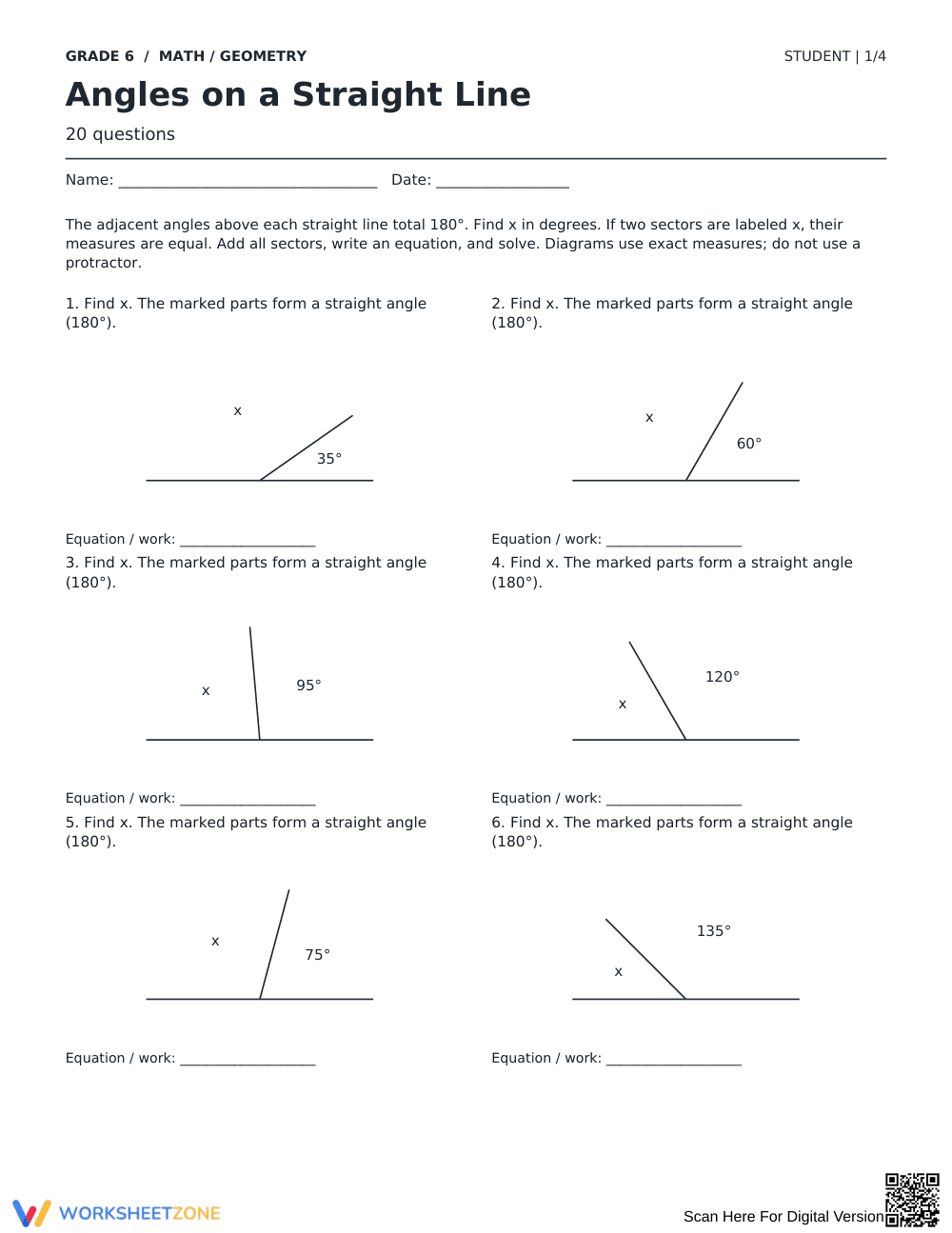
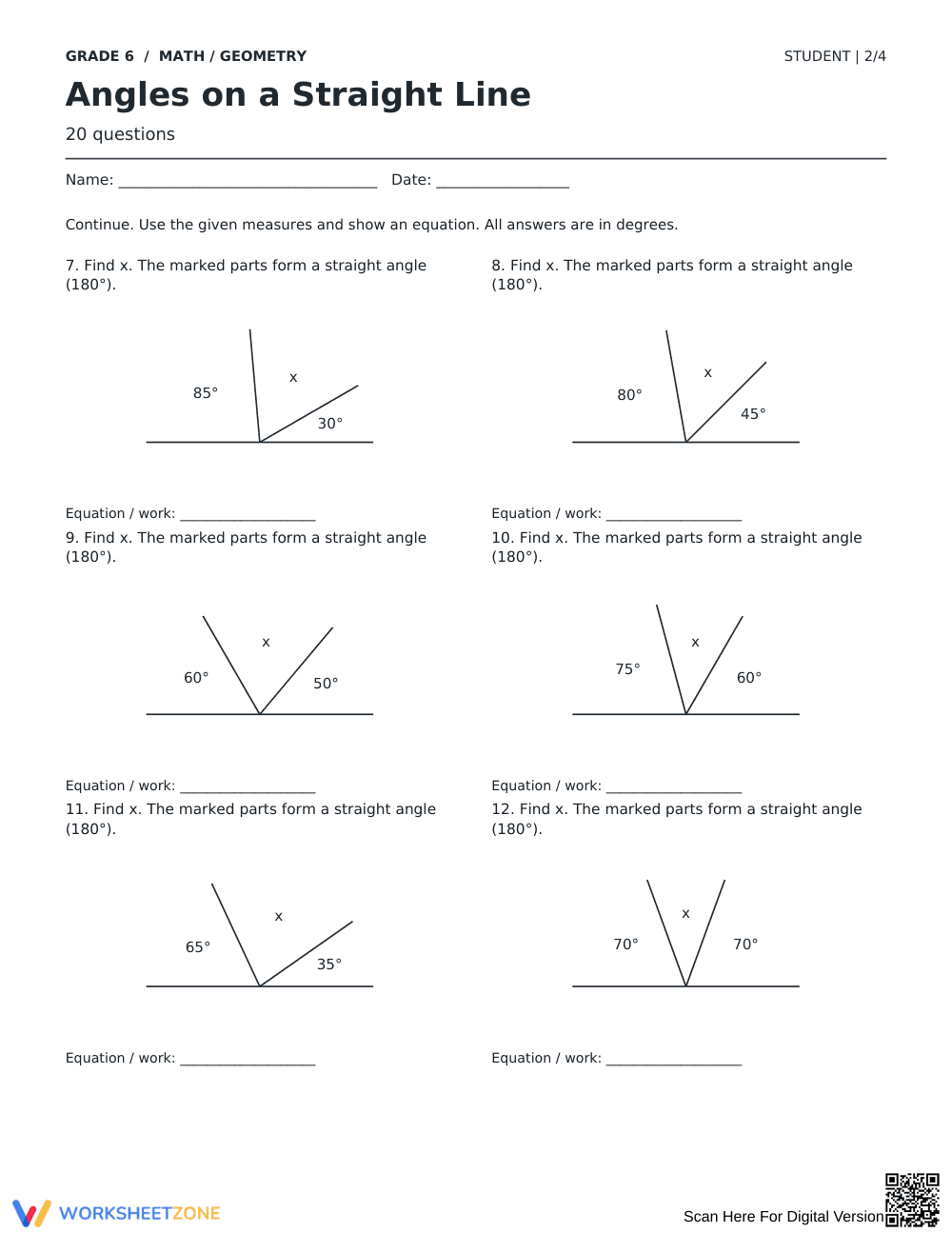
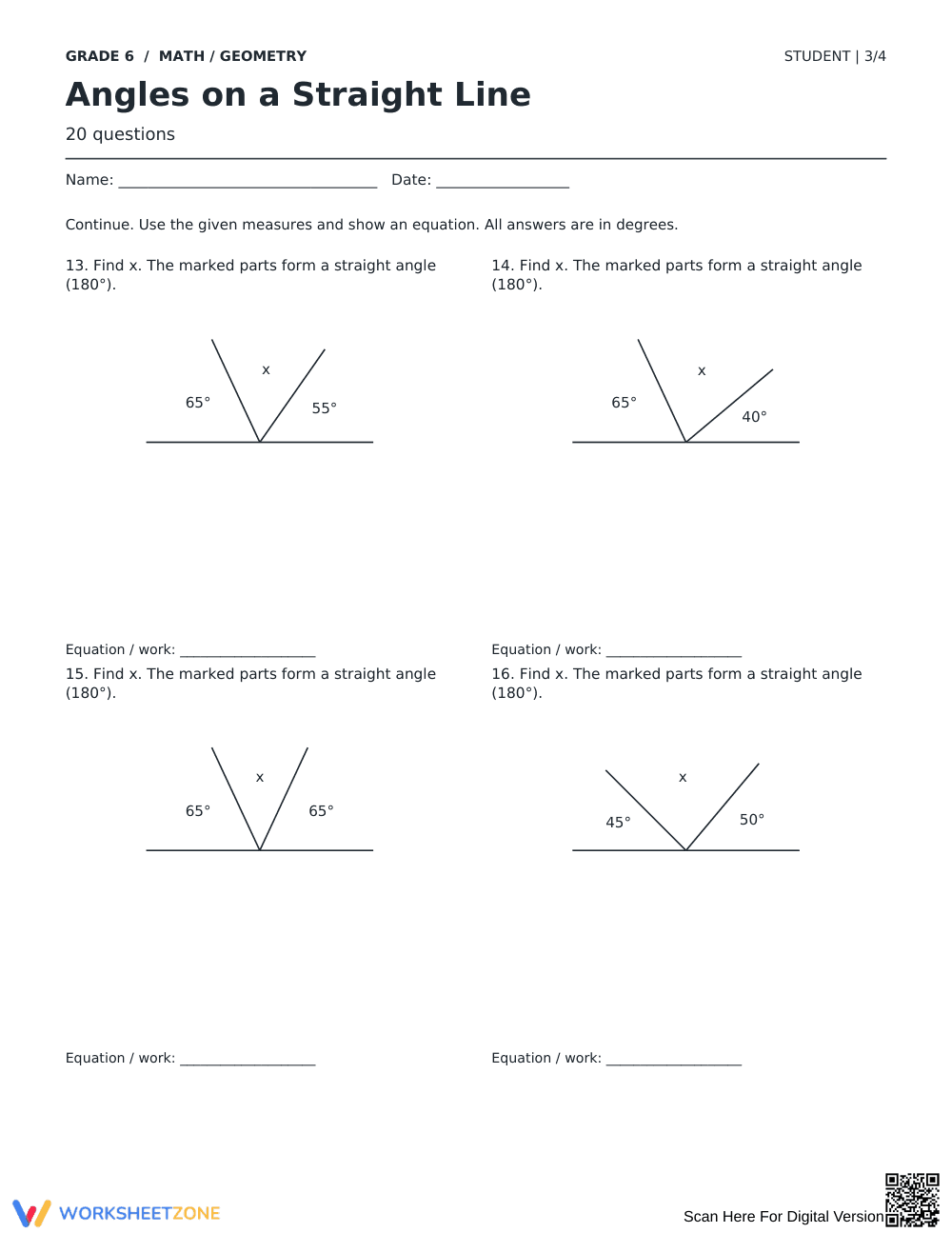
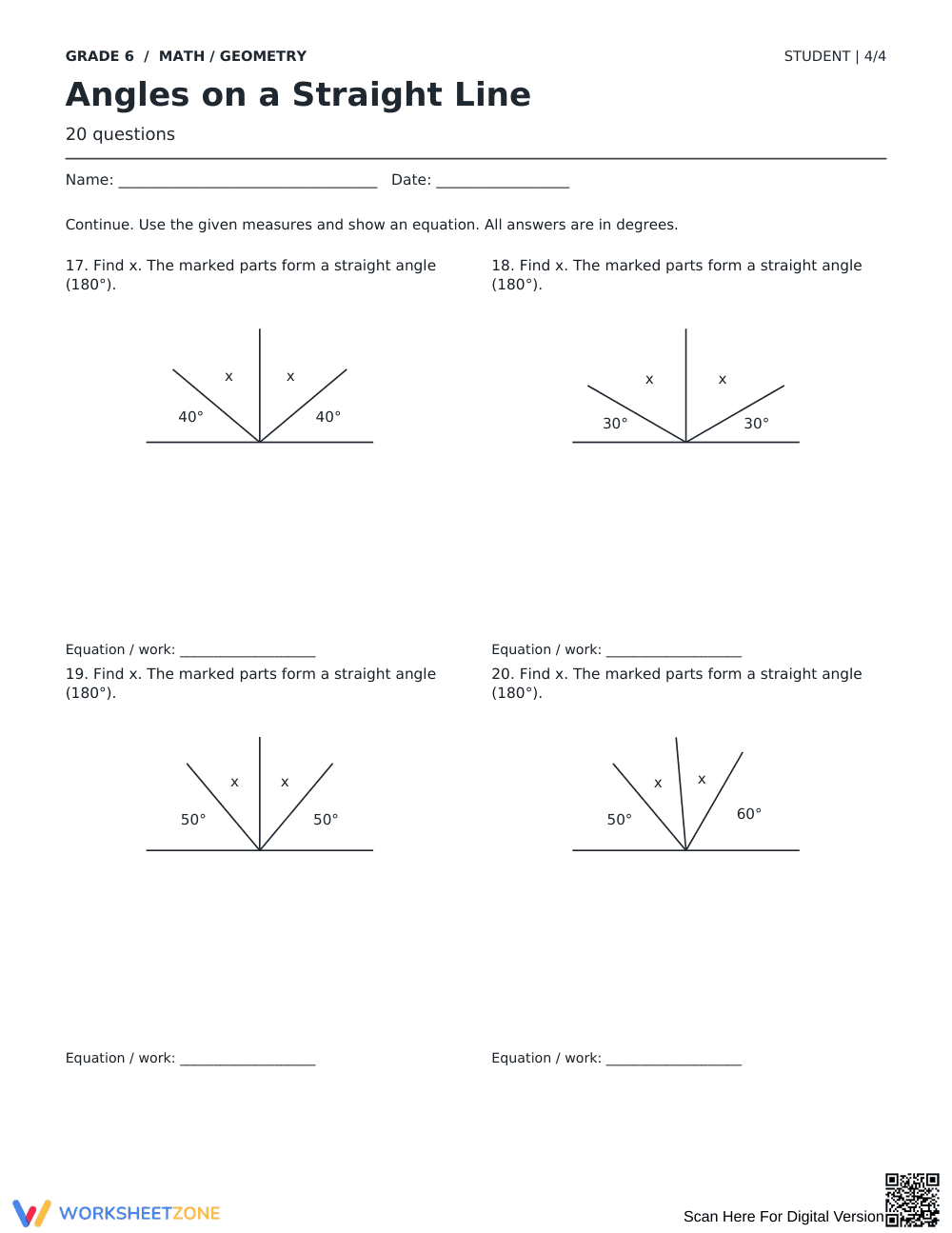

Angles on a Straight Line Printable | Grade 6
Paste this activity's link or code into your existing LMS (Google Classroom, Canvas, Teams, Schoology, Moodle, etc.).
Students can open and work on the activity right away, with no student login required.
You'll still be able to track student progress and results from your teacher account.
This printable worksheet builds student fluency in identifying and calculating missing angles on a straight line. Across 24 structured problems, Grade 6 students apply the supplementary angles property—angles on a straight line sum to 180°—to find unknown angle measures using subtraction and basic algebraic reasoning.
At a Glance
- Grade: 6 · Subject: Math / Geometry
- Standard:
CCSS.MATH.CONTENT.7.G.B.5— Use facts about supplementary angles to write and solve equations- Skill Focus: Finding missing angles on a straight line (supplementary angles)
- Format: 4 pages · 24 problems · Answer key included · PDF
- Best For: Guided practice and independent geometry review
- Time: 20–30 minutes
The worksheet spans 4 pages and presents 24 angle diagrams, each showing one or more rays on a straight line with at least one angle measure given. Students write the missing angle value in the space provided. The answer key covers all 24 items with clearly labeled solutions, making self-correction and teacher review straightforward.
- Guided practice (Problems 1–8): Diagrams show two angles on a straight line with one angle labeled in a whole-number multiple of 10°, giving students a low-entry starting point to confirm the 180° rule before computing.
- Supported practice (Problems 9–16): Angle values become less predictable, requiring careful subtraction. Some diagrams introduce three angles on a line, prompting students to add known angles before subtracting from 180°.
- Independent practice (Problems 17–24): Students work with multi-angle diagrams and non-round values, applying the supplementary property without scaffolding. This mirrors the gradual-release model so the worksheet fits naturally after direct instruction.
Standards Alignment
The primary standard is CCSS.MATH.CONTENT.7.G.B.5: Use facts about supplementary, complementary, vertical, and adjacent angles in a multi-step problem to write and solve simple equations for an unknown angle in a figure. Supporting work connects to CCSS.MATH.CONTENT.6.EE.B.7, as students solve one-step equations of the form x + a = 180 to isolate the unknown angle.
How to Use It
Assign Problems 1–8 immediately after direct instruction on supplementary angles to check for initial understanding. Use Problems 17–24 as an exit ticket or formative check—if a student consistently subtracts from 90° instead of 180°, that error pattern signals a conceptual gap to address next session. Alternatively, distribute the full 24-problem set as homework or a center rotation activity during a geometry unit. Expected completion time is 20–30 minutes for most Grade 6 learners.
Who It's For
This worksheet is designed for Grade 6 students beginning a geometry unit on angle relationships, and it also serves as review for Grade 7 students revisiting supplementary angles before multi-step problems. Teachers can pair it with a supplementary-angles anchor chart showing the straight-line diagram and the 180° rule. On-level and advanced students benefit from combining the worksheet with instruction on vertical and adjacent angles, creating a natural bridge to the full scope of 7.G.B.5.
The skill focus—finding missing angles on a straight line using the supplementary property—is a foundational competency that underpins later work with parallel lines, triangles, and polygon interior angles. The included answer key allows teachers to provide immediate corrective feedback, a practice consistently linked to stronger conceptual outcomes in middle-grades mathematics.


