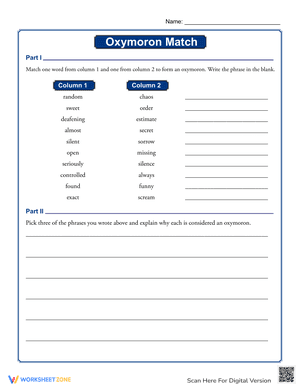
These 7th grade figurative language worksheets move students past the labeling stage into the harder work of interpretation — explaining what a phrase means, what it suggests beyond the literal surface, and how a writer's word choice shapes tone or mood in a passage. The set covers simile, metaphor, personification, hyperbole, idiom, alliteration, and onomatopoeia through formats that include identification in context sentences, short-response analysis, passage-based tasks, and student-created examples.
What Students Practice Across the Set
Each worksheet targets a distinct layer of understanding. Students mark examples in context sentences, explain literal versus suggested meaning, identify which device appears and justify how they know, and describe the effect on tone, mood, or imagery. Writing tasks ask them to turn a plain sentence into a metaphor, add personification to a setting description, or write a line of hyperbole that fits a narrative scene they have already drafted.
What makes 7th grade figurative language worksheets effective at this level is the alignment to CCSS RL.7.4, which asks students to analyze the impact of figurative language on meaning — not simply name the device. That expectation shapes every task in the set. Identification items are paired with explanation prompts; passage-based tasks ask students to connect word choice to tone or characterization; writing tasks require students to deploy a device with purpose rather than at random.
Student Errors Worth Anticipating Before You Distribute These
The personification confusion appears most consistently. Students who correctly mark "the sun smiled down on the valley" will hesitate over "the old engine coughed and rattled to a stop" — then label it simile, vivid description, or skip it entirely. The issue is that they have memorized a template (happy or sad weather verbs) rather than the actual rule (human traits or actions applied to anything nonhuman). Worksheets that use unexpected subjects — machinery, mathematics, fear, silence — push students off that template and force the genuine thinking.
The simile-versus-metaphor gap shows up differently. Most 7th graders check for like or as accurately enough. The breakdown comes in the explanation. Given the metaphor "Her voice was silk over stone," students write "it compares two things" and stop. The follow-up prompt "what two things, and what does that comparison suggest about her?" is what makes the analysis happen. Without it, the written explanation feels optional and students treat it as a bonus step rather than the main event.
Idiom creates a third distinct pattern. Students who grew up hearing "bite the bullet" or "burn bridges" identify idioms without much trouble. Students who did not encounter these expressions in spoken English — including many multilingual learners — may mark them as hyperbole or leave items blank. A sentence frame like "This phrase means ___, not ___" addresses that gap more directly than asking for a full written explanation on the first attempt.
Fitting These Worksheets Into Your Weekly Lesson Plan
The most useful planning decision is to keep each worksheet doing one job. When a single task asks students to identify a device, name it, explain its meaning, and describe its effect — and they miss all of it — you cannot tell whether the problem is definitional ("I don't know what alliteration is") or analytical ("I recognize it but can't explain the effect in writing"). Separating those purposes across different worksheets makes reteaching far more precise and keeps each task short enough to finish in a 10-minute warm-up block.
One sequence that works well: use a sorting or matching worksheet on Monday as students are still transitioning into the school day. Mid-week, bring in a passage-based worksheet tied loosely to whatever the class is reading — even a thematic connection helps students see figurative language operating inside real texts rather than as a disconnected grammar exercise. On Friday, a short-response or original-writing worksheet functions as both review and formative evidence. You leave the weekend knowing who can explain effect and who still needs another round of identification work before moving forward.
These 7th grade figurative language worksheets also slot cleanly into stations, intervention blocks, and sub plans. Because each worksheet has a clear, bounded purpose, a substitute can run identification practice without needing to understand the unit's full arc. An intervention group can work through the same materials at a slower pace, keeping the sentence frames and guided-response structures in place rather than removing them on a fixed timeline.
Adjusting the Worksheets for Mixed-Readiness Groups
The set works across readiness levels without requiring entirely separate materials for each group. For students who still struggle to distinguish literal language from figurative, leave the sentence frames active and highlight the clue words in each example. Reducing answer choices from four options to three removes one decision layer without changing what the standard asks of them.
On-level students work through the passage-based tasks with a partner discussion step added: one student explains the device, the other explains the effect, then they write a shared response. That gives you two pieces of evidence from one worksheet instead of one, and the conversation tends to surface the reasoning that written responses alone sometimes hide.
For students ready to push further, the extension is straightforward: find two figurative language examples in the current class novel, write a paragraph explaining how each one develops a character or establishes a mood, and then revise a paragraph from their own writing to include at least one deliberate figurative choice. That work connects the practice to literary analysis and original craft without requiring a separate enrichment resource.
Standard Alignment
The worksheets address CCSS RL.7.4, which asks students to determine the meaning of words and phrases as used in a text, including figurative and connotative meanings, and to analyze the impact of sound repetitions — including alliteration — on a specific verse or section of a text. They also address CCSS L.7.5, which covers figurative language, word relationships, and nuances in word meaning. In classroom terms, RL.7.4 is what drives the passage-based and short-response tasks, where students explain a device's function within context rather than label it in isolation. L.7.5 supports the identification and writing tasks that build definitional fluency before students move to full-passage analysis.
Frequently Asked Questions
Which figurative language devices are covered across the set?
The worksheets address simile, metaphor, personification, hyperbole, idiom, alliteration, and onomatopoeia. Mixed-review tasks include several types within a single worksheet so students practice distinguishing among devices — not just recognizing each one when it appears alone and already labeled.
How do these worksheets hold up for students reading below grade level?
The sentence frames, highlighted clue words, and reduced-choice formats built into the support-level tasks give students enough structure to engage with the standard without skipping the thinking. Passages run short — most cover two to four sentences — so reading load does not become the main obstacle when the target skill is figurative language interpretation.
Do these worksheets work for test prep?
The multiple-choice tasks built around common confusions — simile versus metaphor, personification versus vivid description, literal versus figurative — reflect the kinds of items students encounter on standardized assessments. The short-response and original-writing tasks go deeper than most tests require, but students who can explain figurative language in writing consistently perform better on recognition items as well. Pulling the 7th grade figurative language worksheets formatted for multiple choice closer to assessment windows and using the analysis tasks during instruction covers both goals without building a separate test-prep unit on top of regular ELA work.
Which formats travel home as homework and which are better kept in class?
Identification and matching worksheets work well as homework — the task is clear enough that students do not stall waiting for clarification. Short-response and passage-based worksheets are better kept in class, where you can address questions about effect before students commit to a written explanation. Sending complex analysis tasks home tends to produce minimal answers where a full sentence was needed, which makes the resulting evidence difficult to act on the next day.















 Interactive Worksheet Maker
 Quiz Maker
 Word Search Maker
 Crossword Puzzle Maker
 Word Scramble Generator
 Sentence Scramble Generator
 Handwriting Worksheet Generator
 Name Tracing Generator
 Fill In The Blank Generator