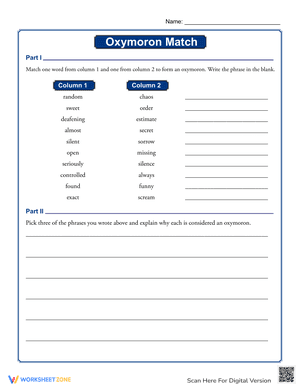
These oxymoron printable worksheets for 7th grade cover the full range of what ELA teachers actually need when figurative language moves from a brief mention to a real instructional focus: identification practice, non-example sorting, meaning in context, and writing application — each built as a standalone worksheet that drops into any part of the lesson sequence.
The Specific Skills Each Worksheet Targets
Teachers who return to oxymoron printable worksheets for 7th grade across multiple lessons usually want resources that span different task formats rather than drilling the same skill repeatedly. Each worksheet in the set isolates a distinct piece of the work:
- Identifying the two conflicting words inside a phrase — students underline the pair, not just circle the whole expression
- Sorting true oxymorons from non-examples — distinguishing deafening silence from a simple opposite pair like "hot and cold"
- Explaining meaning in context — paraphrasing what the phrase communicates in the specific sentence where it appears
- Analyzing authorial purpose — deciding whether the writer used the device for humor, emphasis, tone, or to compress a complicated feeling into a compact phrase
- Writing original sentences — applying an oxymoron purposefully rather than slotting in a memorized example
The writing task deserves its own worksheet. Students who can explain open secret in discussion often freeze when asked to write a sentence where an oxymoron does genuine work. Isolating application as a separate exercise gives students a clearer target and gives teachers a more accurate read on who has moved past surface recognition.
Student Errors Worth Anticipating Before You Hand These Out
The most predictable mistake is treating any opposite pair as an oxymoron. Students flag "hot and cold" or "day and night" because the words contradict each other, even though neither phrase collapses into a unified, paradoxical meaning the way living dead or bittersweet does. The question worth posing — before students begin and again during class discussion — is whether the two words combine into a single expression with its own distinct meaning, or whether they're simply sitting next to each other as contrasts. Non-example sorting tasks create exactly that moment of forced discrimination, and it's where students who thought they understood the device discover they were pattern-matching instead.
A second pattern appears on context questions. Students can walk through jumbo shrimp from memory, but when they encounter an unfamiliar oxymoron inside a poem excerpt — say, living death or sweet sorrow — they either skip the question or read it literally. That gap doesn't show up in definition-matching tasks. It shows up in passage-based work, which is precisely why meaning-in-context questions reveal more about actual understanding than any other format in the set.
At the writing stage, students frequently produce phrases like "happy sadness" that mirror the grammatical structure of an oxymoron without creating any real effect. This is actually a productive stumbling point: the difference between a working oxymoron and two contrasting words placed side by side comes down to whether the phrase carries resonance — whether a reader pauses and registers the tension as meaningful. That distinction is worth discussing aloud after students attempt their first original examples, and it leads to some of the richer craft conversations a figurative language unit can produce.
Building These Into Your Figurative Language Sequence
As a unit component, oxymoron printable worksheets for 7th grade slot most naturally the day after an introductory mini-lesson. Spend 10 to 12 minutes on the board — three solid examples, one clear non-example, a brief discussion of why the device creates tension — then hand out the identification worksheet and model the first item aloud before releasing students independently. That pattern keeps the initial cognitive load lower and gives an immediate read on who absorbed the definition and who needs another pass before moving forward. For literacy centers, the set divides cleanly: identification and sorting at the first station, meaning-in-context at the second, and writing practice at the third, where a partner can read a neighbor's sentence and say whether the oxymoron actually lands. Rotating across two or three sessions distributes the practice without asking students to cycle through every format in a single sitting.
One specific activity worth building a brief class discussion around: ask students to rank the oxymorons in a short passage from most to least effective, then justify the ranking in two sentences. That shift turns identification into author's craft analysis — students stop circling phrases and start arguing whether deafening silence carries more weight than sweet sorrow in the same text, which is the kind of conversation that stays with them after the unit ends.
Adjusting the Worksheets Across Readiness Levels
Students who need additional support do better when the task breaks into two explicit steps: first, circle the two conflicting words; second, select the correct meaning from two provided options. Removing open-ended explanation doesn't eliminate the thinking — students still have to discriminate between interpretations — but it reduces the written-language demand for students who grasp the concept more readily than they can articulate it on paper.
On-level students work through the full sequence: identify, explain the meaning in context, name the author's purpose in one sentence. That middle step is the most diagnostic piece. A student who writes "it means the room was very quiet" in response to deafening silence understands the phrase but hasn't explained why the device works. A student who writes "the writer used this phrase to make the quiet feel overwhelming rather than just absent" has crossed into the analysis that RL.7.4 actually targets.
For enrichment, students compare two oxymorons from the same passage and argue in three to four sentences which creates a stronger effect and why. They can also draft original oxymorons and test them on a partner who must identify the intended meaning without being told. When the partner misreads the phrase, that's the most direct feedback a student writer gets about whether the expression is functioning as intended — sharper than any teacher comment on the same point.
Standard Alignment
These worksheets address CCSS ELA-Literacy RL.7.4, which requires students to determine the meaning of words and phrases as they are used in a text, including figurative and connotative meanings and the effect of word choices on meaning and tone. Oxymoron practice fits that standard directly because students must explain what a phrase means in context — not simply recognize that a device is present. The related standard L.7.5a, which covers figures of speech and their role in text, reinforces the same distinction between literal and nonliteral meaning that runs through each worksheet. Taken together, these two anchor standards place oxymoron instruction squarely at the intersection of reading comprehension and language analysis, which is where it does the most instructional work in a 7th grade classroom.
Frequently Asked Questions
How is an oxymoron different from a paradox or irony?
An oxymoron is a short phrase — typically two words — where conflicting terms create a unified meaning: awfully good, open secret, deafening silence. A paradox is a broader statement that seems self-contradictory but holds a deeper truth on examination. Irony describes a gap between what is said or expected and what actually occurs or is meant. These three devices overlap enough to cause consistent confusion at the middle school level, and a side-by-side comparison with labeled examples clears up more confusion than three separate definitions introduced on different days.
What oxymoron examples work best with 7th graders?
The most effective starting examples are phrases students can connect to a real feeling without needing vocabulary support: bittersweet, deafening silence, old news, clearly confused, and jumbo shrimp. These give students enough shared ground for class discussion without getting stuck on unfamiliar language. Literary examples — sweet sorrow from Romeo and Juliet, living death from Poe — work well once students have the concept and are ready to analyze effect inside a specific text rather than in isolation.
Do these fit into a class that isn't running a full figurative language unit?
Oxymoron printable worksheets for 7th grade work just as well as a standalone two-day sequence as they do inside a longer unit. A single identification worksheet pairs naturally with any text that uses figurative language, and the writing worksheet follows a close-reading lesson without needing additional setup. In a reader's workshop structure, individual worksheets drop into independent practice time without disrupting the reading schedule or requiring a separate lesson block.















 Interactive Worksheet Maker
 Quiz Maker
 Word Search Maker
 Crossword Puzzle Maker
 Word Scramble Generator
 Sentence Scramble Generator
 Handwriting Worksheet Generator
 Name Tracing Generator
 Fill In The Blank Generator