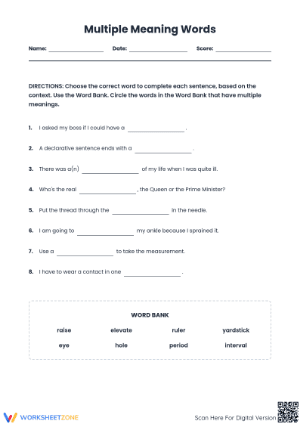
Language and vocabulary worksheets for 7th grade serve a specific instructional need: students at this grade level have moved past basic word recognition but often lack the analytical habits that let them figure out unfamiliar words in context, handle academic vocabulary across subjects, or choose precise language in their own writing. This set addresses that gap directly. Each worksheet targets one vocabulary skill — context clues, morphology, multiple-meaning words, figurative language, shades of meaning, or precise word choice — and includes an answer key.
Skills These Worksheets Build
Seventh grade is when Tier 2 academic vocabulary — words like infer, contrast, sufficient, and elaborate — starts appearing not just in ELA but across every content area. Students who lack strategies for handling unfamiliar words in context fall behind in reading comprehension before teachers even spot the problem. The worksheets in this set spread practice across several interrelated skills:
- Context clues: Students identify the type of clue present — definition, example, contrast, or restatement — rather than guessing at meaning, a distinction that separates genuine strategy use from random selection.
- Roots, prefixes, and suffixes: Students break words apart and apply morphological knowledge to confirm or narrow a word's meaning.
- Multiple-meaning words: Students determine which meaning fits a specific sentence, then explain how they know.
- Synonyms, antonyms, and shades of meaning: Students compare related words and select the most precise option for a given context.
- Figurative language and idioms: Students interpret nonliteral expressions and describe their effect on meaning or tone.
- Precise word choice in writing: Students rewrite sentences or short passages, replacing vague or repeated words with sharper alternatives.
Most worksheets follow a two-step sequence: students identify or label something, then apply or explain it. That structure separates recognition from actual comprehension, which is exactly where vocabulary instruction tends to break down for seventh graders who memorize definitions but never transfer them to new reading.
Mistakes Students Make That These Worksheets Help You Catch
The most persistent error pattern with context clues is students reading only the clause that contains the target word rather than the full sentence or surrounding passage. A student who reads "The policy was draconian, leaving thousands without recourse" will often guess the word means "important" or "complicated" because those feel safe in a policy context — they never read far enough to notice the second clause signals a negative consequence. Passage-based worksheets expose this habit because the target word sits inside a paragraph rather than a stripped-down sentence. Single-sentence items sometimes mask it entirely.
With shades-of-meaning tasks, the typical error is choosing the synonym that's closest in appearance to the target word rather than the one that fits the sentence's tone. Students mark "happy" and "content" as fully interchangeable without registering the difference in intensity. Having them rewrite a sentence using each option in turn — not just circle the best answer — forces the comparison that reveals whether they truly see the distinction.
Morphology work produces a different problem. Students who learn that anti- means "against" will apply it confidently to antipathy (correct) and also to antique (wrong), because they're pattern-matching the prefix rather than verifying whether the etymology holds. Worksheets that ask students to confirm a meaning using context after they've analyzed the root catch this overapplication before it becomes a fixed habit.
Getting the Most From These Worksheets in Your Weekly Plan
These worksheets fit cleanly into the slotted time that ELA teachers always have but rarely fill well — the first 8 minutes on Monday after morning announcements, the gap between a class read-aloud and the transition to independent writing, or the Friday review block before a unit assessment. Because each worksheet focuses on one skill, teachers can use two in a single week without overlap: context clues on Tuesday as a warm-up, shades of meaning on Thursday during small-group rotations.
Language and vocabulary worksheets for 7th grade also work well when anchored to current class reading. After students finish a chapter or article, a context clues worksheet drawn from that same text gives practice authentic grounding — students aren't inferring the meaning of random words but returning to language they already encountered in a real reading situation. Repeated exposure in meaningful contexts is where vocabulary retention compounds.
After students complete a worksheet, a 2-minute follow-up adds real return: ask each student to name one answer they felt sure about and one that felt uncertain, then talk through both with a partner. That brief exchange turns a silent practice worksheet into oral language rehearsal and often reveals whether students genuinely understood the vocabulary or guessed correctly on a multiple-choice item. Teachers who skip this step sometimes don't discover the guessing until the next quiz.
The worksheets also extend naturally into writing. After a shades-of-meaning worksheet, ask students to find three places in their own drafts where a more precise word would sharpen the sentence. After an idioms worksheet, ask them to mark where figurative language appears in the current class text and explain its effect. These small extensions make vocabulary practice part of a larger literacy routine rather than a detached skill drill.
Standard Alignment
The skills in this set align to the Common Core State Standards for English Language Arts at the seventh grade level, primarily CCSS.ELA-LITERACY.L.7.4 (determining or clarifying the meaning of unknown and multiple-meaning words and phrases using context clues, affixes, and reference materials), L.7.5 (figurative language, word relationships, and nuances in word meanings), and L.7.6 (acquisition and use of grade-appropriate general academic and domain-specific words). Classrooms using TEKS or other state frameworks will find close alignment because those standards draw from the same conceptual base. Teachers in states with adapted standards can cross-reference skill names rather than code numbers — context clues, morphology, and figurative language appear across virtually all seventh-grade ELA frameworks.
Differentiating These Worksheets for a Mixed-Ability Class
Seventh grade classrooms routinely span three or four reading levels, and vocabulary practice has to work across that range without requiring teachers to build entirely separate materials. The structure of these worksheets makes adjustment manageable because the core skill stays fixed while the support level changes:
- For students who need more support: Provide a word bank, label the clue type in the passage before students begin, or reduce answer choices from four options to two. These changes lower the processing load without removing the analytical task.
- For on-level students: Assign the worksheet as written, then add a brief written explanation requirement. A sentence frame works well: I know this word means ___ because the passage says ___.
- For advanced students: After completing the worksheet, ask them to compare two near-synonyms from the passage — which word carries the stronger connotation, and what would change if the author had chosen the other one?
- For multilingual learners: Pair worksheet work with a short partner discussion before students write anything. Saying the answer aloud first gives students a chance to process meaning in real language before committing to a written response.
Keeping the same skill target across groups also makes a whole-class debrief possible after independent work — a practical advantage when planning time is short and pulling separate closing discussions for each group isn't realistic.
Frequently Asked Questions
How long does each worksheet take to complete?
Most students finish each worksheet in 10 to 15 minutes, which makes them practical for warm-ups, independent work periods, and homework. Worksheets with constructed-response items — where students explain their reasoning in writing — may run a few minutes longer for students who write slowly or who need to reread the passage.
Which worksheets work best for homework versus in-class practice?
Context clues, roots and affixes, and synonym tasks work well as homework because students can complete them without additional instruction or teacher prompting. Constructed-response items work better as in-class assignments. When students are expected to explain their reasoning in writing, having a teacher nearby to clarify the task or prompt thinking makes a real difference in what students actually produce.
Can these be used in a pull-out or intervention setting?
Yes. In a small-group pull-out, teachers can work through one worksheet together, pausing to discuss answers aloud rather than having students work silently. Language and vocabulary worksheets for 7th grade that focus on context clues and morphology tend to be the most productive for intervention because those two skills transfer directly into reading comprehension gains — students who learn to use clues and word parts don't just do better on vocabulary tasks, they slow down and read more carefully across subjects.
My students are reading below grade level. Will these worksheets still be useful?
The strategies these worksheets teach — using context, analyzing word parts, recognizing figurative language — apply across reading levels even when the specific words differ. For students working below grade level, use a word bank, reduce answer choices, or annotate the passage together before students work independently. Language and vocabulary worksheets for 7th grade reach these students most effectively when paired with a brief oral discussion, where students can say what they think a word means before they write anything down.















 Interactive Worksheet Maker
 Quiz Maker
 Word Search Maker
 Crossword Puzzle Maker
 Word Scramble Generator
 Sentence Scramble Generator
 Handwriting Worksheet Generator
 Name Tracing Generator
 Fill In The Blank Generator