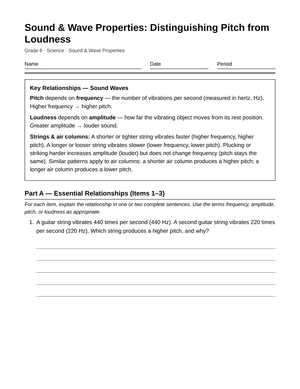
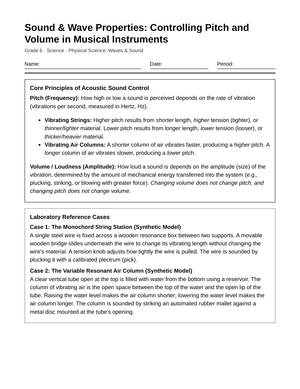
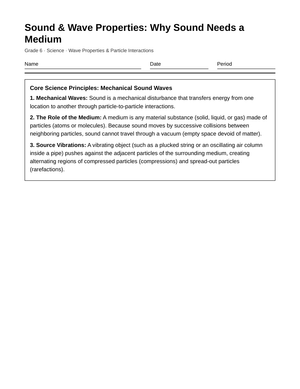
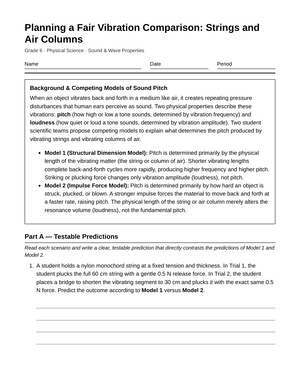
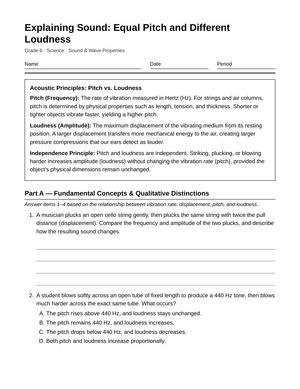
These 6th grade wave properties worksheets resources give science teachers a direct line from wave diagrams to student understanding, covering wavelength, amplitude, frequency, and wave type comparisons in formats that hold up across the full physical science unit. The set works as bell work, post-lab consolidation, and unit review — each worksheet serves a distinct purpose so students aren't navigating three different task types at once. What they get is repeated, low-stakes contact with the same core models in slightly different contexts.
The Specific Skills Covered in Each Worksheet
Wave properties stay frustratingly abstract without diagram work, which is why these resources prioritize visual practice alongside vocabulary. Students move through a sequence of tasks that builds from identification to explanation.
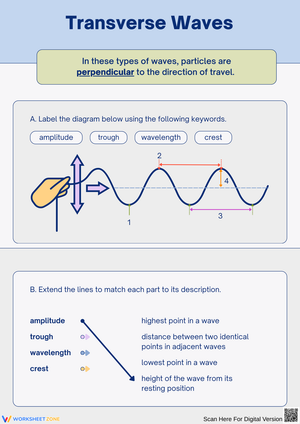
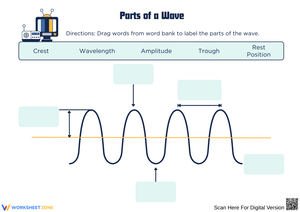
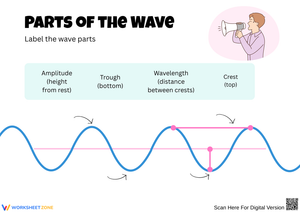
- Labeling wave anatomy: Students mark crest, trough, wavelength, and amplitude on clearly drawn transverse wave diagrams, then write brief definitions that explain what each feature tells a scientist about the wave.
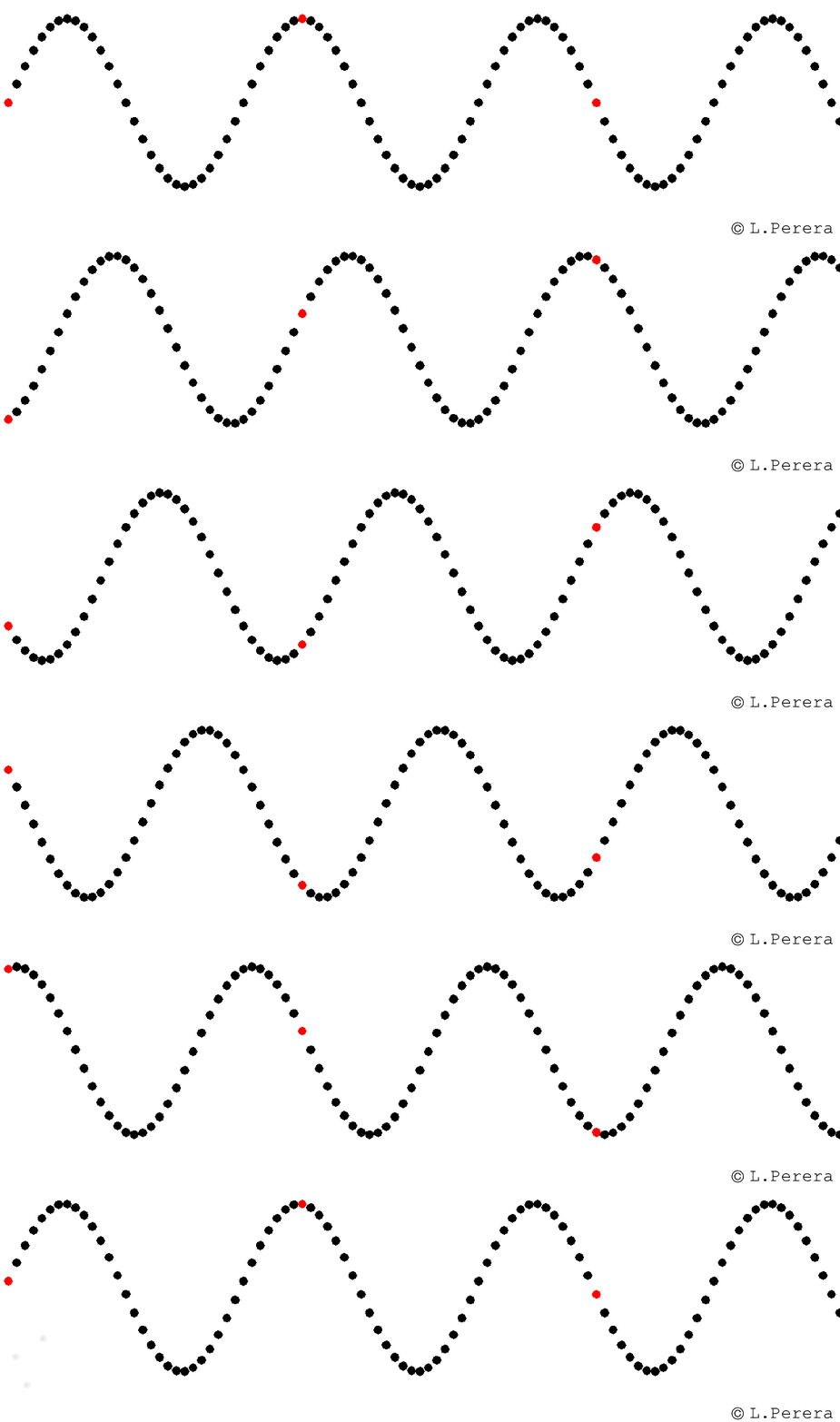
- Comparing wave characteristics: Given two wave drawings side by side, students identify which has greater amplitude, longer wavelength, or higher frequency — then justify the comparison in writing.
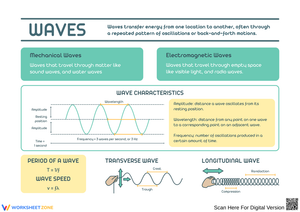
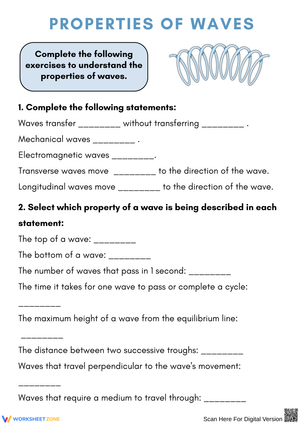
- Transverse vs. longitudinal waves: Students compare how the disturbance moves in each type relative to the direction of travel, using both diagrams and written explanation.
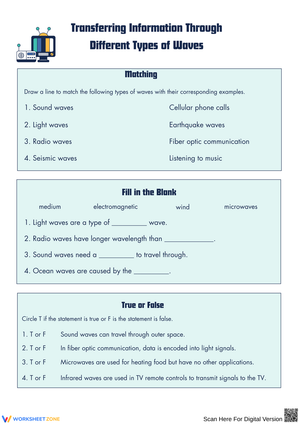
- Mechanical vs. electromagnetic distinction: Students identify which wave types require a medium and apply that understanding to examples like sound and light.
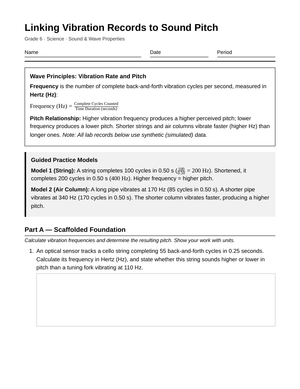
- Sound and light applications: Frequency connects to pitch; amplitude connects to loudness. Students see these relationships through short scenario-based questions grounded in everyday experience.
- Energy transfer: Students explain that waves carry energy from place to place without transporting matter, supporting their answers with evidence drawn directly from diagrams.
Frequent Misconceptions to Watch For and Correct
The single most common error at this level is measuring amplitude from trough to crest — the full vertical height of the wave — rather than from the rest position (the equilibrium line) to the crest. Students have a natural instinct to measure the largest visible distance on the diagram, and the peak-to-trough span is visually dominant. A worksheet that shows a dashed equilibrium line and asks students to mark amplitude starting from that line forces this reckoning early, before the misconception hardens into a test-day habit.
A close second is conflating wavelength with "how tall the wave looks." Students who correctly define wavelength as the distance between matching points — crest to crest, trough to trough — will still circle the vertical height when marking it on a diagram under any time pressure. The fix is variation: when students only see waves drawn at the same scale and orientation every time, they learn to pattern-match the visual rather than apply the actual measurement rule. Worksheets that use differently scaled wave pairs side by side expose this gap quickly.
With longitudinal waves, many students default to sketching a transverse sine shape because that's the wave form they encountered first and it feels more "wave-like" to them. Asking them to draw compression and rarefaction zones from scratch — rather than simply labeling a provided diagram — surfaces this gap in a way that a labeling-only task never would.
Fitting These Worksheets Into the Lesson Sequence
The most productive use is immediate follow-through after a short demonstration. Spend ten minutes showing students a wave tank simulation or a slinky that distinguishes transverse from longitudinal motion, then hand out the labeling worksheet. That rapid sequencing uses the image students just saw as cognitive anchoring for the vocabulary they're about to practice. Waiting a full day loses that window, and students who couldn't hold the visual overnight will struggle more than necessary with the terminology.
During review days before a unit assessment, a different approach works well. Rather than assigning the full set at once, pull two or three comparison-focused worksheets and run them as a partner activity where one student explains their reasoning aloud before both write their answers. This surfaces leftover confusion about amplitude versus frequency that a silent independent task might hide. The 6th grade wave properties worksheets set supports this kind of rotation because each worksheet stays focused on a distinct concept rather than trying to cover everything at once.
Standard Alignment
NGSS MS-PS4-1 asks students to use mathematical representations to describe a simple wave model and explain how amplitude relates to the energy carried by the wave. These worksheets address that standard directly — students don't just label amplitude, they explain what a change in amplitude means for the energy the wave carries. MS-PS4-2 applies to worksheets covering electromagnetic waves and the contrast between mechanical and electromagnetic wave behavior, particularly the fact that light requires no medium. Most 6th grade teachers address both standards within the same unit, using diagram and vocabulary practice as the foundation before shifting to applications in technology, communication, or seismology.
Adjusting the Worksheets for Different Student Levels
Students still building science reading fluency benefit from a simple addition to any labeling worksheet: a word bank and one completed example. That small support removes the retrieval demand from the task and lets students concentrate on understanding the diagram rather than searching for unfamiliar terms. For written-response items, sentence frames — "This wave has greater amplitude because..." — keep the focus on reasoning rather than on generating language from scratch.
For students who move quickly through the core tasks, the most useful extension isn't more labeling — it's application. Ask them to sketch two waves and describe what would happen to the sounds those waves represent if one had twice the amplitude of the other. Or pose a real scenario: why would a seismologist care about both amplitude and frequency when reading an earthquake wave? Those questions pull the same vocabulary into a new context without adding busywork. The 6th grade wave properties worksheets format stays constant across all groups, which makes managing a mixed-ability class considerably less complicated — everyone is working with the same diagram while the response expectations shift.
Frequently Asked Questions
Can each worksheet be used on its own, or do they need to be assigned in order?
Each worksheet stands alone. Teachers who only need vocabulary review can pull that worksheet without assigning the rest. Those who want the full progression — from labeling to comparison to written explanation — can work through the set in sequence across multiple class periods or spread worksheets across homework assignments between lessons.
Do the worksheets cover longitudinal waves, or only transverse waves?
Both types are addressed. Several worksheets in the set focus specifically on the distinction between transverse and longitudinal wave behavior, including diagram work that represents compression and rarefaction zones. That's an area where 6th graders commonly struggle because the longitudinal diagram looks less "wave-like" than the familiar transverse sine shape, and students often need more than one exposure before the difference sticks.
Are answer keys included, and are they useful for quick checking?
Answer keys are included with the set. For diagram-labeling worksheets, the key identifies completed labels and flags the most common measurement error — students counting amplitude as the full trough-to-crest distance — so teachers can scan student work quickly during a brief whole-class check rather than reviewing every paper individually.
How do the worksheets connect wave diagrams to sound and light?
Sound and light appear as the applied context throughout the set, not as a separate add-on section. Students explain how frequency determines pitch and how amplitude determines loudness, and they distinguish electromagnetic waves from mechanical waves based on whether each requires a medium to travel. These 6th grade wave properties worksheets resources treat those connections as essential content — the real-world examples appear consistently across multiple worksheets so students encounter the physics vocabulary in familiar contexts more than once.












 Interactive Worksheet Maker
 Quiz Maker
 Word Search Maker
 Crossword Puzzle Maker
 Word Scramble Generator
 Sentence Scramble Generator
 Handwriting Worksheet Generator
 Name Tracing Generator
 Fill In The Blank Generator