


























Views
Plays
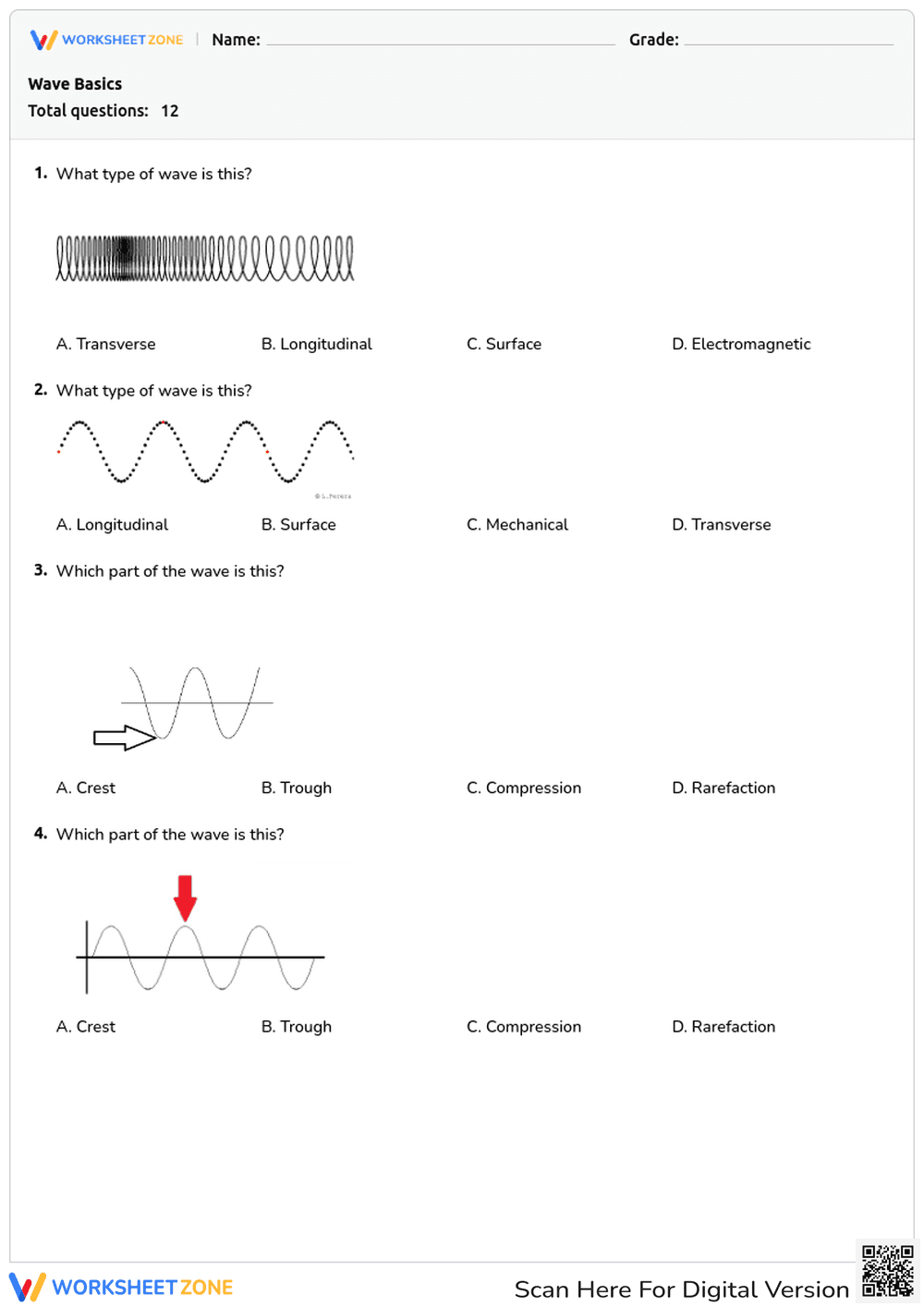


Grade 6-8 Wave Basics — Printable No-Prep Worksheet
Paste this activity's link or code into your existing LMS (Google Classroom, Canvas, Teams, Schoology, Moodle, etc.).
Students can open and work on the activity right away, with no student login required.
You'll still be able to track student progress and results from your teacher account.
This middle school science worksheet provides students with targeted practice identifying and analyzing fundamental wave properties. By completing these questions, learners will demonstrate their understanding of transverse and longitudinal waves, as well as key features like crests, troughs, amplitude, and wavelength.
At a Glance
- Grade: 6-8 · Subject: Science
- Standard:
MS-PS4-1— Describe a simple model for waves and their properties.- Skill Focus: Wave Properties and Types
- Format: 2 pages · 12 problems · Answer key included · PDF
- Best For: Formative assessment or independent practice
- Time: 15–20 minutes
This resource features 12 multiple-choice questions spread across two pages. Students will encounter visual diagrams of both transverse and longitudinal waves, requiring them to label specific parts such as compressions, rarefactions, crests, and troughs. The worksheet also includes conceptual questions about wave speed, frequency, and energy, culminating in a basic calculation problem using the wave speed formula. A complete answer key is provided for quick grading.
Zero-Prep Workflow
This worksheet is designed for immediate classroom use with minimal teacher setup:
- Print (1 minute): Simply print the two-page PDF and the accompanying answer key.
- Distribute (1 minute): Hand out the copies to students as a warm-up, quiz, or homework assignment.
- Review (3 minutes): Use the provided answer key to quickly grade submissions or facilitate a whole-class review session.
With a total teacher prep time of under two minutes, this resource is an excellent addition to any emergency sub plan or busy instructional week.
Standards Alignment
This worksheet aligns with MS-PS4-1: Use mathematical representations to describe a simple model for waves that includes how the amplitude of a wave is related to the energy in a wave. It also supports foundational knowledge required for understanding how waves transmit energy through various mediums. Both standard codes can be copied directly into lesson plans, IEP goals, or district curriculum mapping tools.
How to Use It
Deploy this worksheet after direct instruction on wave mechanics to assess student comprehension. It serves perfectly as a mid-unit formative assessment or a structured homework assignment. While students work, observe whether they can accurately distinguish between amplitude and wavelength on the provided diagrams, as this is a common misconception. Expect most students to complete the 12 questions within 15 to 20 minutes.
Who It's For
This resource is designed for middle school science students in grades 6 through 8. The clear diagrams and straightforward multiple-choice format make it accessible for diverse learners, including those who benefit from visual aids. It pairs exceptionally well with hands-on demonstrations using slinkies or ripple tanks, allowing students to connect the 2D diagrams on the page to real-world physical phenomena.
Aligning instructional materials to MS-PS4-1 ensures students can accurately describe a simple model for waves and their properties. According to a ScienceDirect TpT Analysis, providing students with clear, diagram-based assessments significantly improves their ability to conceptualize abstract physical science topics like wave mechanics. When learners interact with visual representations of transverse and longitudinal waves, they build stronger mental models of how energy travels through a medium. This targeted practice helps solidify foundational vocabulary—such as crest, trough, compression, and rarefaction—which is critical for advanced scientific literacy. By integrating structured, standards-aligned practice into the curriculum, educators can effectively monitor comprehension and address misconceptions early. Regular formative assessment using visual models is a proven strategy for enhancing long-term retention in middle school physical science classrooms.


