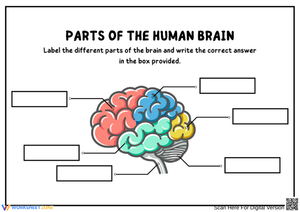
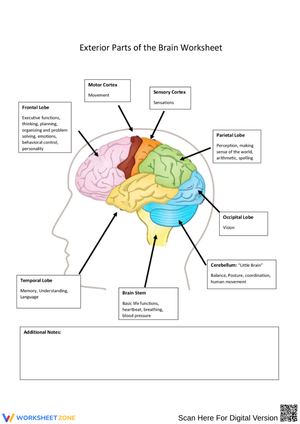
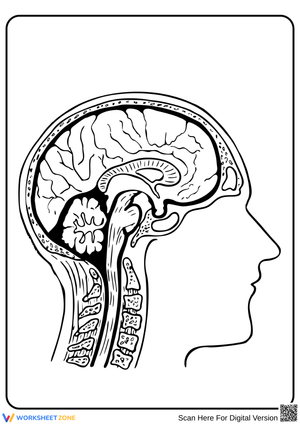
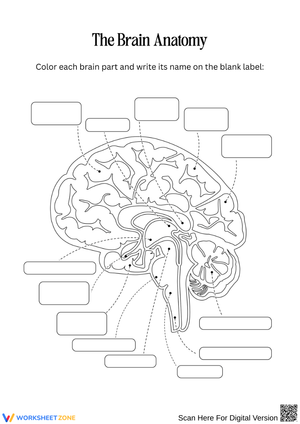
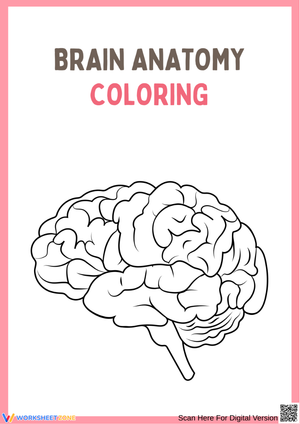
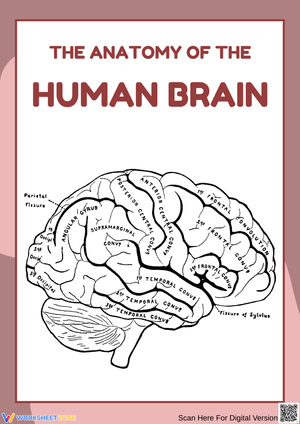
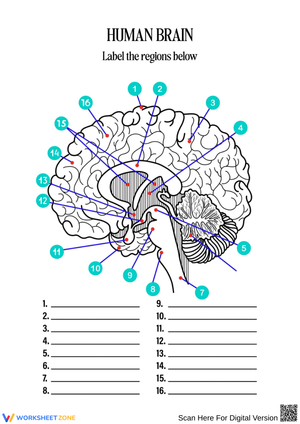
These 6th grade labeling brain anatomy printable worksheets target the structures middle school life science standards expect students to identify — cerebrum, cerebellum, brain stem, and the four cortical lobes — without the diagram density that belongs in a high school anatomy elective. A side-view brain outline with a contained word bank and a short function follow-up is the format that moves this vocabulary from fragile short-term recall into something students can retrieve on an assessment two weeks later.
Structures Covered in the Set
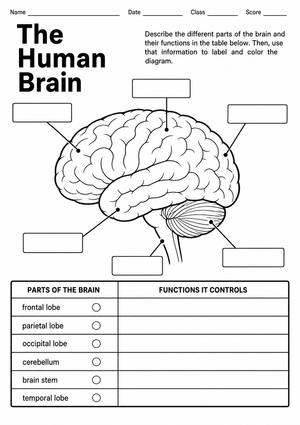
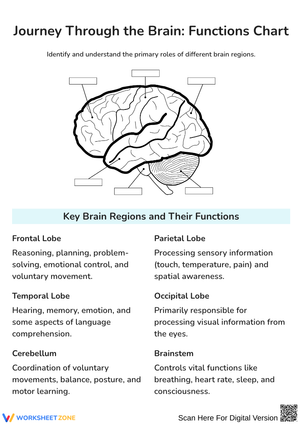
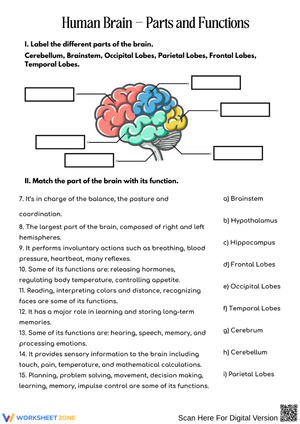
The worksheets follow a labeling sequence based on how students actually read a brain diagram — largest visible region first, then connecting structures, then the lobes. That order reduces the overwhelm that happens when seven labels appear at once with no anchor points.
- Cerebrum — voluntary movement, thinking, sensory processing, and memory
- Cerebellum — balance and coordination
- Brain stem — automatic functions including breathing and heart rate regulation
- Frontal lobe — planning, decision-making, and speech production
- Parietal lobe — processing touch and spatial information
- Temporal lobe — hearing, language comprehension, and certain memory functions
- Occipital lobe — vision processing
Not every worksheet in the set uses all seven labels. Introductory versions use three or four structures; later worksheets bring in all four lobes for a more detailed follow-up. That range lets you sequence content across two or three class periods without assigning the same activity twice.
Frequent Student Errors Worth Watching For
The most predictable labeling mistake at this grade is the cerebrum-cerebellum swap. Both names start with "cerebr-," both get introduced in the same lesson, and one reliably ends up near the brain stem on the finished diagram. Writing a brief anchor phrase on the board before students work independently — something like cerebrum = big, top, thinking / cerebellum = small, back, balance — cuts that error rate noticeably without giving the answer away.
Lobe direction is the second consistent problem. Students who correctly write "frontal lobe" will sometimes draw the label arrow toward the back of the head. The occipital-frontal swap is the most common version. Asking students to mark the front and back of the brain outline before placing any lobe labels removes most of that directional confusion — it takes 30 seconds and changes the error pattern significantly.
A subtler issue shows up in function questions after labeling: students who place a label correctly still assign the wrong function to it. A student can write cerebellum in the right spot and then write "thinking" next to it because thinking was the first brain function mentioned in class. A short matching or fill-in follow-up after the labeling step is the fastest way to catch that disconnect before it solidifies.
Fitting These Worksheets Into Your Lesson Plans
The most efficient opening lesson runs about 15 minutes. Project a plain brain outline, ask students to call out everything they know the brain does — they'll say thinking, seeing, breathing, moving — then distribute the worksheet and model just the cerebrum and brain stem labels before releasing students to finish independently or with a partner. That brief two-minute model prevents most of the "I don't know where to start" stalls that turn a simple task into a classroom management moment.
For a two-day approach, use an unlabeled version as retrieval practice on the second day. Students attempt it from memory first, then use a word bank or labeled reference to self-correct. The correction step — physically crossing out a wrong label and writing the right one — does more for retention than starting clean on a fresh worksheet. The error stays visible and the fix sits right next to it.
Station rotations also work well here. One station for labeling the diagram, one for matching each structure to a function card, one for a short applied question: Which brain structure is most involved when a soccer player adjusts her balance mid-kick? Questions at that level are accessible for Grade 6 and push students past simple name recall without requiring any additional materials. These 6th grade labeling brain anatomy printable worksheets include answer keys for every format, which makes station-based self-checking practical even when 30 students are rotating at once.
Adjusting the Worksheets for a Range of Learners
For students who need more support, reduce the label count to the three main structures and keep the word bank on the worksheet itself. Color-coding adds a second layer — asking students to shade the cerebellum before placing any labels locks in the spatial location before the vocabulary has to attach to it. A side-by-side function column (structure on one side, what it does on the other) gives struggling students a second path to meaning beyond arrow placement alone.
Students ready for more challenge work from a word-bank-free version and answer two or three short-answer questions after labeling: explain why the brain stem continues to function even when a person is unconscious, or describe what symptoms might follow damage to the occipital lobe. Those additions require no extra materials — just different printed directions on the same diagram. The 6th grade labeling brain anatomy printable worksheets in this set include both supported and extended versions, so you are not building new materials from scratch for each level.
For English learners, pairing each vocabulary term with a plain-language function phrase every time it appears — cerebellum: balance and coordination, not just cerebellum alone — builds the term-to-meaning connection through repetition with meaning. That pairing matters more than any single design choice on the worksheet.
Standard Alignment
NGSS MS-LS1-3 asks students to construct an argument supported by evidence that the body's systems interact to carry out life functions. Brain anatomy connects directly: the nervous system coordinates the activity of every other body system, and the brain serves as its command center. When students label the brain stem and link it to breathing regulation, or connect the cerebrum to voluntary muscle movement, they are building the conceptual model that standard requires — not simply memorizing vocabulary. These 6th grade labeling brain anatomy printable worksheets give students a concrete, visual reference they can return to when class discussion moves toward those cross-system connections later in the unit.
Frequently Asked Questions
What brain structures should 6th graders be expected to label?
At minimum, the cerebrum, cerebellum, and brain stem. Most Grade 6 life science units also include the four cortical lobes — frontal, parietal, temporal, and occipital. The practical approach is to start with the three major structures and add lobes once students have those placements solid.
Do these worksheets include answer keys?
Yes. Every worksheet in the set comes with a completed answer key. That matters most during station work or independent practice, when checking individual papers in real time is not realistic.
How long does completing a brain labeling worksheet take?
A focused student finishes the labeling portion in 8–12 minutes. Add 5 minutes if the worksheet includes a function-matching or short-answer follow-up. That total fits comfortably inside a standard class period alongside a brief introductory discussion.
Can these be used as formative assessments rather than practice?
The unlabeled, word-bank-free versions work well as low-stakes formative checks before a unit quiz. They show exactly which structures a student can place independently versus which ones still need review — that is more diagnostic information than a standard matching test provides.












 Interactive Worksheet Maker
 Quiz Maker
 Word Search Maker
 Crossword Puzzle Maker
 Word Scramble Generator
 Sentence Scramble Generator
 Handwriting Worksheet Generator
 Name Tracing Generator
 Fill In The Blank Generator




 BACK TOSCHOOL