




























Views
Downloads
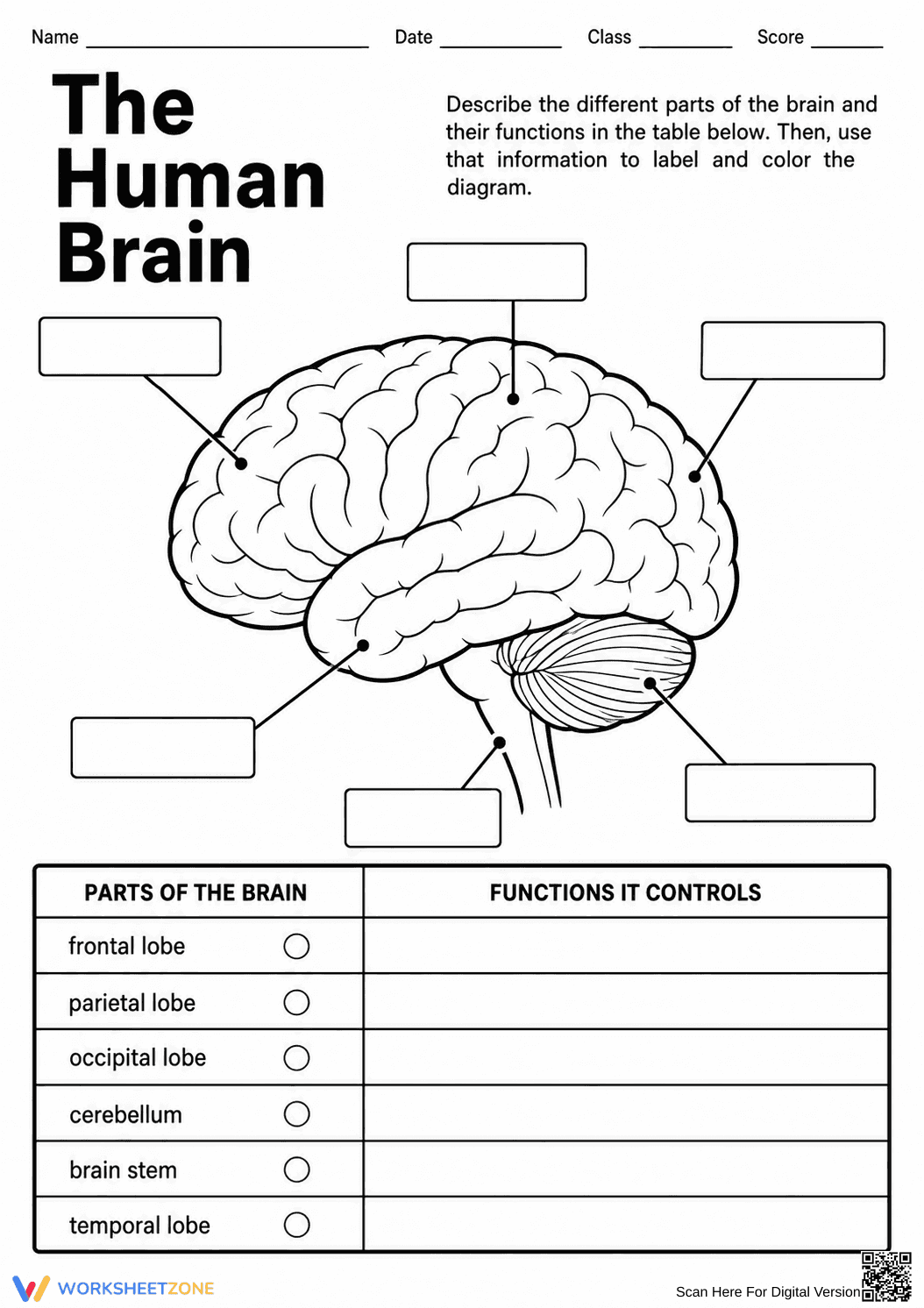

Essential Human Brain Labeling Worksheet | Grade 6-8

Paste this activity's link or code into your existing LMS (Google Classroom, Canvas, Teams, Schoology, Moodle, etc.).
Students can open and work on the activity right away, with no student login required.
You'll still be able to track student progress and results from your teacher account.
This Grade 6-8 brain anatomy worksheet provides a structured way for students to identify major cerebral regions and their physiological roles. By combining visual labeling with a functional analysis table, learners develop a concrete understanding of how the nervous system is organized to process information and control bodily actions.
At a Glance
- Grade: 6-8 · Subject: Science
- Standard:
MS-LS1-8— Gather information on how the brain processes sensory stimuli and controls behavior- Skill Focus: Brain Anatomy & Function
- Format: 1 page · 12 tasks · Answer key included · PDF
- Best For: Nervous system unit review or sub plans
- Time: 20–30 minutes
What's Inside: This single-page PDF features a high-resolution anatomical diagram of the human brain with six clear call-out boxes for labeling. Below the diagram, a systematic table lists the frontal lobe, parietal lobe, occipital lobe, cerebellum, brain stem, and temporal lobe. Students must match these terms to the diagram and then synthesize their knowledge to describe the specific functions each region controls, such as motor skills, visual processing, or balance.
Zero-Prep Workflow: This resource is designed for immediate classroom implementation with three simple steps. First, print the single-page PDF (30 seconds). Second, distribute the sheets to students as a bell-ringer or independent practice activity (1 minute). Third, review the completed diagrams and function tables using the provided answer key for instant formative feedback (5 minutes). It requires no teacher setup and serves as an ideal emergency sub plan.
Standards Alignment: The primary focus is `MS-LS1-8`, which requires students to understand how the brain functions as a central processing unit for the body. By identifying the specific lobes and the brain stem, students build the foundational knowledge necessary to explain how sensory receptors send messages to the brain for behavior or memory storage. This standard code can be copied directly into lesson plans, IEP goals, or district curriculum mapping tools.
How to Use It: Use this worksheet during the "Explain" phase of a 5E lesson cycle to reinforce direct instruction on the nervous system. It also functions effectively as a formative assessment after a lab activity involving sensory response. Teachers should observe if students can correctly distinguish between the temporal and parietal lobes, as this indicates a high level of anatomical precision. Expected completion time is 20 to 30 minutes.
Who It's For: This resource is tailored for middle school science students, including those in life science or introductory biology courses. It provides excellent support for visual learners and can be paired with a 3D brain model or an interactive nervous system simulation. It is also suitable for high school health classes needing a quick refresher on neuroanatomy.
According to EdReports 2024, high-quality science instruction requires materials that integrate three-dimensional learning by connecting core ideas like the nervous system to crosscutting concepts of structure and function. This worksheet aligns with the MS-LS1-8 standard by requiring students to not only name parts of the brain but also to articulate the functional significance of those structures. Research indicates that dual-coding—combining visual diagrams with verbal descriptions—significantly improves long-term retention of complex anatomical terminology. By engaging in both labeling and functional analysis, students move beyond rote memorization toward a conceptual understanding of biological systems. This resource provides the necessary scaffolding for middle schoolers to master the vocabulary of the brain while preparing them for more advanced neurological studies in high school biology. It is a reliable tool for ensuring curriculum alignment across diverse classroom settings.


