These 6th grade parts of the brain printable worksheets give science teachers diagram-based materials for one of the denser units in middle school life science — the one where naming structures is only the first step, and students also need to connect each region to its function in ways they can explain out loud. The set covers the three primary brain divisions, the four lobes of the cerebrum, and the contrast between voluntary and involuntary control. Each worksheet isolates a specific skill, which makes sequencing them across a full unit far more manageable than compressing everything into one lesson.
What Each Worksheet Targets
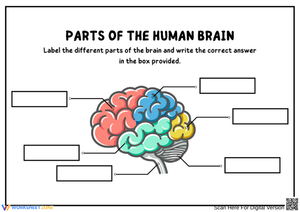
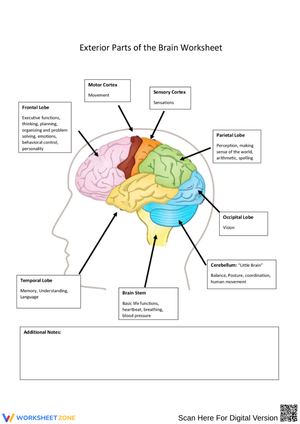
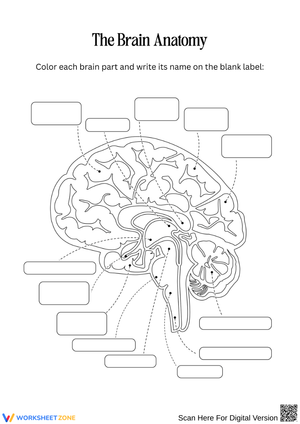
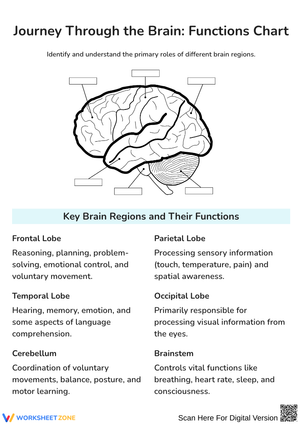
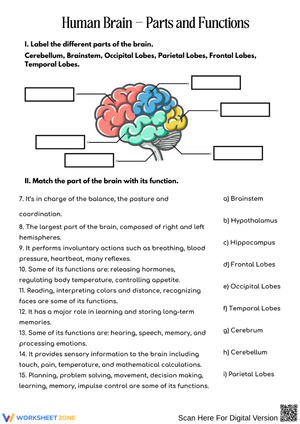
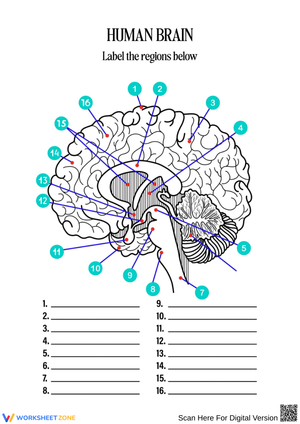
Labeling is the entry point. Each labeling worksheet presents a lateral-view brain diagram with leader lines pointing to the cerebrum, cerebellum, brainstem, and the four cerebral lobes. Students write structure names and then return to the same diagram to add a brief function note beside each label — a second-pass approach that pushes retrieval rather than passive copying. Function-matching worksheets present everyday scenarios: balancing on a beam, recognizing a familiar song, feeling cold water on your hand. Students identify which brain region is primarily at work. A third task type focuses on voluntary versus involuntary control, asking students to sort actions like swallowing, deciding to speak, blinking, and writing their name into the correct column. Scenario-based reading worksheets close out the set — each presents a short paragraph about a character doing something (playing guitar, reading a map, smelling bread) and asks students to annotate which brain region is most active and why.
Student Errors Worth Addressing Before You Teach This Unit
The cerebrum-cerebellum confusion is the most consistent one in student work. The names look similar on paper and sound similar out loud, and students who anchor new vocabulary to sound rather than meaning will flip them on assessments. A student who can correctly tell you the cerebellum handles coordination will often label coordination as a cerebrum function on a diagram — because the larger structure dominates the visual and the eye lands there first. Addressing this before students see the labeling worksheet pays off: pointing out that "cerebellum" contains a Latin diminutive root meaning "little brain" gives students something structural to hold onto rather than a name to memorize.
A second reliable error involves the lobes. Students learn that the temporal lobe handles hearing and immediately apply that logic to all sensory input. They will confidently mark taste and touch as temporal lobe functions. The parietal lobe's role in processing touch and temperature is the one most frequently crowded out — probably because it sits between lobes students find more intuitive. The worksheet that uses a body-sensation scenario (a character touching ice, then tasting lemon, then hearing a door slam) addresses this more efficiently than a definition list, because students are forced to distinguish between sensory inputs rather than treating them as a single category.
Students who arrived with any pop-science "left-brain versus right-brain" framing already built in will conflate hemispheres and lobes as if they represent the same system of division. That misconception needs to be named and corrected directly — if it goes unaddressed, students layer new lobe content on top of a faulty mental model and the errors compound rather than resolve.
How to Work These Worksheets Into Your Lesson Sequence
Using a 6th grade parts of the brain printable worksheets as a Day 1 consolidation activity — immediately after direct instruction, not before it — gives students their first chance to organize what they just heard into a spatial representation. Give them five minutes to attempt the labels independently before doing a whole-class check. On Day 2, the voluntary-involuntary sorting worksheet makes a solid eight-minute opener at the start of the period before moving into detailed instruction on the brainstem and cerebellum. Students who struggled with the diagram the day before often perform better on the sorting task because the column format plays to a different kind of reasoning.
The scenario-based reading worksheets are best used as exit tasks in the last ten minutes of class, particularly midway through the unit when students have enough vocabulary to reason but still need application pressure to consolidate it. The function-matching worksheets — the ones with real-world scenarios like catching a ball or tasting something sour — work well on Fridays before a quiz, when students need low-stakes retrieval practice without feeling like they are being tested again.
Standard Alignment
This set aligns with NGSS MS-LS1-3, which asks students to construct arguments supported by evidence for how body systems interact to support an organism's life functions. The brain unit lands squarely in that standard because students are not just naming regions — they are explaining what those regions do and why the separation between voluntary and involuntary control matters for homeostasis. In most Grade 6 sequences, this unit follows cell biology and precedes the other body systems, which means students arrive already comfortable with the idea that structures carry out specialized functions. The brain worksheets extend that logic into a far more complex organ where multiple regions share responsibility for broad categories of work.
Adjusting the Worksheets Across Ability Levels
For students still building their academic vocabulary, the diagram-based labeling worksheets carry the instructional load without heavy text demands. If those students are also overwhelmed by the volume of new terms, narrow the first labeling worksheet to the three major divisions only — cerebrum, cerebellum, brainstem — and introduce the four lobes the following day. That reduction in the number of terms lowers the cognitive demand at the start without removing any content from the unit.
Students who move through the material ahead of their peers can extend the scenario-based worksheets by writing their own three-sentence brain scenarios targeting a specific lobe, then trading with a partner to annotate. Creating the stimulus requires more precise understanding than responding to one — a student cannot write a believable temporal lobe scenario without actually knowing what the temporal lobe does, and the same holds for each of the other lobes. These 6th grade parts of the brain printable worksheets include blank scenario templates that support this kind of peer-challenge extension without requiring a separate activity sheet.
Frequently Asked Questions
Do these worksheets cover the limbic system, or only the major structural divisions?
The set focuses on the three primary divisions and the four lobes of the cerebrum — the content most Grade 6 standards expect students to master. Memory and emotion appear in function-matching and scenario questions, so students do reason about those processes, but the limbic system's internal structures, including the hippocampus and amygdala, are not the focus of a dedicated labeling task. If your curriculum requires that level of anatomical detail, the scenario-based worksheets pair well with a supplemental reading on limbic structures.
Can these be used as quiz materials, or only for practice?
Either. A 6th grade parts of the brain printable worksheets collected and scored midway through instruction serves as a formative check; the same worksheet used at the close of a unit becomes a summative task. The labeling and function-matching formats produce specific data — you can see exactly which structures a student is confusing — which is far more useful than a multiple-choice score that only tells you something went wrong.
Where in a brain unit do these worksheets fit best?
After direct instruction, not before. These worksheets assume students have encountered the vocabulary at least once in a lesson context. Using the labeling worksheet as a pre-assessment before any teaching will surface prior knowledge — expect mostly blank diagrams and a few guesses from students who have absorbed information informally. The strongest outcomes come when the worksheets follow a class discussion or short reading and serve as the first retrieval attempt rather than the first exposure to the terms.












 Interactive Worksheet Maker
 Quiz Maker
 Word Search Maker
 Crossword Puzzle Maker
 Word Scramble Generator
 Sentence Scramble Generator
 Handwriting Worksheet Generator
 Name Tracing Generator
 Fill In The Blank Generator




 BACK TOSCHOOL