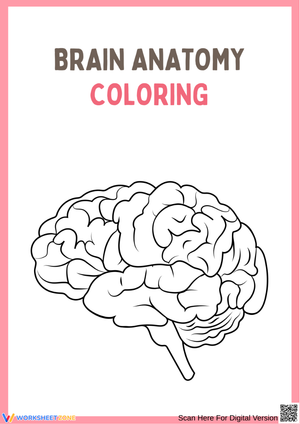
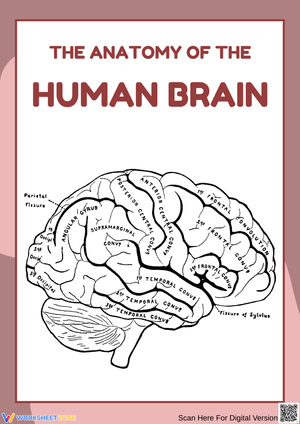
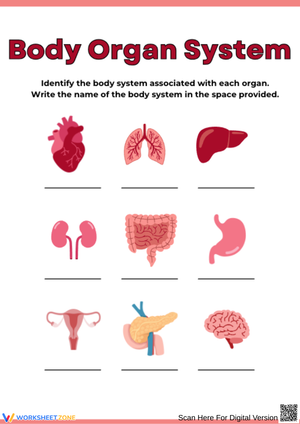
These 6th grade brain worksheets resources give science teachers ready-to-print diagrams, labeling activities, and function-matching exercises for a nervous system unit. The set covers the cerebrum, cerebellum, and brainstem, moves down to the four cortical lobes, and extends to neuron structure and basic brain health — enough range to support the full instructional arc from vocabulary introduction through end-of-unit review. At this grade level, students are making a conceptual shift from naming body systems to understanding how those systems work at a structural level, and these worksheets address that transition directly.
What's Inside the Set
Each worksheet targets a specific layer of brain anatomy or function, so teachers can assign them selectively rather than working through the full set in one block.
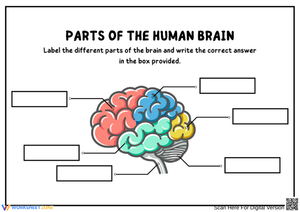
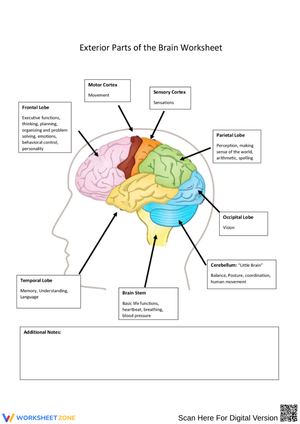
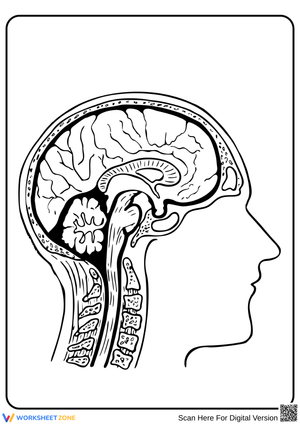
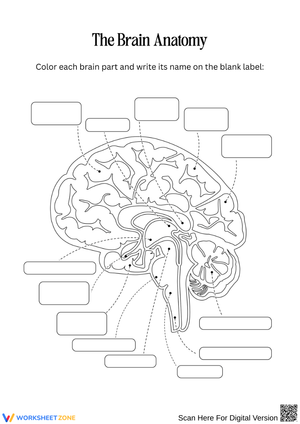
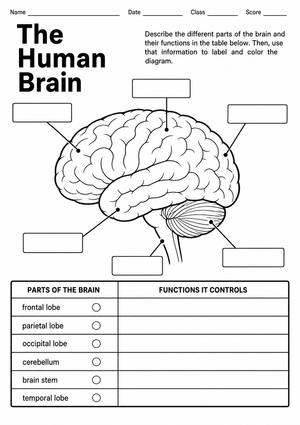
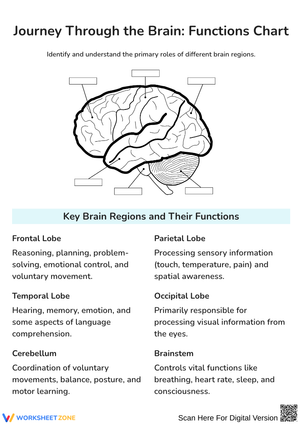
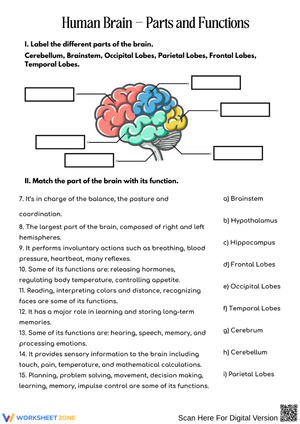
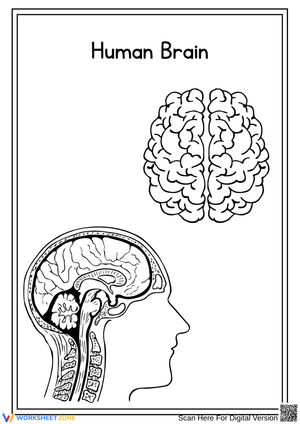
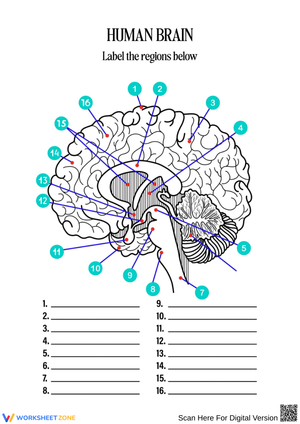
- Labeled diagram identification: Students receive an unlabeled exterior or cross-section view of the brain and mark the cerebrum, cerebellum, brainstem, and all four lobes — frontal, parietal, temporal, and occipital.
- Function matching: Students read a short scenario — catching a pass, recalling a lunch order, hearing a fire alarm — and identify the region responsible. This connects anatomical vocabulary to observable, relatable behavior.
- Neuron structure and signal transmission: Students label the cell body, axon, dendrites, and synapse, then trace a signal from stimulus to response in the correct order.
- Sensory pathway tracing: Starting from a specific stimulus — a loud sound or a sharp pinprick — students map the route from sensory organ through the nervous system to the appropriate processing lobe.
- Brain health application: Short-answer questions ask students to connect lifestyle choices — sleep, nutrition, helmet use — to specific brain functions, including memory consolidation in the cerebrum.
How to Work These Worksheets Into Your Instructional Week
The labeling worksheet earns its place as a first-day pre-assessment. Give students five minutes to fill in as much as they already know, collect the papers without marking them, and return them on the last day of the unit so students can complete the same worksheet again. The before-and-after comparison gives students a concrete record of their growth and costs almost no additional prep time.
Function-matching worksheets run well during small-group rotations, partly because students argue with each other in useful ways. Three students working through whether reflexes are governed by the brainstem or the spinal cord will remember the answer longer than if they had copied it from a slide. The brain health sections fit naturally as homework — assign them after the cerebrum lesson, ask students to track their own sleep for two nights, and open the next class with a ten-minute discussion about what they noticed. That exchange connects anatomy content to students' actual daily experience in a way that diagram labeling alone cannot.
Reserve the neuron-labeling and sensory-tracing worksheets for after direct instruction on cellular-level nervous system function. Students who attempt them without that foundation tend to guess at the sequencing rather than reason through it, which builds incorrect habits before the unit test.
Frequent Student Errors Worth Watching For
The cerebellum-brainstem swap is the most consistent error at this grade level. Students learn early that the brainstem sits below the cerebrum, and many conclude from that spatial relationship that it must control movement. As a result, they assign balance and coordination to the brainstem and place breathing and heart rate in the cerebellum. The function-matching activities surface this confusion quickly because students commit to a written answer before any peer discussion takes place — and a written error is far easier to address directly than a verbal misstatement students can walk back.
Lobe confusion follows close behind. Students who correctly label all four lobes on the diagram will still write "the temporal lobe controls vision" in a short-answer response, swapping it with the occipital lobe. One strategy that holds: have students use the same color for each lobe on the diagram and in their written notes. When the occipital lobe is always blue — on the diagram and in the margins of the science journal — the visual association proves more durable than verbal repetition at this age.
A subtler gap appears in the neuron worksheets. Students understand signal transmission as an abstract idea — "messages travel through nerves" — but cannot correctly sequence dendrite, cell body, axon, synapse when asked to trace a specific path in writing. The vocabulary is present; the directionality is not. Teachers working through this 6th grade brain worksheets set in unit order will encounter all three of these errors before the summative assessment, which is exactly when they are still correctable.
Standard Alignment
These worksheets address NGSS MS-LS1-3, which asks students to use evidence to argue that the body is a system of interacting subsystems made up of groups of cells. The brain is the most concrete example of that principle that 6th graders encounter: neurons are specialized cells that form the tissue of the brain and spinal cord, and together they coordinate the organism's responses at every level. The NINDS Brain Basics: Know Your Brain guide and the University of Washington's Neuroscience for Kids resource both treat the brain this way — not as a static vocabulary list but as a coordination system with observable, testable functions. Worksheets that ask students to trace sensory pathways or match a behavior to a brain region are performing the analytical move MS-LS1-3 requires: using structure-function relationships as evidence for systems-level claims.
Adapting the Set for Mixed-Ability Classrooms
For students still building anatomical vocabulary, the labeling worksheet is more accessible when they reference a completed diagram from their notes or textbook while working through the blank version. They are still making decisions — reading, comparing, applying — without the added burden of pure cold retrieval. Students who need more depth can extend the brain health section into a short research task: choose one neurological condition — concussion, Parkinson's disease, or aphasia — and explain which region it affects and why the resulting symptoms make anatomical sense.
The 6th grade brain worksheets format — single-topic, diagram-centered, print-ready — works well for students who process information more effectively through written tasks than verbal ones. Students who go quiet during class discussion often produce more specific, detailed written responses when a labeled diagram sits in front of them as a concrete reference. That is worth factoring into how the small-group rotation is structured.
Frequently Asked Questions
What grade level are these resources built for?
The worksheets target 6th grade science, aligning with the middle school life science standards that introduce the nervous system at a structural and functional level. Some 5th grade teachers use the introductory labeling worksheets as a preview, and 7th grade teachers occasionally pull the neuron-sequencing worksheet for review before more advanced cell biology. The 6th grade brain worksheets set is organized so each worksheet stands on its own, which makes it practical to assign individual activities without working through the entire collection.
Can these worksheets function as assessments, or only as practice?
Both. The labeling and function-matching worksheets work as low-stakes quizzes when collected and graded. The sensory pathway and neuron-sequencing worksheets reveal depth of understanding more accurately than multiple-choice formats — a student who correctly traces a signal from the eardrum to the temporal lobe in writing has internalized the concept rather than memorized a label. For formal assessment, pair a completed worksheet with a brief verbal explanation and you have substantive evidence for a standard like MS-LS1-3.
How long does each worksheet take to complete during class time?
The labeling diagrams take roughly 8 to 12 minutes for most 6th graders working independently. Function-matching runs closer to 10 to 15 minutes depending on the number of scenarios included. The neuron-sequencing and sensory-tracing worksheets take 15 to 20 minutes because students need to recall and correctly order multiple steps. In a 50-minute block, one labeling worksheet paired with a function-matching activity fills the first half while leaving time for instruction or whole-group discussion.












 Interactive Worksheet Maker
 Quiz Maker
 Word Search Maker
 Crossword Puzzle Maker
 Word Scramble Generator
 Sentence Scramble Generator
 Handwriting Worksheet Generator
 Name Tracing Generator
 Fill In The Blank Generator




 BACK TOSCHOOL