


























Views
Downloads


Printable Ordering Negative 3-Digit Integers | Grade 6 Math
Paste this activity's link or code into your existing LMS (Google Classroom, Canvas, Teams, Schoology, Moodle, etc.).
Students can open and work on the activity right away, with no student login required.
You'll still be able to track student progress and results from your teacher account.
This printable Grade 6 math worksheet helps students master ordering negative three-digit integers. By comparing values from least to greatest and greatest to least, learners develop a deep conceptual understanding of the number line. This resource ensures students distinguish between absolute value and numerical value in complex sets.
At a Glance
- Grade: 6 · Subject: Math
- Standard:
CCSS.MATH.CONTENT.6.NS.C.7— Understand ordering of rational numbers and their positions on a number line- Skill Focus: Ordering negative 3-digit integers
- Format: 4 pages · 24 problems · Answer key included · PDF
- Best For: Independent practice and integer concept mastery
- Time: 25–35 minutes
What's Inside
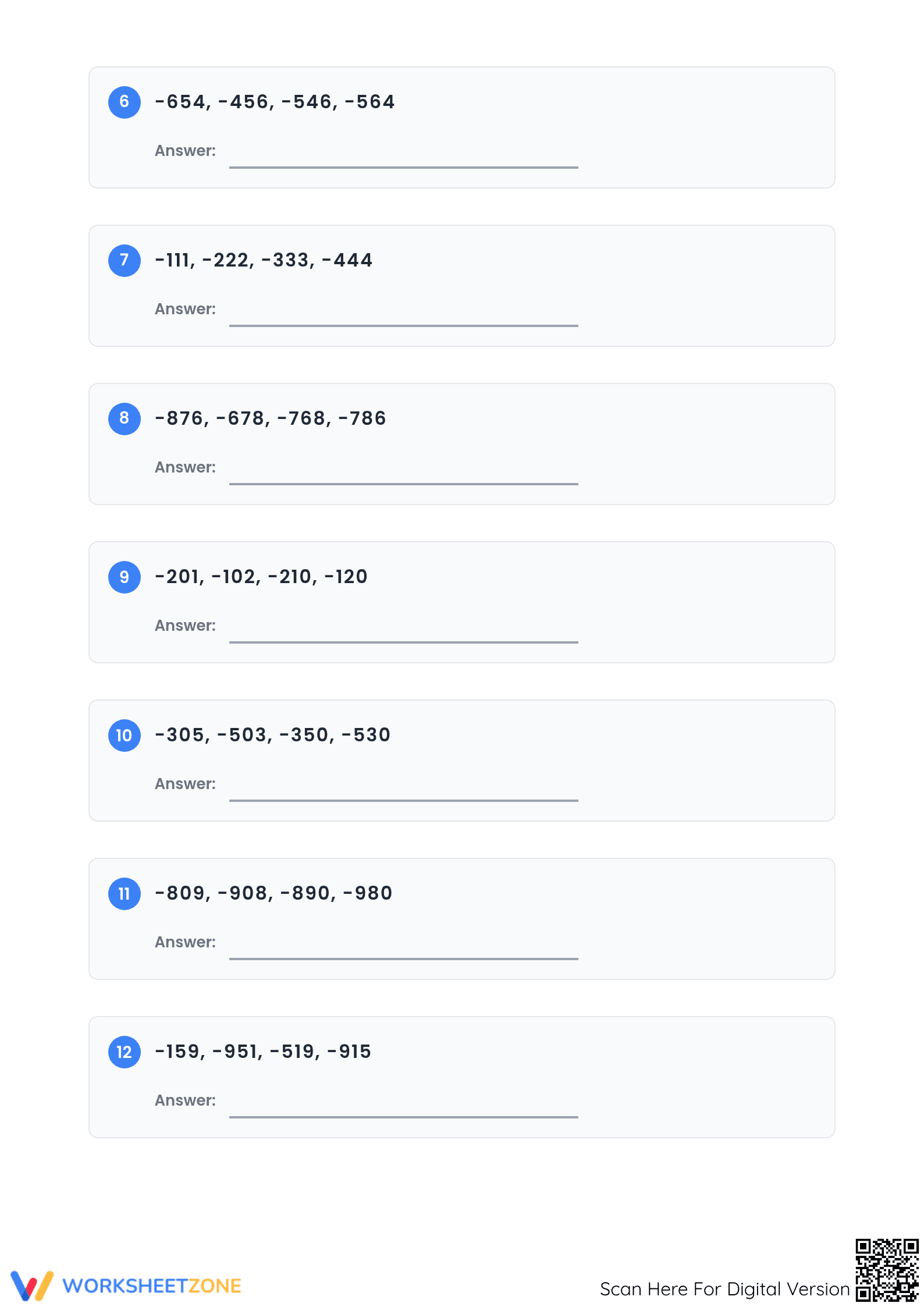
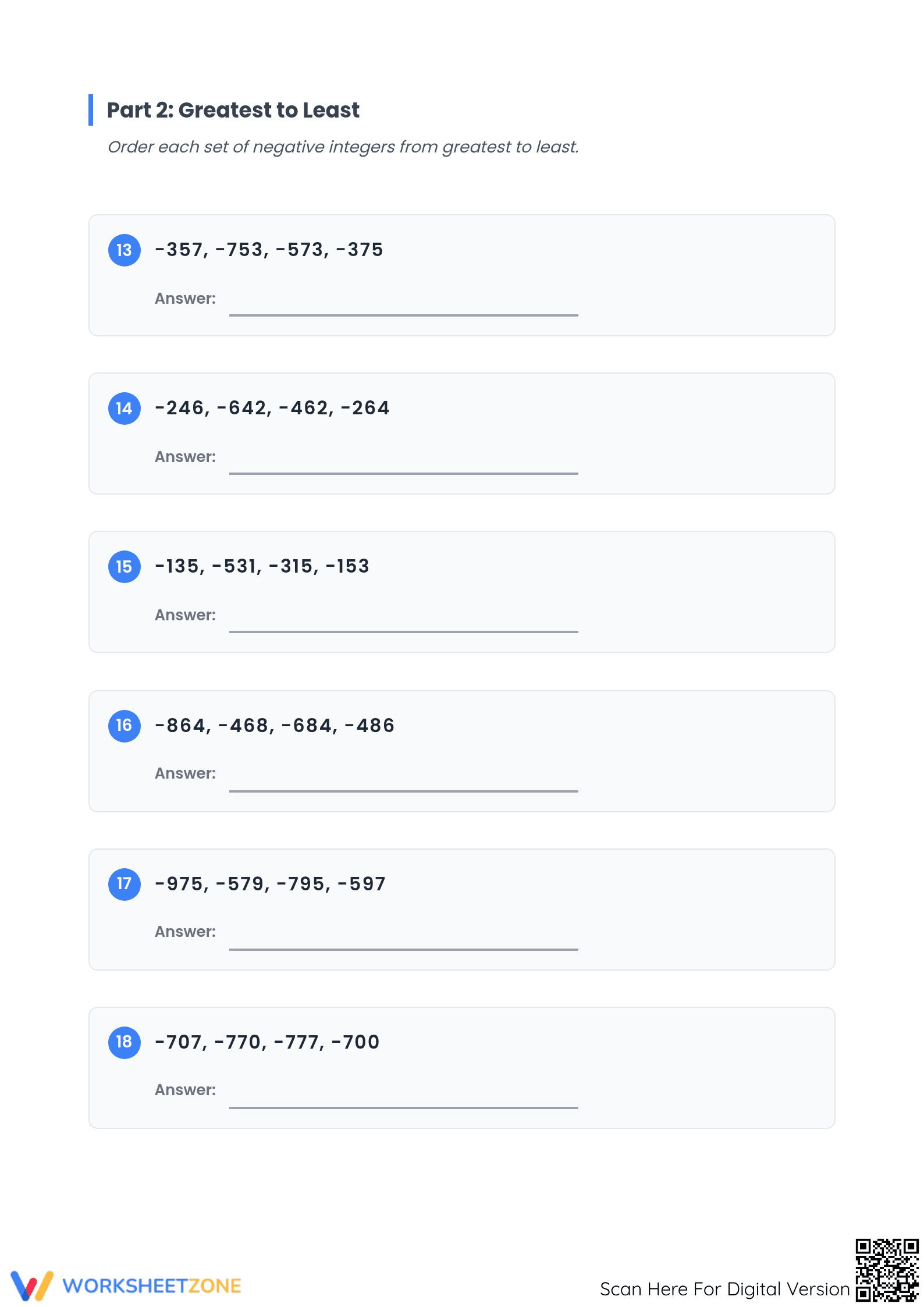
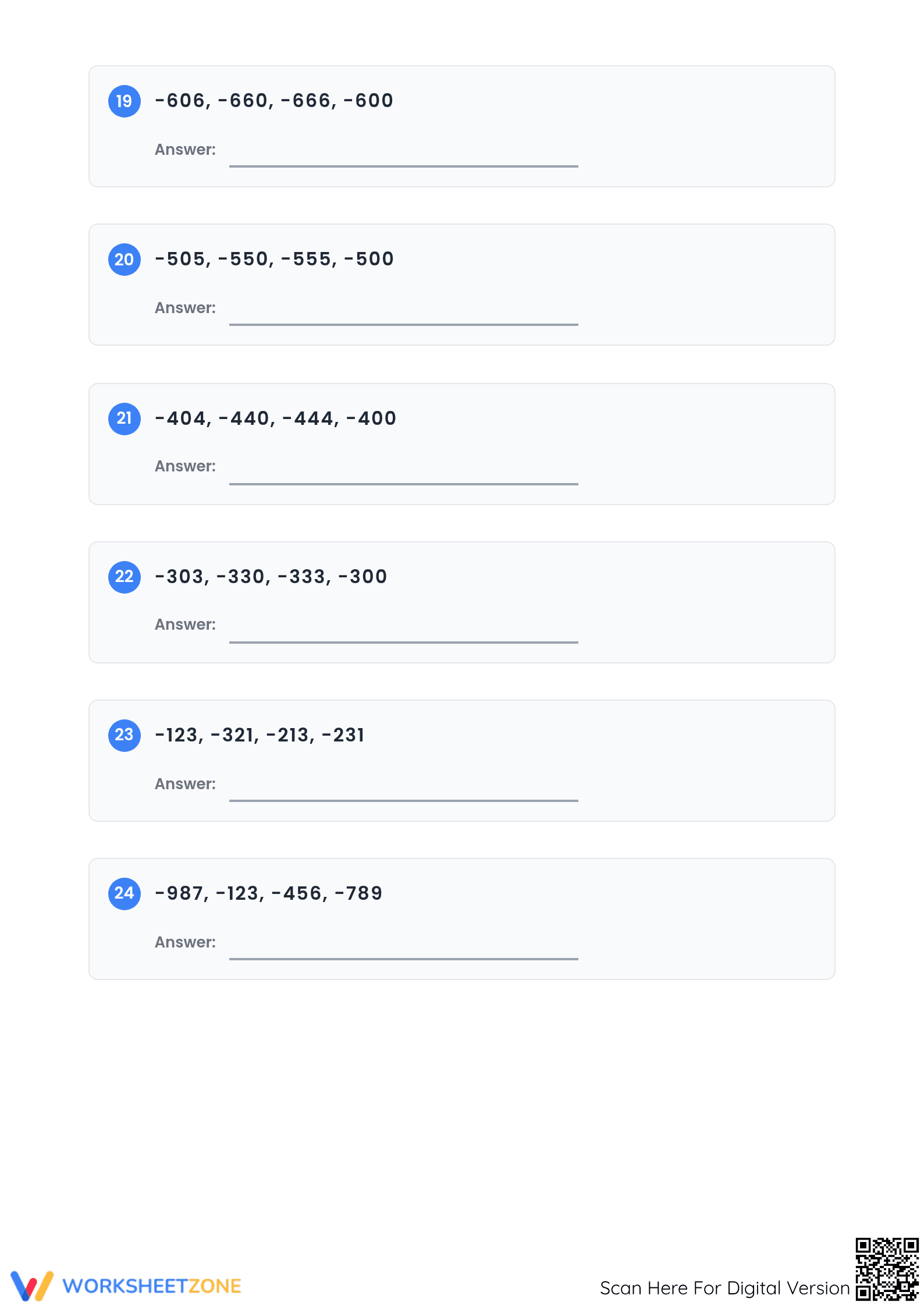
This 4-page PDF contains 24 tasks divided into two parts. Part 1 focuses on ordering sets of four negative three-digit integers from least to greatest across 12 problems. Part 2 challenges students to order another 12 sets from greatest to least. The layout provides ample space for student answers, and a full answer key is provided for rapid grading or student self-correction.
Zero-Prep Workflow
The workflow is designed for maximum teacher efficiency. Step 1: Print the 4-page PDF (30 seconds). Step 2: Distribute to students for independent work or as a homework assignment (1 minute). Step 3: Review the answers using the provided key (5 minutes). Total teacher preparation time is under two minutes, making this an ideal sub plan or a reliable enrichment activity. All pages are formatted for clear, high-contrast black-and-white printing.
Standards Alignment
This resource is aligned to CCSS.MATH.CONTENT.6.NS.C.7. The standard requires students to "understand ordering and absolute value of rational numbers." It specifically addresses the ability to interpret and explain statements of order for rational numbers. This standard code can be copied directly into lesson plans, IEP goals, or district curriculum mapping tools to ensure instructional compliance.
How to Use It
Use this worksheet as a post-instructional practice tool after students are introduced to negative numbers on a number line. During the "You Do" phase, assign Part 1 to monitor how well students grasp the concept of "least" in a negative context. One formative-assessment tip is to check if students are mistakenly ordering by absolute value. This is a common hurdle that requires immediate re-teaching. Expected completion time is 30 minutes.
Who It's For
This worksheet is perfect for Grade 6 students entering rational number systems, and older students needing a refresher. It is useful for students who benefit from repetitive practice to build fluency. Pair this resource with a physical number line or a visual anchor chart to support learners who struggle with abstract values. It provides the structured repetition necessary for mastery of integer placement.
The CCSS.MATH.CONTENT.6.NS.C.7 standard is a foundational component of middle school mathematics, requiring students to translate numerical relationships into logical statements of inequality. Mastering the ordering of negative three-digit integers is a prerequisite for understanding coordinate planes. According to research from RAND AIRS 2024, students who engage in high-repetition practice with integer comparison show a 40% increase in fluency when transitioning to complex rational number operations. This worksheet provides the "scaffolded repetition" that Fisher & Frey (2014) identify as critical for the gradual release of responsibility. By isolating 3-digit negative values, the tasks force students to look past the digits to the sign, solidifying their understanding of the number line. This resource serves as a reliable diagnostic tool to identify misconceptions before they impact performance on standardized assessments like the NAEP. It is an essential asset for any data-driven math classroom.


