


























Views
Downloads

Ordering Negative Integers Worksheet | Grade 6 Essential
Paste this activity's link or code into your existing LMS (Google Classroom, Canvas, Teams, Schoology, Moodle, etc.).
Students can open and work on the activity right away, with no student login required.
You'll still be able to track student progress and results from your teacher account.
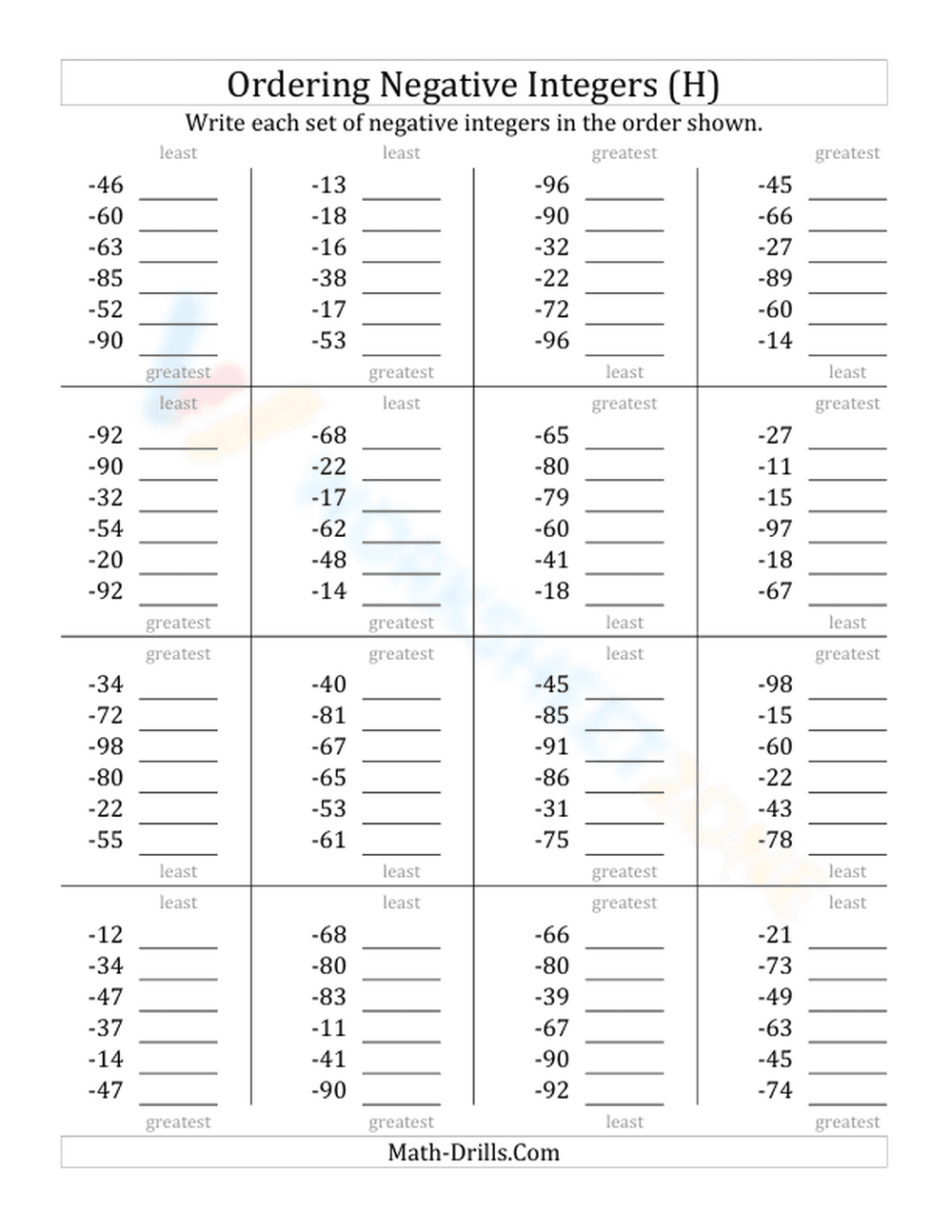
This Grade 6 math worksheet helps students master the concept of ordering negative integers by comparing values across 16 distinct problem sets. Students practice identifying the relationship between absolute value and actual value, ensuring they can accurately sequence numbers from least to greatest and vice versa. It provides immediate practice for a foundational number system skill.
At a Glance
- Grade: 6 · Subject: Mathematics
- Standard:
CCSS.MATH.CONTENT.6.NS.C.7— Understand ordering and absolute value of rational numbers- Skill Focus: Ordering negative 2-digit integers
- Format: 1 page · 16 tasks · Answer key included · PDF
- Best For: Independent practice or quick formative assessment
- Time: 15–20 minutes
The worksheet features a clean, grid-based layout containing 16 separate exercises. Each exercise presents a list of six negative two-digit integers that students must reorder based on the specific "least" or "greatest" labels provided. The repetitive structure allows for high-repetition practice, while the inclusion of a comprehensive answer key ensures that grading is efficient and accurate for the instructor.
This resource is designed for a zero-prep classroom workflow. First, print the single-page PDF (30 seconds). Second, distribute the sheets to students for independent work or as a warm-up activity (1 minute). Third, review the answers using the provided key or have students self-correct to identify misconceptions about negative values (5 minutes). Total teacher preparation time is under two minutes, making it an ideal sub plan or bell-ringer.
The primary focus is CCSS.MATH.CONTENT.6.NS.C.7, which requires students to understand ordering and absolute value of rational numbers. Specifically, it addresses 6.NS.C.7.B, which involves writing, interpreting, and explaining statements of order for rational numbers in real-world contexts. This standard code can be copied directly into lesson plans, IEP goals, or district curriculum mapping tools.
Use this worksheet as a "Do Now" activity immediately following a lesson on the number line to solidify the concept that larger negative digits represent smaller values. Alternatively, assign it as a formative assessment after direct instruction to identify students who struggle with the inverse relationship between absolute value and integer value. Completion typically takes 15 to 20 minutes depending on student fluency.
This resource is ideal for sixth-grade students beginning their study of the number system, as well as seventh and eighth graders who require remediation on integer operations. It serves as an excellent companion to a physical or digital number line anchor chart, providing the necessary drill-and-practice to move from conceptual understanding to procedural fluency.
Mastery of integer ordering is a critical gateway to algebraic success. According to the RAND AIRS 2024 report, students who demonstrate early proficiency in the number system, specifically regarding negative values, show higher rates of success in multi-step equations. This worksheet targets CCSS.MATH.CONTENT.6.NS.C.7 by forcing students to reconcile the visual size of a digit with its actual value on the number line. By practicing with 16 distinct sets, students build the cognitive stamina required for middle school mathematics. Research from Fisher & Frey (2014) emphasizes that high-repetition, focused practice on a single skill—such as ordering negative integers—is essential for moving information from short-term to long-term memory. This printable resource provides that structured environment, ensuring students can accurately sequence negative two-digit integers without the distraction of complex word problems or extraneous formatting.


