


























Views
Downloads
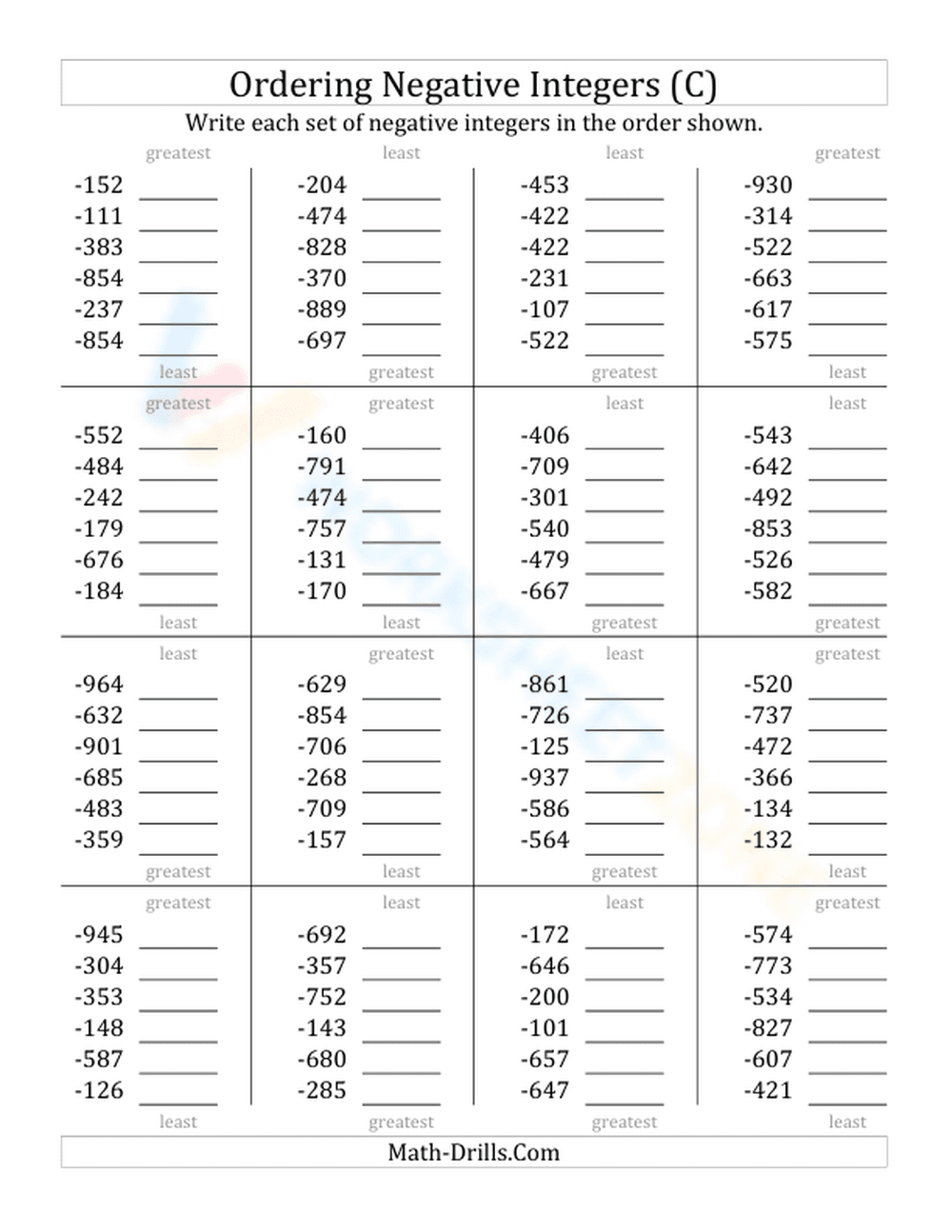

Grade 6 Negative Integers — Printable No-Prep Worksheet
Paste this activity's link or code into your existing LMS (Google Classroom, Canvas, Teams, Schoology, Moodle, etc.).
Students can open and work on the activity right away, with no student login required.
You'll still be able to track student progress and results from your teacher account.
This Grade 6 math worksheet gives students focused practice ordering negative three-digit integers from least to greatest and greatest to least. By comparing large negative numbers, learners build a strong conceptual understanding of absolute value and integer placement on the number line, ensuring readiness for advanced algebraic operations.
At a Glance
- Grade: 6 · Subject: Math
- Standard:
CCSS.MATH.CONTENT.6.NS.C.7— Understand ordering and absolute value of rational numbers- Skill Focus: Ordering negative 3-digit integers
- Format: 1 page · 16 problems · Answer key included · PDF
- Best For: Independent practice and review
- Time: 15–20 minutes
Inside this single-page resource, educators will find 16 distinct problem sets designed to reinforce integer comparison skills. Each block requires students to sequence six different three-digit negative numbers according to specific directional prompts, alternating between greatest-to-least and least-to-greatest ordering. The straightforward layout minimizes visual distractions, while the included answer key allows for rapid grading or peer review.
Zero-Prep Workflow
- Print (1 minute): Simply download the PDF and print the required number of copies. The black-and-white design is ink-friendly and requires no special formatting.
- Distribute (1 minute): Hand out the worksheets as a warm-up, homework assignment, or independent station activity. The instructions are completely self-explanatory.
- Review (3 minutes): Use the provided answer key to quickly check student work or project it on the board for self-correction.
Total teacher prep time is under two minutes, making it ideal for emergency sub plans or last-minute skill reinforcement.
Standards Alignment
This worksheet aligns to CCSS.MATH.CONTENT.6.NS.C.7, requiring students to understand ordering and absolute value of rational numbers. It targets the ability to write and interpret statements of order. Both standard codes can be copied directly into lesson plans, IEP goals, or district curriculum mapping tools.
How to Use It
Use this worksheet during independent practice after direct instruction on negative numbers. Alternatively, use it as a targeted intervention tool for middle schoolers struggling with integer operations. As a formative assessment observation tip, watch for students who mistakenly order the numbers as if they were positive; this indicates a need to revisit number line visualizations. Expected completion time ranges from 15 to 20 minutes.
Who It's For
This resource is primarily designed for sixth-grade math students mastering the rational number system, but it serves as excellent review for seventh and eighth graders preparing for complex algebraic equations. To differentiate, teachers can allow struggling learners to use a physical number line or cross off numbers as they place them. It pairs naturally with introductory lessons on absolute value or interactive anchor charts displaying horizontal and vertical number lines.
Mastering the conceptual framework of negative numbers represents a critical milestone in middle school mathematics instruction. According to EdReports 2024, students who demonstrate early fluency in ordering rational numbers are significantly better prepared for high school algebra and advanced STEM coursework. This specific worksheet directly supports CCSS.MATH.CONTENT.6.NS.C.7 by requiring learners to understand ordering and absolute value of rational numbers. By repeatedly practicing the sequencing of three-digit negative integers, students internalize the often counterintuitive rule that a larger absolute value results in a smaller overall quantity. This targeted repetition effectively dismantles common mathematical misconceptions before they can solidify into long-term learning barriers. Providing structured, straightforward practice opportunities ensures that foundational number sense is firmly established, allowing educators to confidently transition their classrooms into more complex operations involving negative integers and rational expressions.


