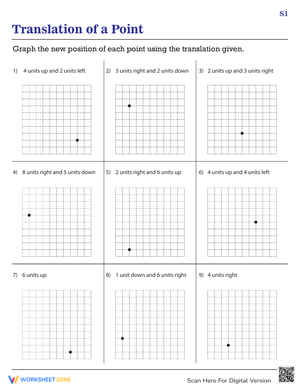
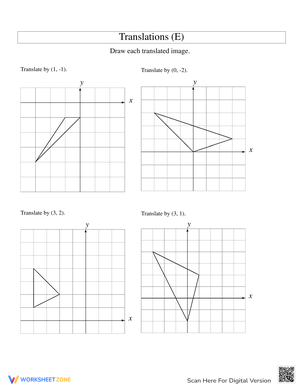
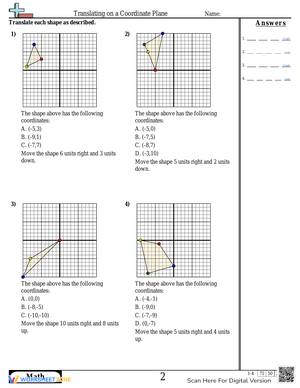
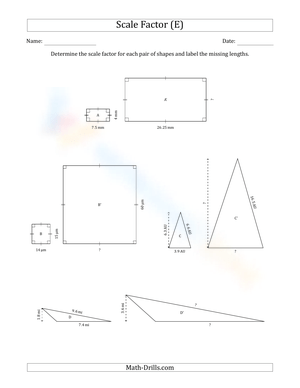
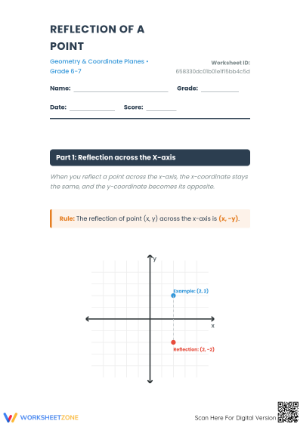
These transformations worksheets for 6th grade cover the three rigid transformations — translations, reflections, and rotations — through tasks that move from visual identification on simple grids to coordinate-plane work requiring accurate plotting and written explanation. Teachers get ready-to-print resources with clear vertex labeling, answer keys that show image points, and problem types that fit multiple classroom contexts.
What the Set Targets Across Each Transformation Type
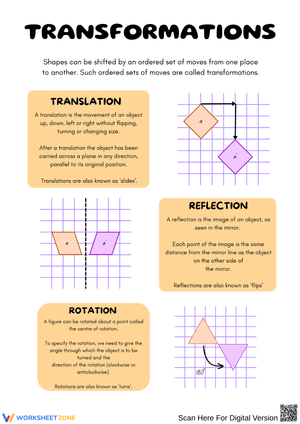
Sixth grade is the year students move from informally recognizing that a shape "moved" to describing precisely how it moved — direction, distance, angle, orientation. Each worksheet in the set targets one of those demands or asks students to connect them, building toward the combination of execution and explanation that shows real understanding.
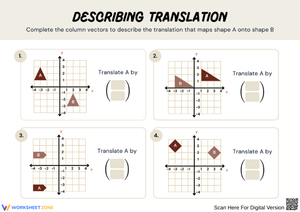
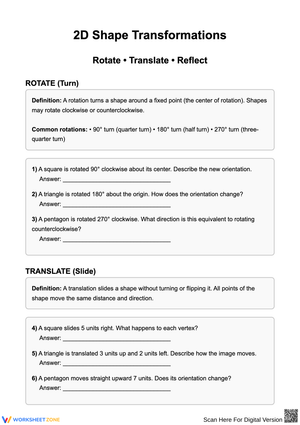
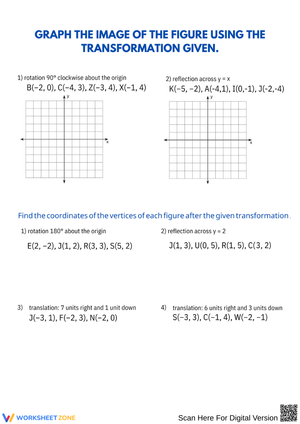
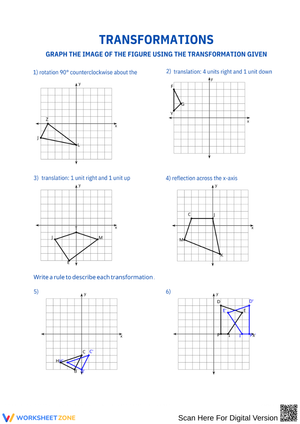
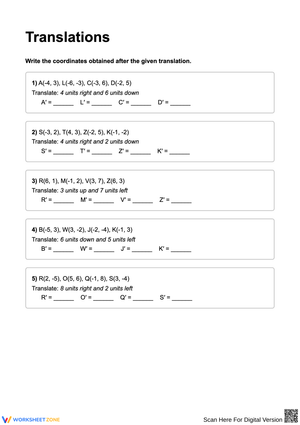
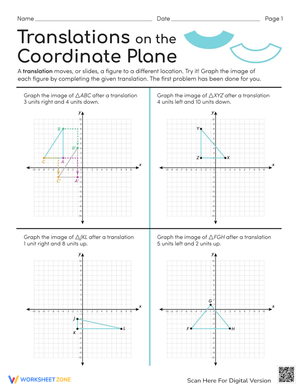
- Translations: students mark each image vertex individually by counting the directed displacement before connecting any edges — not just repositioning the whole figure at once
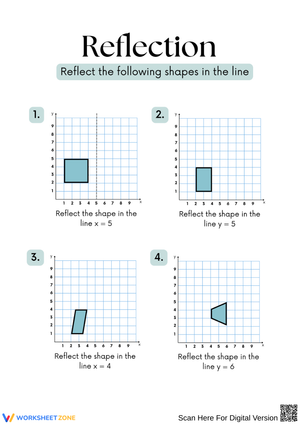
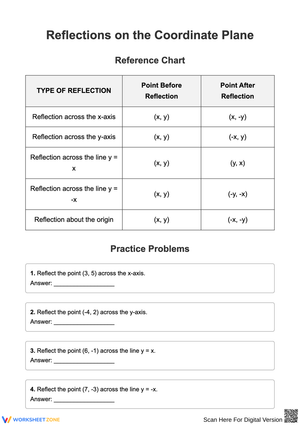
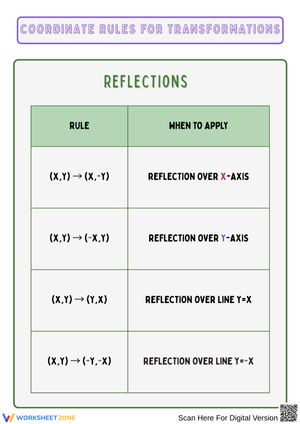
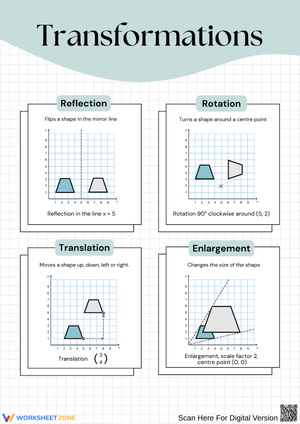
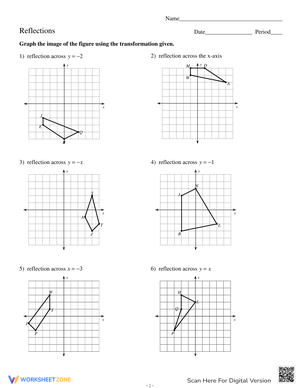
- Reflections across horizontal lines, vertical lines, and both coordinate axes, with emphasis on counting perpendicular distance from the line rather than eyeballing
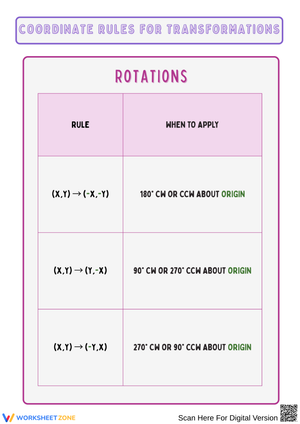
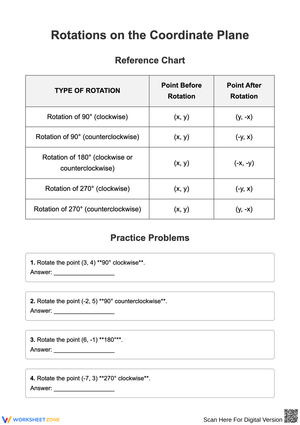
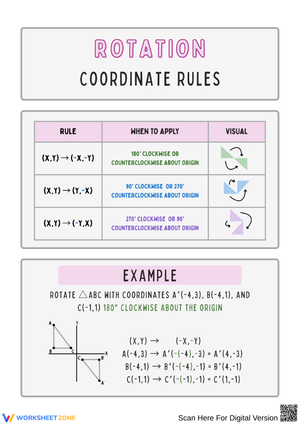
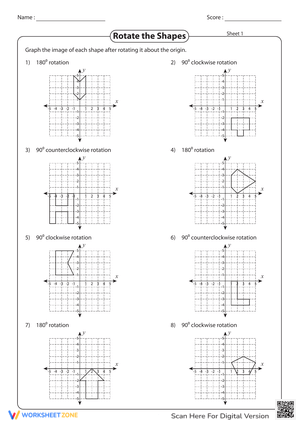
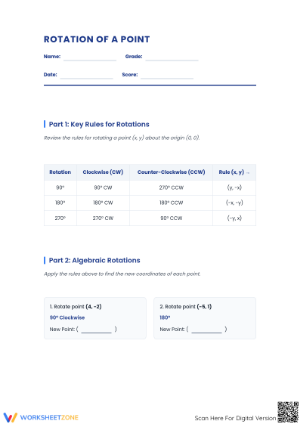
- Rotations of 90° and 180° clockwise and counterclockwise, with the center of rotation specified in each problem — sometimes the origin, sometimes another named point
- Vocabulary integration: preimage, image, line of reflection, center of rotation, and direction of rotation appear in problems and in the written-response prompts
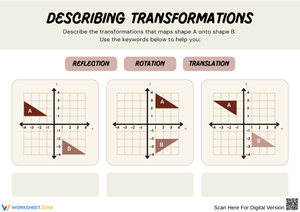
- Mixed-identification tasks: students examine two congruent figures, name the transformation, and write a sentence explaining how they know
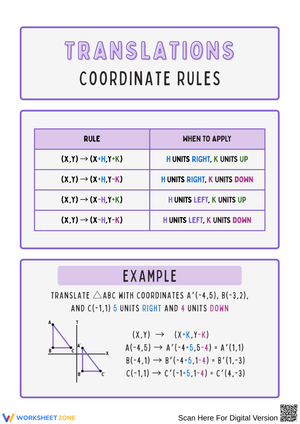
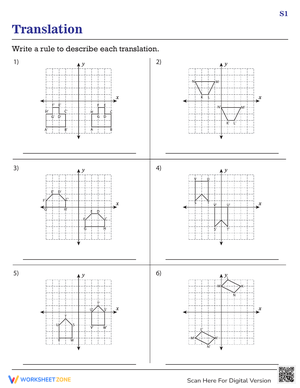
One worksheet pairs translation problems with a coordinate-rule extension: students who finish the drawing must also express the move as (x, y) → (x + a, y + b) rather than arrow notation on the grid. That prompt separates students with genuine coordinate understanding from those who are still working by counting squares visually.
The Specific Errors Transformation Practice Brings to the Surface
Reflection errors follow the most consistent pattern. Students correctly identify the line and understand that the figure "flips," but they measure casually. A student will place vertex A′ roughly across the line without counting perpendicular grid units, producing an image that looks close enough to pass a quick scan but sits at the wrong distance. The check that catches this: ask students to mark the midpoint between each vertex and its image after completing the drawing. If those midpoints don't all fall on the line of reflection, the work is wrong — and students can see exactly why.
Rotation problems surface two separate errors. The first is direction: students who can rotate 90° clockwise around the origin after a demonstration will still flip the direction on the next problem without prompting. The second is anchor-point confusion — most students default to the origin as the center of rotation even when a problem names a different point, like (2, −3). That habit persists because classroom examples almost always use the origin, and students stop reading for the specified center. Labeling errors compound both: students assign A′, B′, C′ in the order they draw rather than pairing each image vertex to its preimage counterpart, making it impossible to check corresponding relationships afterward.
Translation mistakes tend to be directional reversals. Students moving quickly read "right 3, down 4" and end up going left 3 or up 4 — swapping one component, not both. A reliable fix is requiring students to mark every vertex of the image before drawing any connecting edges. Students who connect first and label after skip the one step that would have caught the reversal before it was committed to paper.
Working These Worksheets Into the Unit Without Losing Pacing
The first worksheet in the sequence works well as a cold-start task before any formal lesson begins. Give it during the week before you introduce transformations and ask students to group figures by how they appear to be related. That 8-minute activity reveals which students can already distinguish a flip from a slide visually and which ones are guessing — information that shapes how long you spend on the conceptual introduction before moving to coordinate work.
During direct instruction, keep each worksheet to one transformation type. Assign the coordinate-plane tasks only after students have worked through at least two grid-picture worksheets for that same transformation. Moving to coordinate notation before students can reliably locate image vertices by counting creates a frustrating collision between two new demands — and students who are overwhelmed will guess by appearance rather than reason through the move.
The mixed-identification tasks in this set of transformations worksheets for 6th grade do their best work in the final days before an assessment. Two problems at the end of class — one drawing task, one explanation task — give faster formative information than a five-question quiz because both execution and language appear together. Students who draw a correct image but write "I flipped it" without naming the line show you exactly where vocabulary instruction still needs to land.
Standard Alignment
CCSS 6.G.A.3 asks students to draw polygons in the coordinate plane and reason about side lengths using coordinates — work that builds the vertex-labeling fluency transformation tasks depend on. The formal transformation standards appear at Grade 8 under 8.G.A.1 through 8.G.A.3, which require students to describe rigid transformations as functions and verify that they preserve side lengths and angle measures. Teachers who use transformations worksheets for 6th grade are doing deliberate preparatory work — giving students coordinate-plane experience and geometric vocabulary before those Grade 8 standards formalize both. Several state frameworks outside Common Core, including frameworks that revised the CCSS sequence, place translation and reflection work explicitly at Grade 6; teachers working under those expectations will find this set directly aligned to their grade-level standards.
Matching Practice Level to Student Readiness
The most effective adjustment for students who need more support is simplifying the figure, not reducing the transformation type. A triangle with three clearly labeled vertices is easier to track than a pentagon, and students who are successful with triangles can move to quadrilaterals without changing the worksheet format. One concrete prep step: ask students to circle preimage vertices in pencil and image vertices in pen before writing any answer. That visual distinction makes the comparison between the two figures easier to see and catches position errors before they become final answers.
On-level students benefit most from the combination of drawing and explaining. After completing an image, require a sentence that names the transformation, specifies the direction or line of reflection, and includes the distance or angle. "I reflected it" doesn't meet the standard; "I reflected figure ABC across the y-axis, so each image vertex is the same distance from the y-axis as its preimage vertex" does. That three-part requirement makes vague answers visible instead of just marked wrong.
Students who are ready for more challenge respond well to reverse-engineering tasks rather than harder drawing problems. Give them an image and a preimage and ask them to write the complete transformation rule — not just the type, but the full specification including the line or center and the direction. Or present a worked example with a deliberate vertex-labeling error and ask them to locate, explain, and correct it. Either task can be added to any worksheet in the set without creating separate materials.
Frequently Asked Questions
Can students work through these worksheets before they've studied the coordinate plane?
Yes. The grid-based identification and drawing worksheets do not require coordinate notation — students count grid squares and use directional language rather than ordered pairs. Those worksheets work well as entry points for students who haven't yet studied coordinate-plane conventions. The coordinate-plane tasks belong later in the sequence, once students can plot points reliably.
What should a good answer key include beyond the completed figure?
Each image vertex should be labeled so teachers can identify exactly where a student's process went wrong, not just that the answer was incorrect. The transformation name should appear, and for reflections and rotations, the key should make the line of reflection or center of rotation visually clear. A key that shows only the completed figure tells you a student was wrong but not why — which slows reteaching considerably.
How do these worksheets fit into a unit that also covers dilations?
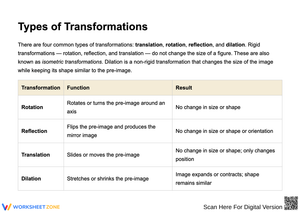
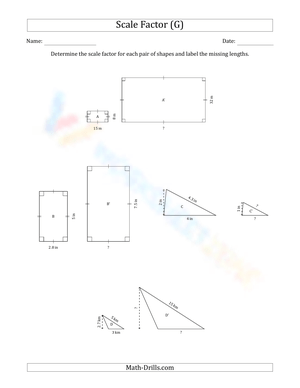
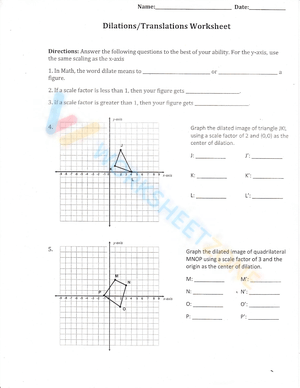
The set focuses on rigid transformations, which preserve size and shape. Dilations change size and fall into a separate category. The mixed-identification worksheets support contrast work: ask students to examine a figure pair where one figure is a dilation rather than a rigid transformation and explain why no translation, reflection, or rotation accounts for the change. That comparison sharpens the conceptual line between rigid and non-rigid transformations without requiring a separate dilation worksheet.
How often should teachers pull from this set during a transformation unit?
Spacing these transformations worksheets for 6th grade across the unit — one every day or two rather than several in a row — produces stronger retention than clustering practice. Daily use during the instructional sequence, followed by the mixed-review worksheets every few days in the second half of the unit, keeps all three transformation types active and reduces the forgetting that occurs when students don't revisit a skill for more than a week.













 Interactive Worksheet Maker
 Quiz Maker
 Word Search Maker
 Crossword Puzzle Maker
 Word Scramble Generator
 Sentence Scramble Generator
 Handwriting Worksheet Generator
 Name Tracing Generator
 Fill In The Blank Generator