




























Views
Downloads

Reflection of a Point Worksheet | Essential Grade 6-7 Math

Paste this activity's link or code into your existing LMS (Google Classroom, Canvas, Teams, Schoology, Moodle, etc.).
Students can open and work on the activity right away, with no student login required.
You'll still be able to track student progress and results from your teacher account.
This comprehensive math worksheet helps middle school students master the geometry of reflections on a coordinate plane. By focusing on the specific relationship between coordinates and axes, students learn to predict exactly where a point will land after a transformation. This resource ensures students move beyond simple guessing to applying mathematical rules for accuracy.
At a Glance
- Grade: 6-7 · Subject: Math
- Standard:
CCSS.MATH.CONTENT.6.NS.C.8— Solve problems by graphing points and finding distances in all four quadrants.- Skill Focus: Reflecting points across axes
- Format: 4 pages · 16 problems · Answer key included · PDF
- Best For: Coordinate geometry practice and formative assessment
- Time: 25–35 minutes
What's Inside
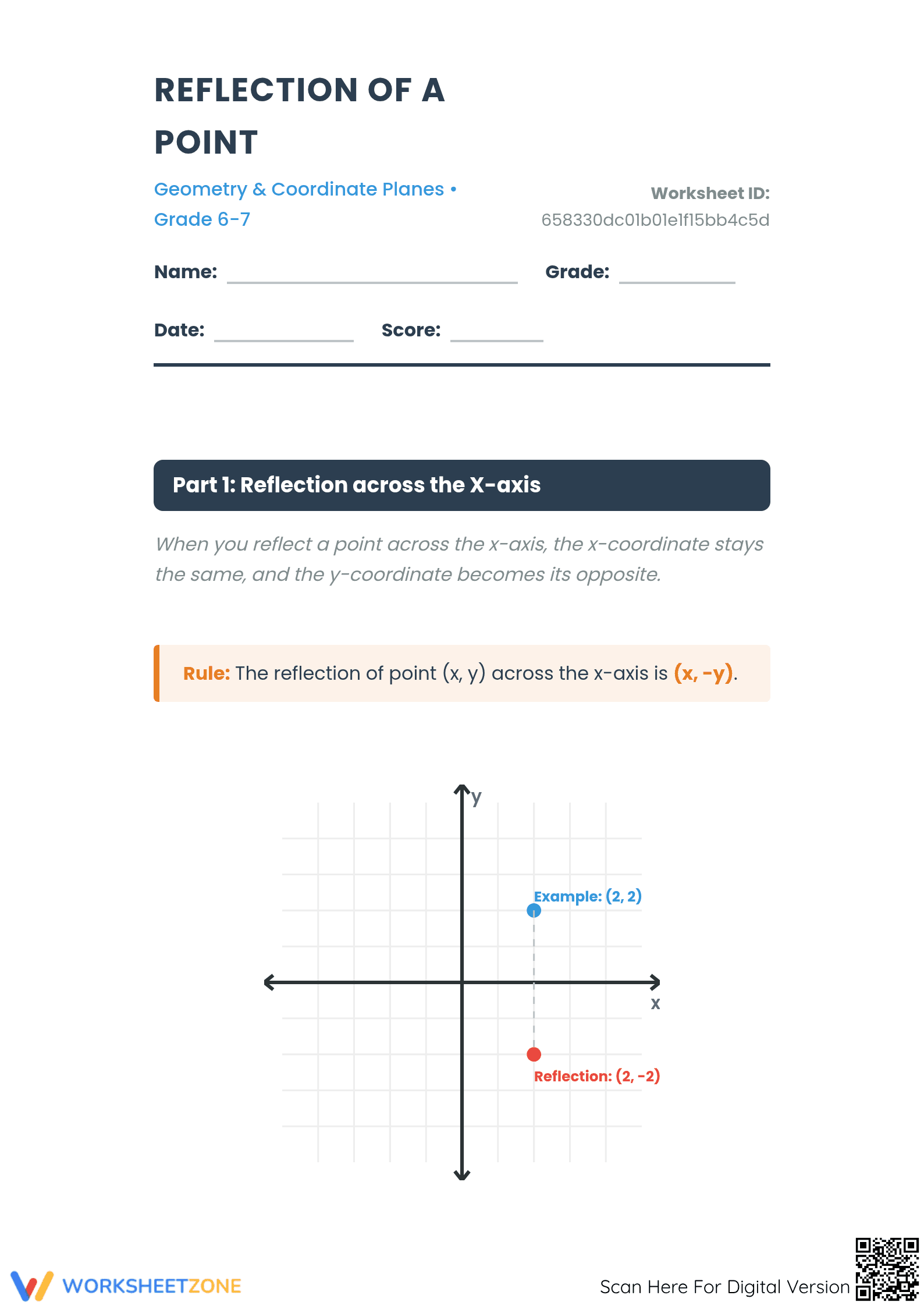
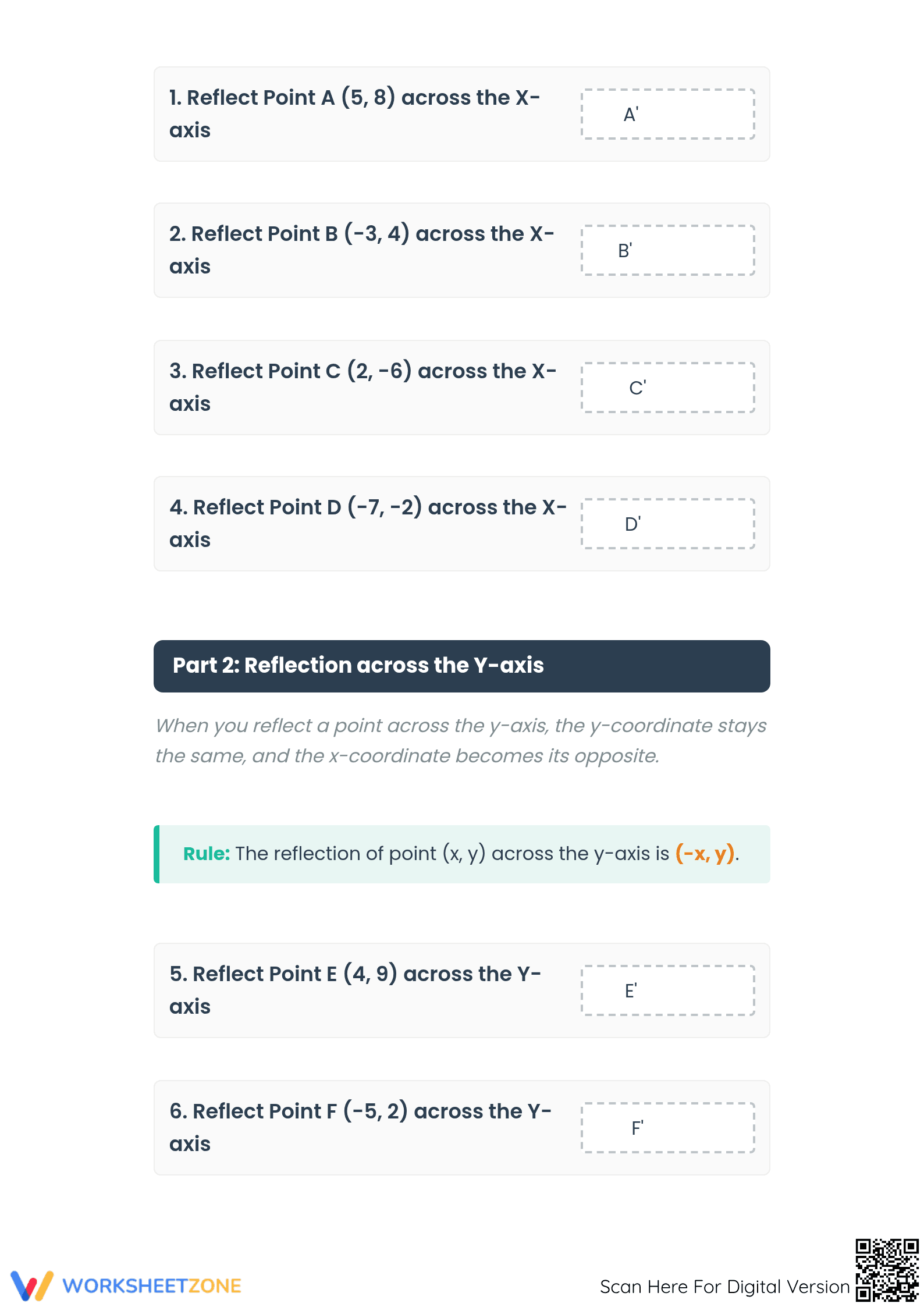
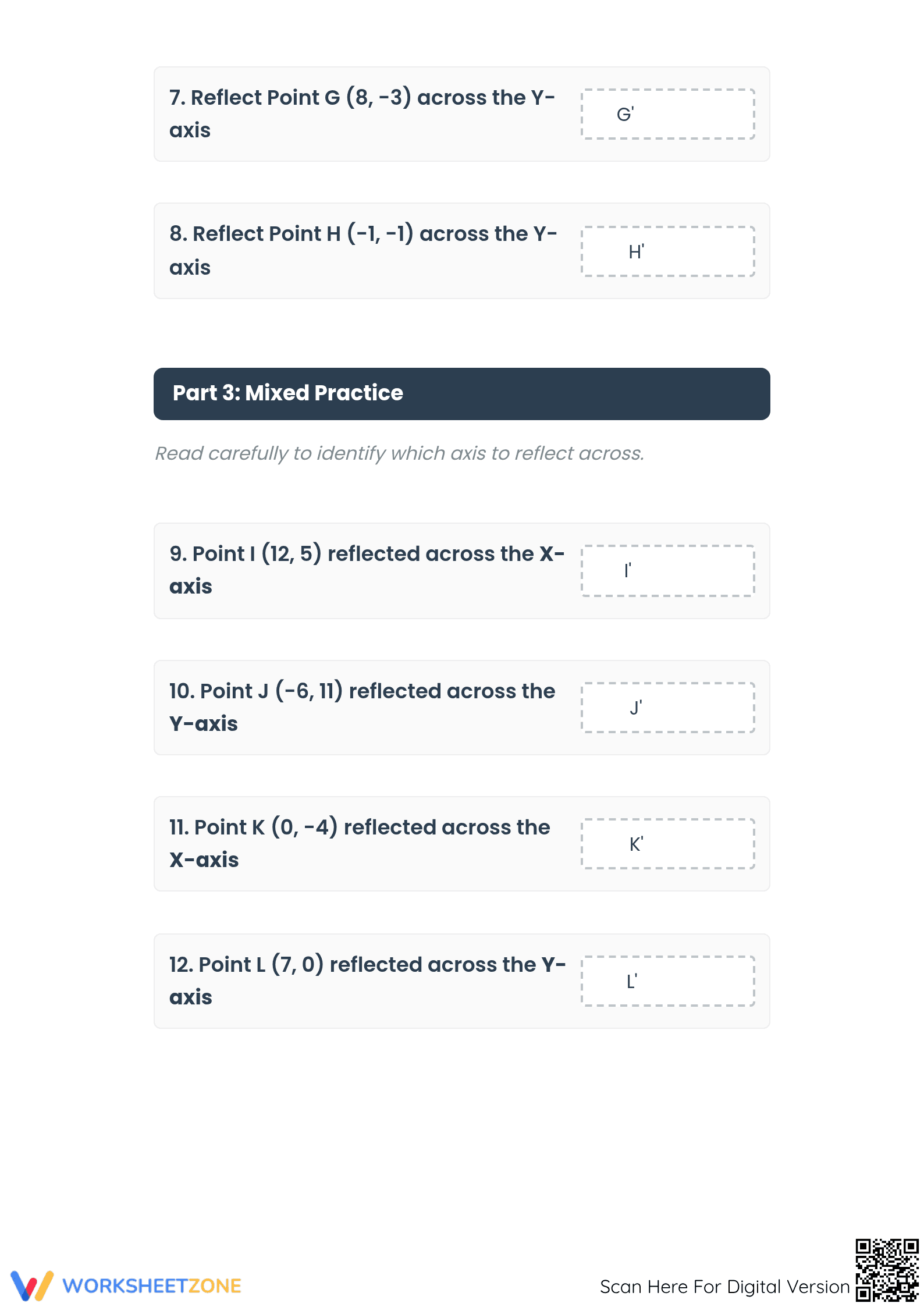
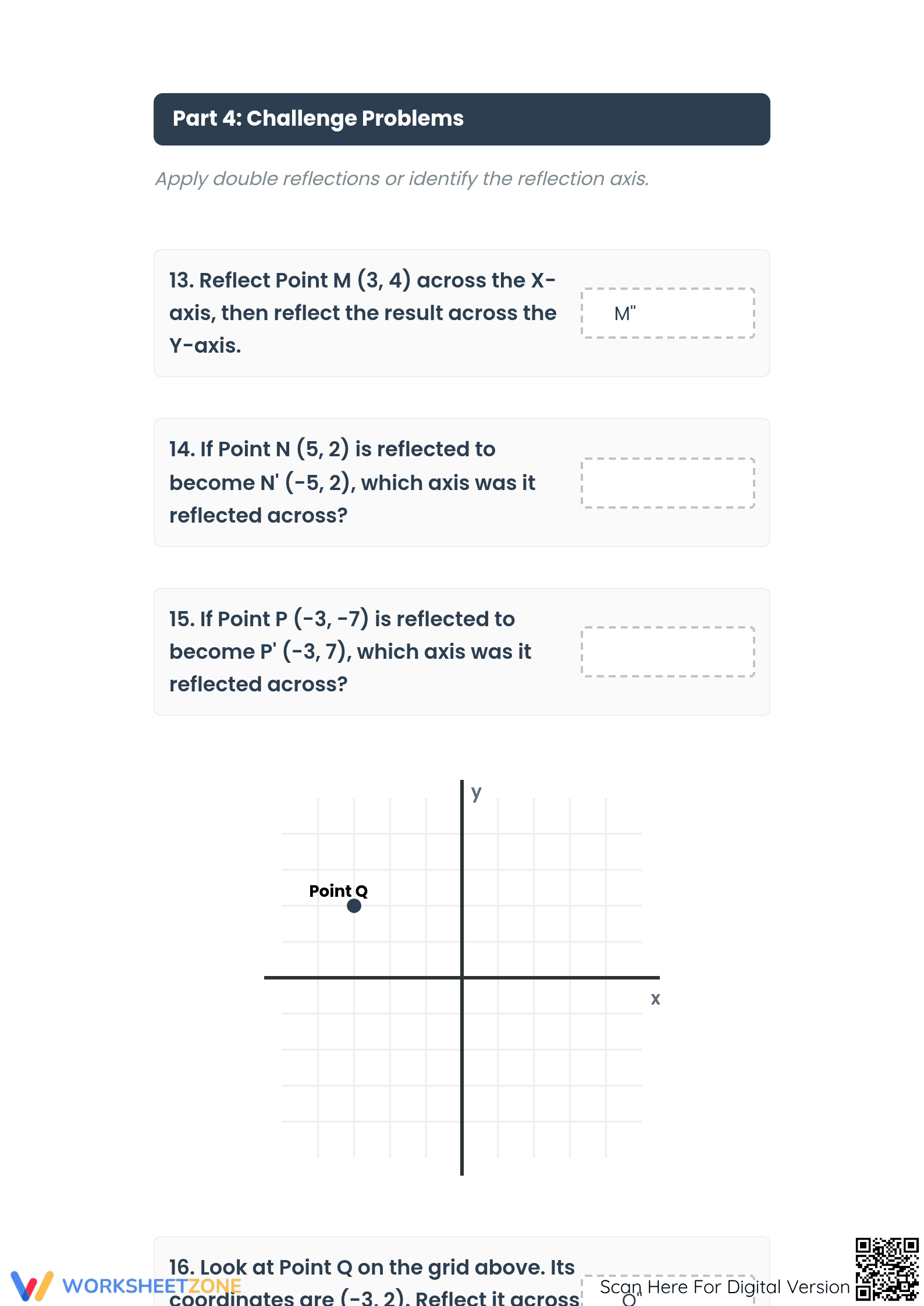
The 4-page PDF contains 16 structured problems divided into four distinct learning phases. It includes clear instructional headers that define the rules for reflecting across the x-axis (x, -y) and the y-axis (-x, y). The layout features a mix of coordinate identification, rule application, and visual graphing tasks, supported by a full answer key for immediate feedback.
Skill Progression
- Guided Practice: The first section provides 4 problems focused exclusively on the x-axis, accompanied by a visual example and a clearly stated rule to build initial confidence.
- Supported Practice: Section two transitions to y-axis reflections, providing 4 additional problems that require students to apply the inverse coordinate rule while maintaining the same structural support.
- Independent Practice: The final sections offer mixed practice and challenge problems, where students must identify the axis of reflection or perform double transformations without explicit prompts.
This gradual-release model follows the I Do, We Do, You Do instructional framework to ensure student mastery.
Standards Alignment
This resource is primary aligned to `CCSS.MATH.CONTENT.6.NS.C.8`: Solve real-world and mathematical problems by graphing points in all four quadrants of the coordinate plane. It also supports 8.G.A.3 by describing the effect of reflections on two-dimensional coordinates. Both standard codes can be copied directly into lesson plans, IEP goals, or district curriculum mapping tools.
How to Use It
Use this worksheet during the independent practice phase of a geometry lesson. It works exceptionally well as a formative assessment tool; teachers should observe if students are consistently changing the correct sign (x vs y) during the first 8 problems. Expect students to complete the full set in approximately 30 minutes.
Who It's ForThis is designed for 6th and 7th-grade students introduced to the four-quadrant coordinate system. It is an ideal pairing for an anchor chart on transformations or as a follow-up to a direct instruction lesson on symmetry and graphing data.
This instructional resource targets CCSS.MATH.CONTENT.6.NS.C.8, focusing on the geometric transformation of points across the x-axis and y-axis within a four-quadrant coordinate system. By requiring students to apply algebraic rules—specifically (x, -y) for horizontal reflections and (-x, y) for vertical reflections—the worksheet bridges the gap between visual spatial reasoning and abstract numerical manipulation. According to the RAND AIRS 2024 report on mathematics proficiency, structured practice in coordinate geometry is essential for developing the foundational fluency required for high school functions and advanced algebraic modeling. The worksheet provides 16 distinct tasks that progress from rule-based application to complex problem-solving, including identifying axes of reflection from given image points. This systematic approach ensures that learners internalize the relationship between sign changes and spatial orientation. Educators can utilize this standalone PDF to provide targeted intervention or as a summative check for mastery in middle school geometry units.


