


























Views
Downloads


Printable Character Traits Worksheet | Grades 3-6
Paste this activity's link or code into your existing LMS (Google Classroom, Canvas, Teams, Schoology, Moodle, etc.).
Students can open and work on the activity right away, with no student login required.
You'll still be able to track student progress and results from your teacher account.
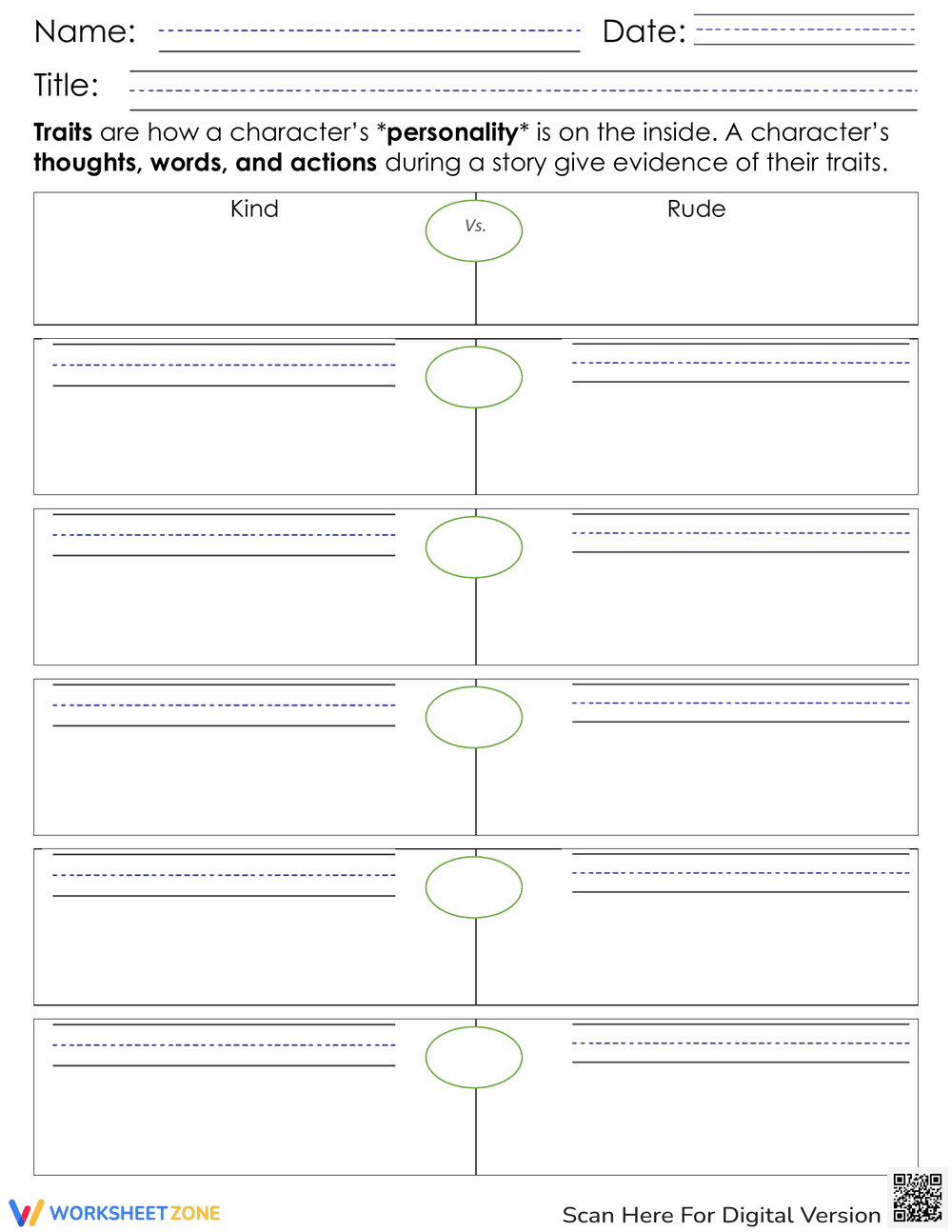
This printable character traits worksheet helps students in grades 3 to 6 analyze personality dynamics by comparing opposing behaviors. Students identify fifteen distinct trait pairs and apply their understanding through a structured character analysis writing prompt. This resource strengthens reading comprehension and vocabulary acquisition by encouraging students to examine how actions reveal internal motivations.
At a Glance
- Grade: Grades 3–6 · Subject: English Language Arts (ELA)
- Standard:
CCSS.ELA-LITERACY.RL.3.3— Describe how character actions and traits influence story events- Skill Focus: Opposing character traits and textual evidence
- Format: 3 pages · 15 problems · Answer key not included · PDF
- Best For: Independent practice and reading response activities
- Time: 20–30 minutes
This three-page PDF features a clean layout to minimize distractions. Page one defines how thoughts, words, and actions reveal personality, providing a completed 'Kind' versus 'Rude' example. The remaining sections contain fourteen blank comparison templates for student-generated trait pairs. The final page concludes with a writing prompt requiring students to analyze a character and write supporting evidence.
Zero-Prep Workflow
This resource requires zero teacher preparation. Follow these three steps:
- Print (1 minute): Print copies for your class. The black-and-white design ensures fast copying.
- Distribute (1 minute): Hand out packets. The visual example allows students to begin immediately.
- Review (5 minutes): Grade responses using the final writing prompt as a quick formative check.
With under two minutes of setup, this worksheet is ideal for emergency sub plans or homework.
Standards Alignment
This activity aligns with CCSS.ELA-LITERACY.RL.3.3, where students describe characters and explain how their actions contribute to events. By brainstorming opposing traits, students analyze character motivations. It also supports vocabulary development under CCSS.ELA-LITERACY.L.3.5. Both standard codes can be copied directly into lesson plans, IEP goals, or district curriculum mapping tools.
How to Use It
Assign this worksheet during or after direct instruction on characterization. During a novel study, use it as a reading response task to map opposing characters. Alternatively, use it as a pre-writing organizer before students draft narrative stories. For formative assessment, observe students completing the final writing prompt to evaluate their evidence-based writing. Completion takes 20 to 30 minutes.
Who It's For
This resource is designed for students in grades 3 through 6. It is easily differentiated; struggling writers can focus on fewer trait pairs, while advanced learners can use complex vocabulary. This worksheet pairs naturally with any short story or characterization anchor chart.
This character analysis resource targets the development of critical reading skills aligned with CCSS.ELA-LITERACY.RL.3.3. By prompting students to identify opposing character traits and justify their choices with written evidence, the worksheet reinforces the connection between character actions and internal motivations. According to research by Fisher & Frey (2014) on the gradual release of responsibility, structured graphic organizers combined with independent writing prompts help scaffold student transition from basic comprehension to deeper literary analysis. The layout provides 15 structured opportunities for students to practice vocabulary categorization before applying their knowledge to a synthesis writing task. This dual approach ensures that students build both the vocabulary necessary to describe complex characters and the writing stamina required to explain character development in longer texts. Educators can confidently integrate this tool into ELA units to support evidence-based writing and character analysis.


