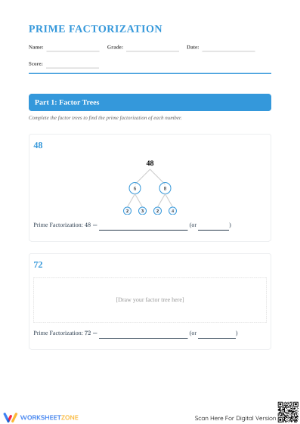
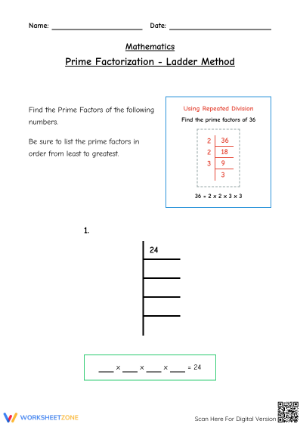
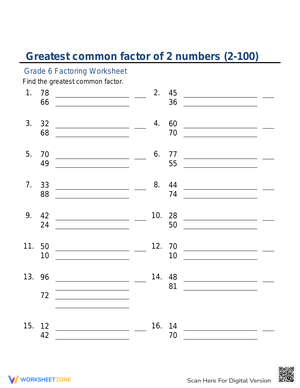
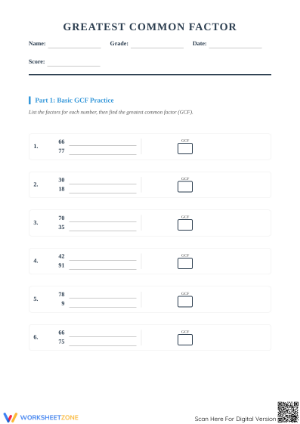
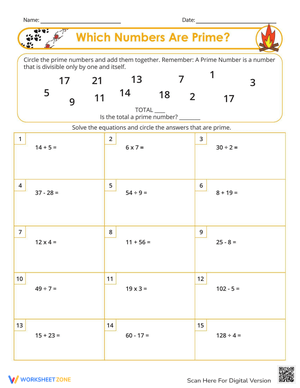
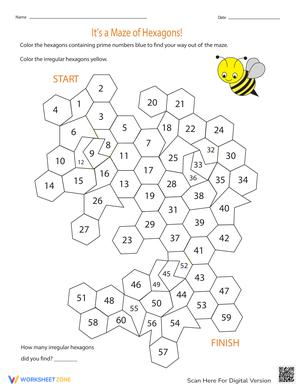
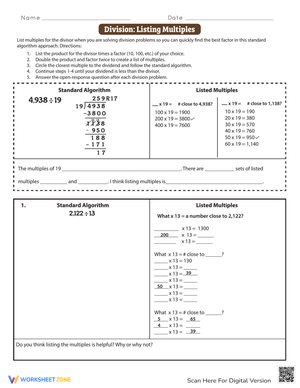
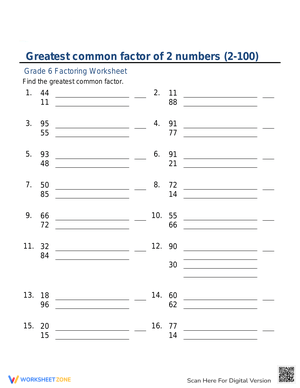
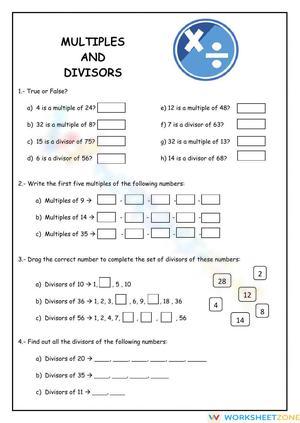
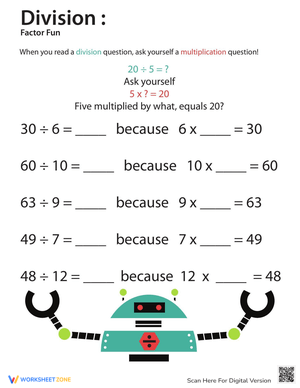
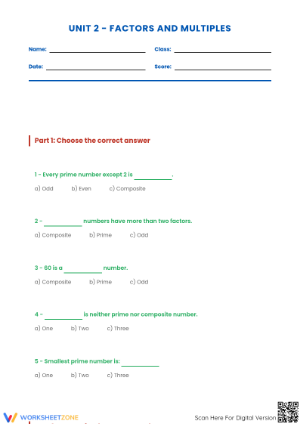
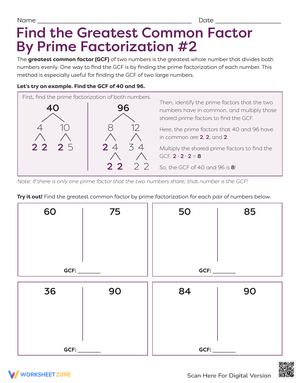
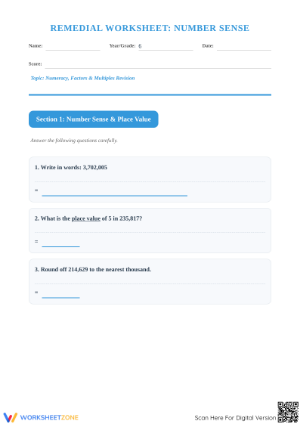
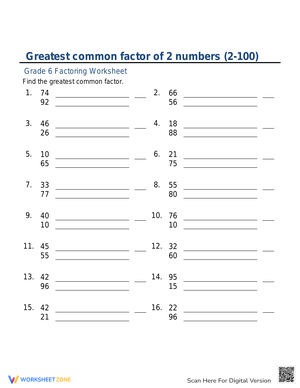
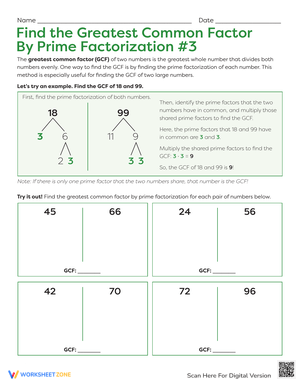
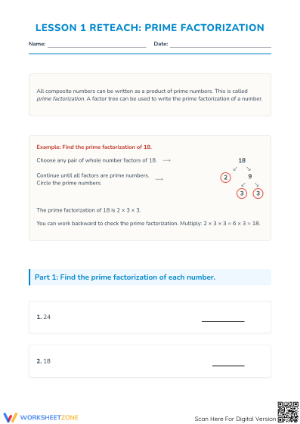
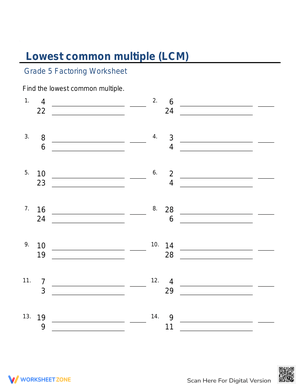
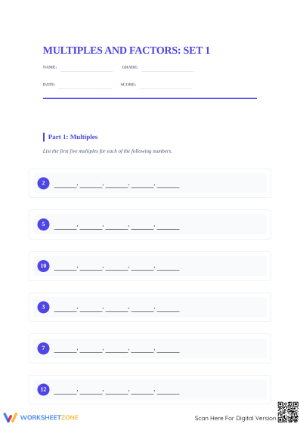
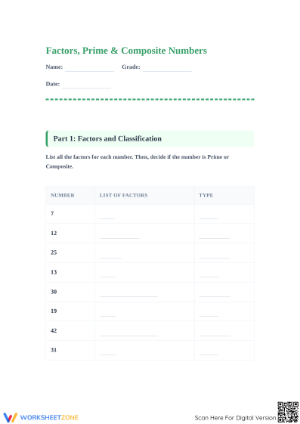
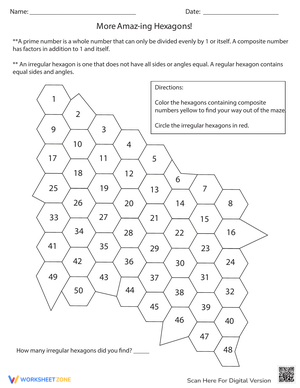
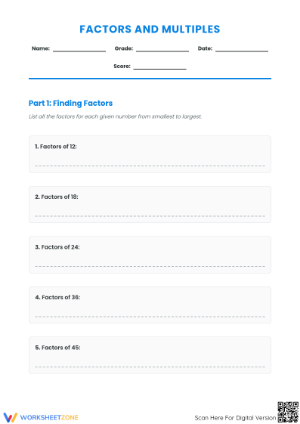
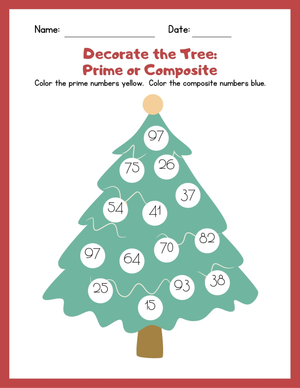
These 5th grade number theory pdf worksheets give teachers ready-to-print practice across the number relationships grade 5 students revisit most — factors, multiples, prime and composite classification, divisibility rules, greatest common factor, and least common multiple. The resources are available as PDF downloads on Worksheetzone, which means pulling a focused warm-up worksheet or a targeted mixed-review set takes seconds rather than a planning period.
The Specific Skills These Worksheets Target
Number theory at this grade covers a tight cluster of ideas that build on each other more than they appear to at first glance. Factor pairs feed directly into prime and composite classification. Divisibility rules speed up factor-listing. GCF and LCM tasks only run cleanly on top of solid factor and multiple fluency. Each worksheet in the set stays narrowly focused on one of those subskills, which makes it easier to assign the right practice at the right point in a unit without hunting across unrelated resources.
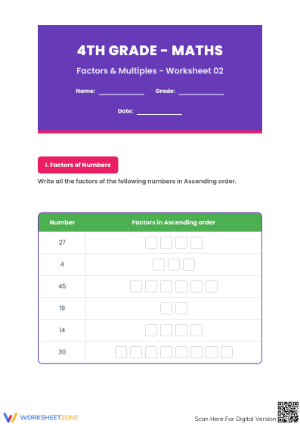
- Factor pairs: Students list all pairs for a given number and verify they have found every one — a discipline that matters more as numbers move past 30 or 40.
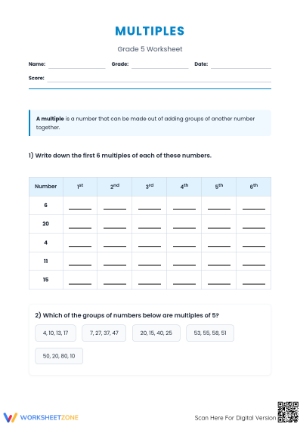
- Multiples: Generating and comparing sequences of multiples builds the fluency that GCF and LCM tasks depend on.
- Prime and composite numbers: Classification items ask students to justify answers using factor structure rather than label recall.
- Divisibility rules: Short pattern-based tasks help students work through factor identification faster before moving into GCF and LCM problems.
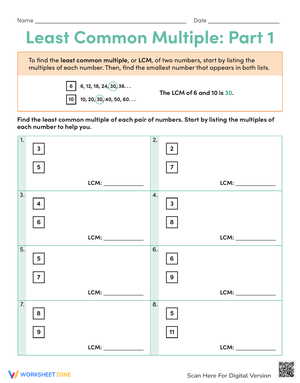
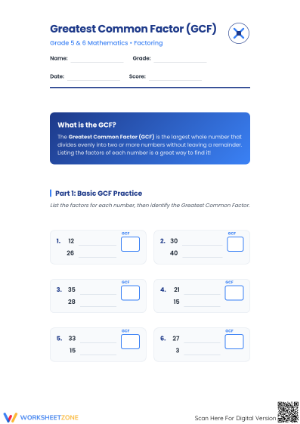
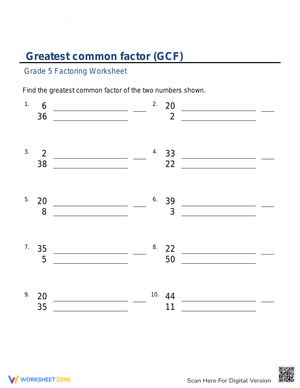
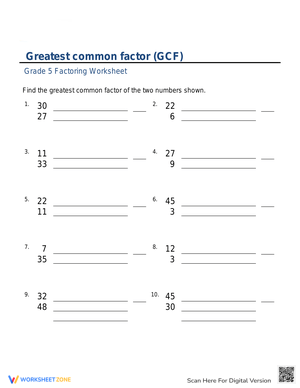
- Greatest common factor and least common multiple: The most demanding worksheets in the set, best assigned once students show reliable accuracy on factor pairs and multiples independently.
Number Theory Errors That Surface Repeatedly in Student Work
The most consistent error in factor work is the missing pair. Students listing factor pairs of 36 will typically find 1 and 36, 2 and 18, 4 and 9 — and stop there, skipping 3 and 12 entirely and missing 6 and 6. They stop because they have several pairs written down, not because they have actually checked systematically. Each worksheet that targets factor pairs builds the habit of organized verification, which is worth making explicit the first time students work through one of them.
The confusion between factors and multiples is nearly universal in grade 5. Students who list "the multiples of 6 are 1, 2, 3, and 6" have mixed the concepts from the start, and no amount of practice resolves that without direct instruction alongside the worksheet. Number 1 is a separate and reliable trouble spot: students who correctly classify 17 as prime and 12 as composite will still write "1 is prime" without pausing. That misconception calcifies quickly if it goes unaddressed. When 5th grade number theory pdf worksheets surface these patterns across a short set of items, teachers have the specific evidence they need to plan a five-minute reteach before the class moves on.
Standard Alignment
The skills in this collection align to Common Core State Standards for Mathematics standard 4.OA.B.4, which asks students to find factor pairs for whole numbers from 1 to 100, identify multiples of single-digit numbers, and classify whole numbers in that range as prime or composite. That upper boundary of 100 is a practical planning detail — tasks that push well past it shift cognitive attention toward computation rather than number relationships, which changes what the practice is actually measuring. Teachers who reach for 5th grade number theory pdf worksheets to support review of this standard should look for items that stay in that range for factor pair and classification work, then step up difficulty through GCF and LCM tasks rather than through larger numbers.
Illustrative Mathematics approaches 4.OA.B.4 partly through equal-row rectangle area models, connecting factor pairs to physical arrangement. That lens is useful diagnostically: a student who can sketch all the rectangles for 24 but still marks it as prime likely has a vocabulary gap rather than a factor reasoning gap — a distinction that changes the reteaching response entirely.
Using This Set Across a Typical Teaching Week
The sharpest use of these resources is as formative tools, not filler. A factor-pair worksheet assigned at the start of a number theory unit takes about eight minutes and shows which students are listing pairs methodically versus which are guessing and stopping early. That information shapes the next twenty minutes of instruction more reliably than a pre-assessment survey. For intervention groups, sequencing matters: factor pairs first, prime and composite classification next, then GCF or LCM only after students show dependable accuracy with the earlier skills.
- For warm-ups, choose a multiples or factor-pair worksheet and use student responses to decide whether the class is ready to move into classification or GCF work.
- For exit tickets, assign four to six items from a prime/composite or GCF worksheet rather than the full resource. That sample is enough to see whether the concept landed.
- For math centers, keep each worksheet focused and completable within one rotation. Students who finish early can write one sentence explaining why their answer is correct.
- For substitute plans, the PDF format and clear item structure mean these worksheets need no additional materials or lengthy verbal setup.
Adjusting the Work for Students at Different Points in the Unit
The most practical way to differentiate with this set is to control entry point. A student still building multiplication fluency needs a factor-pair worksheet that stays with numbers less than 50. A student who can list all twelve factor pairs of 48 in under two minutes is ready for GCF tasks with two- or three-number sets, or for problems that ask them to apply LCM to a comparison scenario and explain the reasoning. That range of difficulty exists within the collection, and selecting the right worksheet takes far less time than modifying a single resource to serve both groups simultaneously.
For students who need more support, pairing a prime/composite worksheet with a multiplication chart lets them verify factor pairs before answering classification questions — a process that keeps the mathematical reasoning intact without stripping out the demand. For students moving faster, ask them to write one sentence per item: "24 is composite because it has more than two factors: 1, 2, 3, 4, 6, 8, 12, and 24." That extension adds genuine thinking and requires nothing beyond the worksheet itself. When 5th grade number theory pdf worksheets are sorted by subskill rather than bundled into one undifferentiated packet, selecting the right level of work for a specific student becomes a quick decision rather than a planning project.
Frequently Asked Questions
What number theory topics do these worksheets cover?
The collection addresses factor pairs, multiples, prime and composite classification, divisibility rules, greatest common factor, and least common multiple. Those skills cover the core number theory work grade 5 students revisit most in review and intervention contexts, and they connect directly to the fraction reasoning that follows in later units.
How do these worksheets function as formative assessment tools?
Because each worksheet stays within a single subskill, teachers can read results quickly. A student who misses most prime/composite items but answers factor-pair questions accurately likely needs vocabulary correction rather than a full reteach of factor structure. That clarity is harder to get from a mixed-review assignment where errors could be coming from several different sources at once.
Are these worksheets suited to intervention group settings?
Yes, and the single-subskill structure makes them especially well-suited there. Start with factor pairs and multiples, confirm accuracy, then move into prime and composite classification before introducing GCF or LCM. Moving to GCF before a student can reliably list the factor pairs of a two-digit number produces confusion that looks like a concept problem but is actually a fluency gap — two very different instructional responses.
How do these worksheets fit alongside other instructional materials?
Many teachers use these resources alongside visual and discussion-based activities — rectangle area models drawn during direct instruction, factor trees, partner number talks — and reserve the PDF worksheets for independent practice and formative check-ins. Completed worksheets also fit well in student data folders, where teachers can track accuracy across several weeks to see whether foundational fluency is building or holding steady.














 Interactive Worksheet Maker
 Quiz Maker
 Word Search Maker
 Crossword Puzzle Maker
 Word Scramble Generator
 Sentence Scramble Generator
 Handwriting Worksheet Generator
 Name Tracing Generator
 Fill In The Blank Generator




 BACK TOSCHOOL