


























Views
Downloads
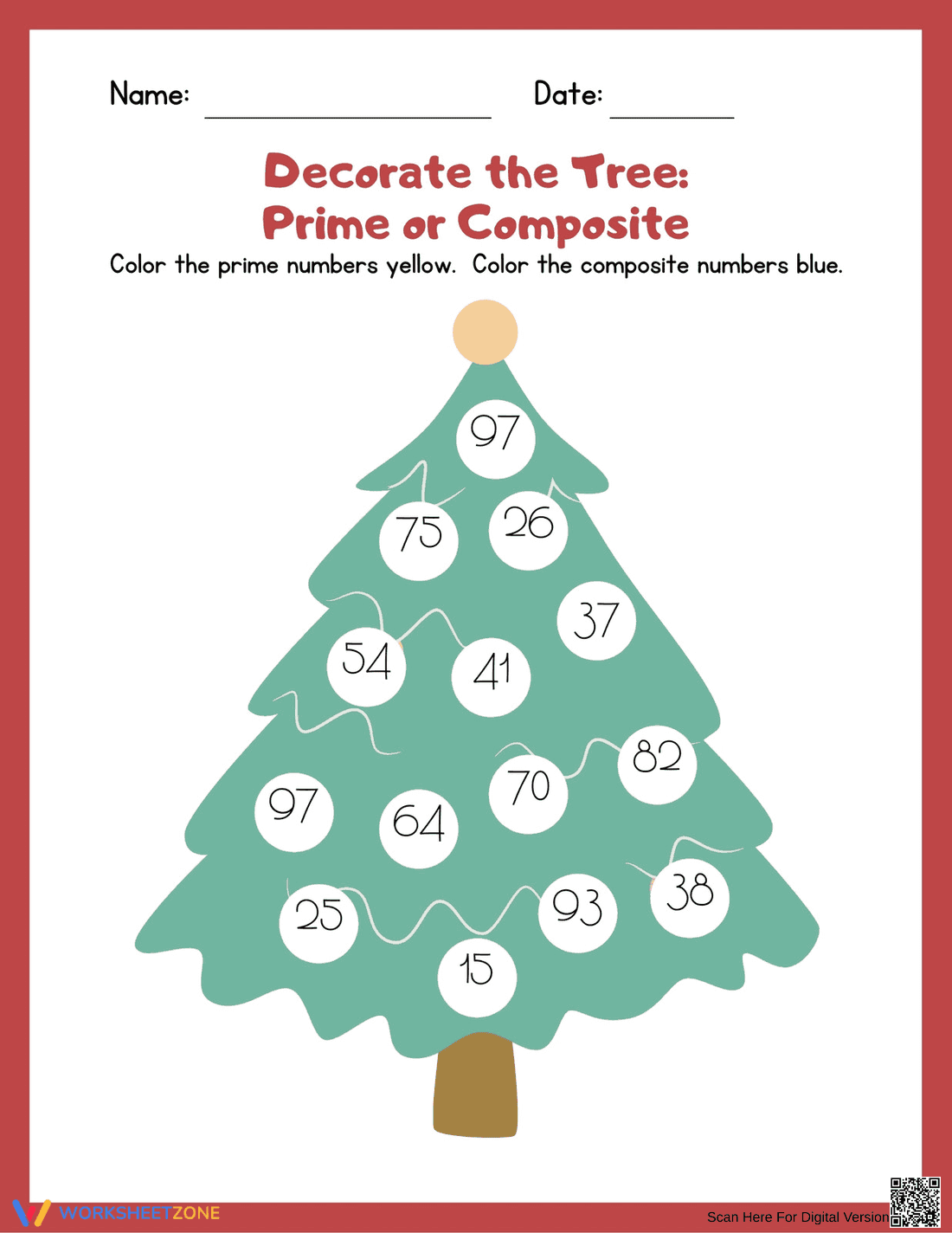

Printable Christmas Prime and Composite Math Worksheet
Paste this activity's link or code into your existing LMS (Google Classroom, Canvas, Teams, Schoology, Moodle, etc.).
Students can open and work on the activity right away, with no student login required.
You'll still be able to track student progress and results from your teacher account.
This printable Christmas math worksheet provides practice identifying prime and composite numbers for fourth-grade students. By coloring fourteen festive ornaments based on number properties, learners reinforce their understanding of factors. This seasonal activity transforms standard math drills into an enjoyable holiday exercise that builds essential algebraic thinking skills.
At a Glance
- Grade: 4 · Subject: Mathematics
- Standard:
CCSS.MATH.CONTENT.4.OA.B.4— Determine whether a given whole number up to 100 is prime or composite- Skill Focus: Prime vs. Composite Numbers
- Format: 1 page · 14 problems · Coloring Activity · PDF
- Best For: Holiday math review and independent practice
- Time: 15–20 minutes
This single-page PDF features a Christmas tree decorated with 14 ornaments, each containing a whole number between 15 and 97. Clear instructions direct learners to color prime numbers yellow and composite numbers blue. The clean layout provides a clear visual structure, making it easy for students to work independently without overwhelming text.
Zero-Prep Workflow
This holiday activity requires absolutely zero teacher preparation. First, print the single-page PDF for your class, taking less than one minute. Second, distribute the sheets along with yellow and blue crayons, taking another minute. Finally, review the completed trees visually. With a total teacher setup time under two minutes, this worksheet serves as an excellent emergency sub plan or morning work option during the hectic winter season.
Standards Alignment
This activity aligns directly with Common Core Standard CCSS.MATH.CONTENT.4.OA.B.4, requiring students to determine whether a given whole number up to 100 is prime or composite. By analyzing numbers like 41, 75, and 97, students apply divisibility rules. Both standard codes can be copied directly into lesson plans, IEP goals, or district curriculum mapping tools.
How to Use It
Incorporate this worksheet after direct instruction on factors. It works exceptionally well as a formative assessment tool; walk around to observe if students recognize that numbers ending in five, like 15 and 25, are composite. Expect students to complete the 14 problems within 15 to 20 minutes, making it an ideal transition activity before holiday breaks.
Who It's For
This resource is tailored for fourth-grade students mastering number theory, but also serves as a review for fifth graders. For differentiation, pair this worksheet with a hundreds chart to support struggling learners as they determine factor pairs. It naturally pairs with a direct instruction lesson on divisibility rules to reinforce conceptual understanding.
According to research from EdReports 2024, integrating seasonal, highly contextualized visual activities into mathematics instruction significantly increases student engagement and retention of abstract concepts like number theory. When students actively categorize numbers using color-coded systems, they build stronger cognitive pathways between procedural fluency and conceptual understanding. This worksheet targets the critical fourth-grade milestone of distinguishing between prime and composite numbers within 100, a foundational skill required for future fractional computation and algebraic factoring. By limiting the task count to 14 focused problems, the resource prevents cognitive overload while ensuring rigorous practice aligned to CCSS.MATH.CONTENT.4.OA.B.4. Teachers can confidently utilize this mathematically sound, zero-prep resource to gather immediate formative data while maintaining high student motivation during holiday classroom periods, ensuring that instructional time remains highly productive and aligned with state standards.


