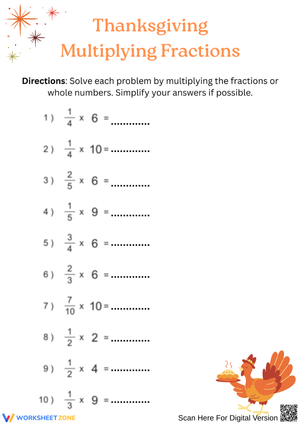
These 5th grade multiply fractions by whole numbers printable worksheets resources give teachers a focused collection of practice materials for one of the trickiest conceptual leaps in upper elementary math — the moment students must stop thinking of fractions as static objects and start treating them as quantities that can be scaled. The set moves from visual fraction models through the standard algorithm, improper fraction conversion, and multi-step word problems, covering the full arc from first introduction to procedural fluency.
What Students Practice Across the Set
Each worksheet targets a specific layer of the skill rather than mixing everything into one undifferentiated problem set. The progression looks like this:
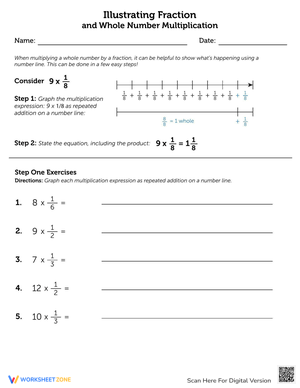
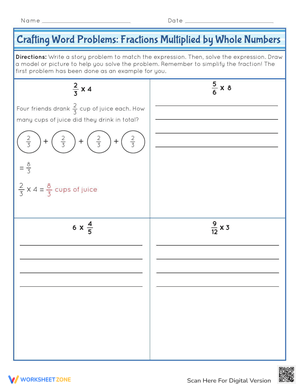
- Number line models where students mark equal-sized hops of a given fraction to land on the product — four jumps of 2/3, for instance, landing at 8/3
- Area model problems where students shade a rectangle to show a fraction of a whole quantity
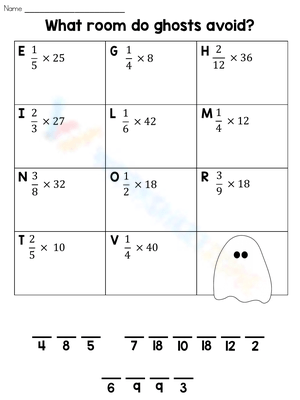
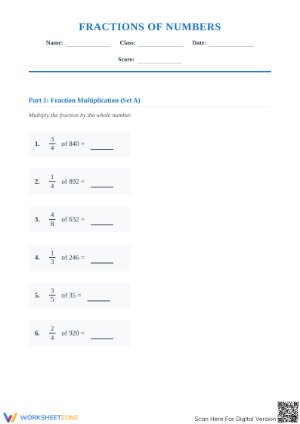
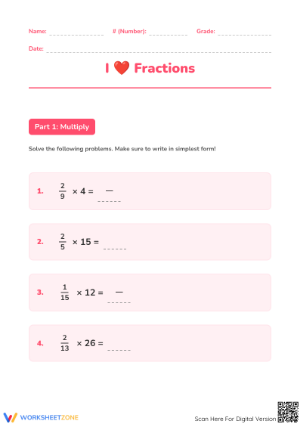
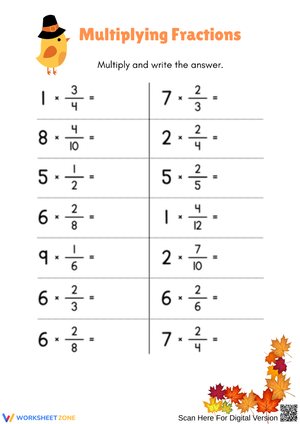
- Algorithm practice with the whole number rewritten as a fraction over one, so students can see exactly which values are being multiplied together
- Improper fraction conversion — computing the product and then rewriting it as a mixed number in lowest terms
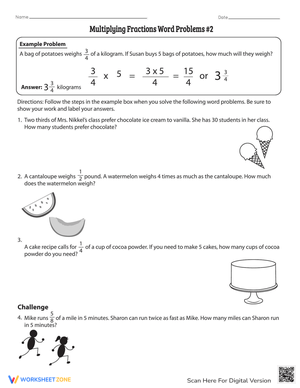
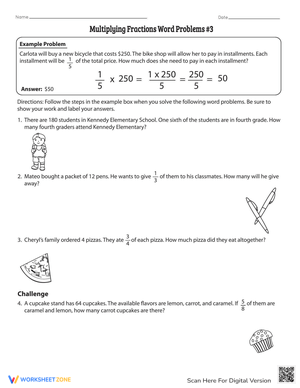
- Word problems requiring students to identify the multiplication structure in the text before they ever write an equation
The word problem worksheets deserve specific attention. A problem framed as "a recipe calls for 3/4 cup of oats per batch — how many cups are needed for 6 batches?" looks simple, but students who can compute 6 × 3/4 without hesitation will still stall when asked to write the equation if they haven't practiced reading problems of this type repeatedly. These worksheets put that reading work directly in students' hands.
Errors Worth Anticipating Before the Unit Begins
The single most predictable mistake is multiplying both the numerator and the denominator by the whole number. A student who computes 3 × 1/2 and writes 3/6 has applied the logic of equivalent fractions — multiply top and bottom by the same value — to a context where that logic does not apply. What makes the error difficult to dislodge is that it feels internally consistent to the student. It's not carelessness; it's the wrong rule applied with confidence.
One correction that actually works: require students to rewrite the whole number as a fraction before multiplying. When 3 becomes 3/1, the problem reads (3/1) × (1/2), and the separate multiplication of numerators and denominators becomes explicit — 3 × 1 on top, 1 × 2 on the bottom, giving 3/2. Students who go through that rewriting step consistently almost never write 3/6. Several worksheets in this set build that step in as a required intermediate line, not an optional one.
A secondary error appears during conversion. Students who correctly arrive at 15/8 will sometimes write the mixed number as 1 7/15 instead of 1 7/8 — the denominator slips. It's a working-memory issue more than a conceptual one; they've just performed a division, and the divisor no longer feels like it belongs in the answer. Catching this pattern in a small group during the first week is far easier than correcting it after it has become habit.
Standard Alignment
CCSS 5.NF.B.4 requires students to apply and extend previous understandings of multiplication to multiply a fraction or whole number by a fraction. The standard has two explicit components: representing the product using visual fraction models, and interpreting multiplication through story contexts. These worksheets address both. Visual model problems appear on the earlier worksheets in the sequence; algorithm-focused practice and word problems appear on the later ones. The standard sits within the Numbers and Operations—Fractions domain and feeds directly into 5.NF.B.5, where students begin reasoning about multiplication as a form of scaling — so the fluency built here carries real weight later in the year.
Building These Worksheets Into Your Lesson Sequence
The visual model worksheets work best in the first few days of the unit, immediately after the opening whole-group lesson. At that stage they function better as guided practice than independent work. Sitting with a small group while students draw repeated hops on the number line shows you within a few minutes who understands that the denominator represents piece size rather than piece count — and who is just copying a procedure they don't yet own.
Once students are ready for the algorithm, the rewriting-as-a-fraction worksheets make strong material for the 8–10 minutes after morning meeting. The problems are short enough to complete without rushing, and doing a handful of them across several consecutive mornings builds the procedural memory that later frees up cognitive space for harder word problems. A student who has to think hard about the algorithm while also decoding a word problem is managing two demanding tasks at once; automaticity with the calculation removes one of them.
The 5th grade multiply fractions by whole numbers printable worksheets set also holds up well as a review tool after the unit closes. One worksheet in a Friday warm-up rotation every two or three weeks keeps the skill active without requiring a full re-teach.
Adapting the Worksheets for Different Student Levels
Students who are still unsteady on foundational fraction concepts — what the denominator represents, how to read a number line — need the visual model worksheets with the number line pre-labeled rather than blank. Having them draw the hops without also setting up the number line removes one layer of cognitive demand and keeps the focus on the multiplication structure itself.
For students ready to move beyond the core standard, the multi-step word problem worksheets provide genuine extension. A problem that requires multiplying a fraction by a whole number and then comparing the product to another quantity pulls in the reasoning 5.NF.B.5 asks for, without introducing entirely new content. Those students can work through that worksheet while the rest of the class consolidates the algorithm.
One honest limitation: students who freeze when they encounter an unfamiliar word problem context — especially if the scenario involves something like carpentry or cooking that doesn't connect to their experience — sometimes stop before they've identified the operation. For those students, a brief whole-group read-aloud of the word problem before releasing them to work independently tends to help more than any modification to the worksheet itself.
Frequently Asked Questions
Why does the denominator stay the same when multiplying a fraction by a whole number?
The denominator names the size of each piece. When you compute 4 × 2/3, you are counting four groups of two-thirds. The thirds don't get larger or smaller — only the count of them increases. Having students write the repeated addition sentence (2/3 + 2/3 + 2/3 + 2/3 = 8/3) directly beside the multiplication on their worksheet makes this visible in a way that verbal explanation alone rarely does. The denominator stays thirds because no operation changed the size of a third.
Where does this skill typically fall in a 5th-grade curriculum map?
Most curriculum sequences place fraction multiplication in the second or third quarter, after students have worked through fraction addition and subtraction with unlike denominators (5.NF.A.1). It almost always precedes fraction-by-fraction multiplication and decimal operations. By the time students reach this skill, they should be comfortable converting between improper fractions and mixed numbers. If they aren't, that conversion work needs to run alongside the multiplication practice rather than waiting until later.
Can advanced 4th graders use these worksheets after finishing 4.NF.B.4?
The 5th grade multiply fractions by whole numbers printable worksheets set is written to 5th-grade expectations, which means the later worksheets include improper fraction conversion and multi-step word problems that go beyond what 4.NF.B.4 typically addresses. A strong 4th grader finishing an early fraction multiplication unit could work through the visual model and basic algorithm worksheets productively, but the word problem and mixed-review worksheets assume a readiness level that most 4th graders won't have reached yet.
How is the set organized?
The worksheets follow a skill progression — visual models first, then the standard algorithm with the whole-number-as-fraction step, then word problems, then mixed review. Each worksheet focuses on one layer of the skill. That structure lets teachers assign the worksheet that fits the current lesson rather than working through the entire set in order. The 5th grade multiply fractions by whole numbers printable worksheets resources are meant to be pulled selectively, not assigned as a single packet from start to finish.














 Interactive Worksheet Maker
 Quiz Maker
 Word Search Maker
 Crossword Puzzle Maker
 Word Scramble Generator
 Sentence Scramble Generator
 Handwriting Worksheet Generator
 Name Tracing Generator
 Fill In The Blank Generator




 BACK TOSCHOOL