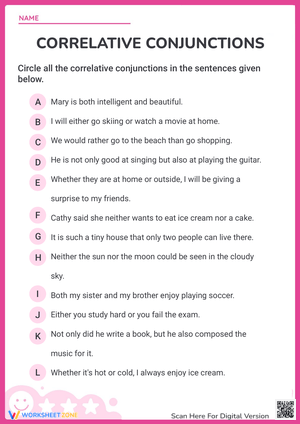
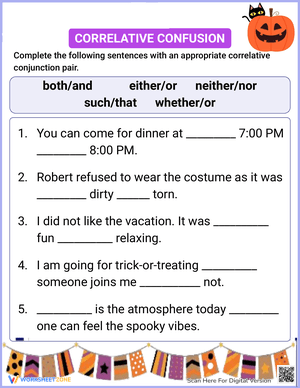
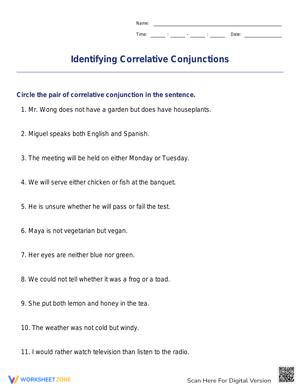
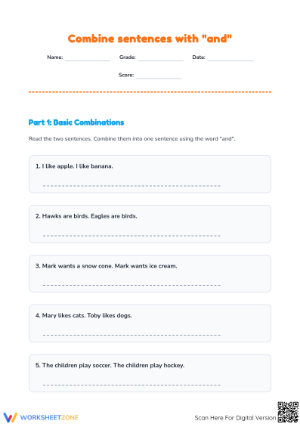
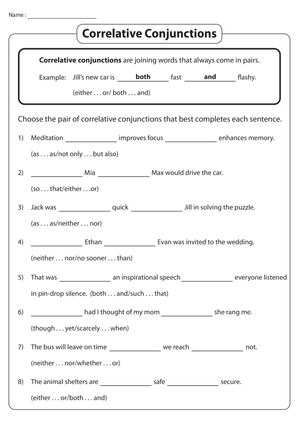
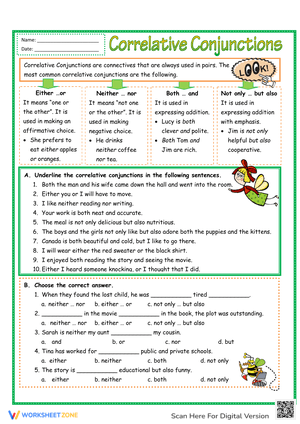
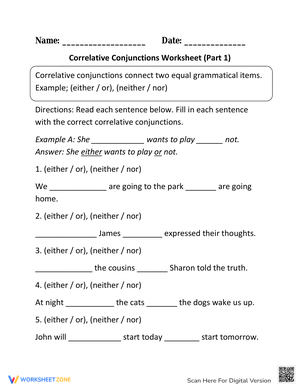
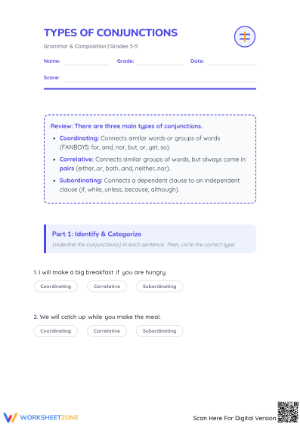
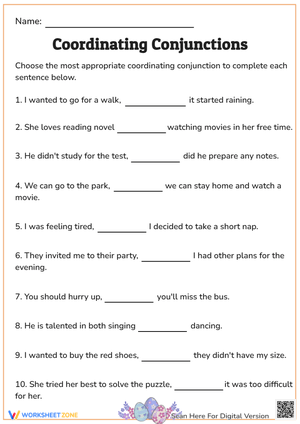
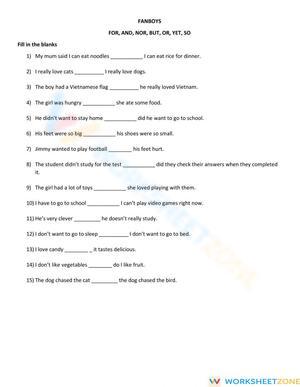
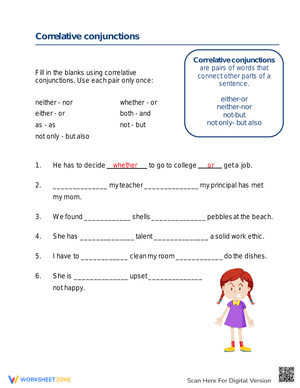
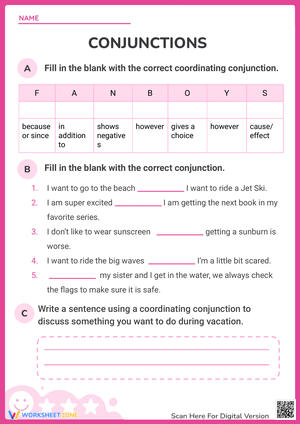
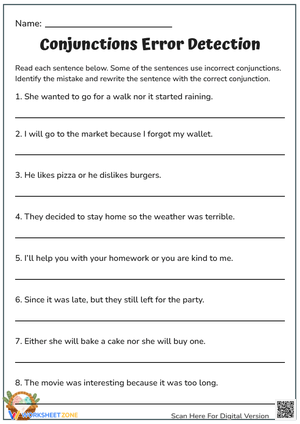
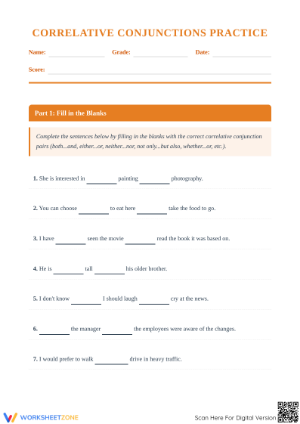
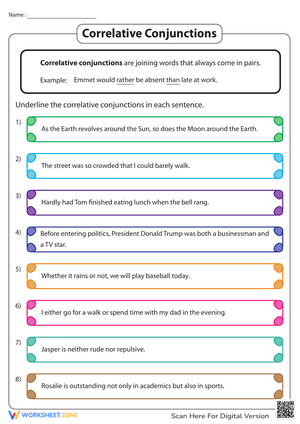
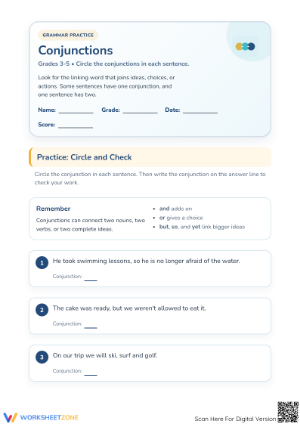
These conjunctions printable worksheets for 5th grade give teachers a targeted way to check whether students are making real sentence decisions — not just circling a connector and moving on. Each worksheet focuses on the kind of thinking students need during actual drafting and revision: choosing a conjunction that shifts meaning, combining shorter sentences, and explaining why one word fits a clause relationship better than another.
Concepts Each Worksheet Targets
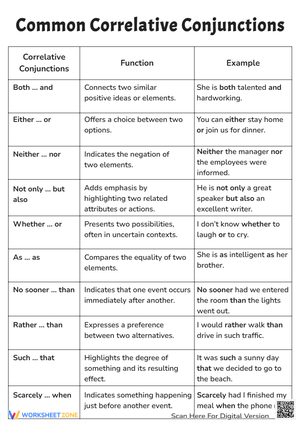
The set addresses both coordinating and subordinating conjunctions without turning each worksheet into a grammar reference page. Students move through tasks that require them to read the relationship between two ideas first — addition, contrast, time, cause, or condition — then select or apply a conjunction that makes that relationship explicit. That sequencing matters because students who skip the meaning step almost always default to and, regardless of what the sentence actually calls for.
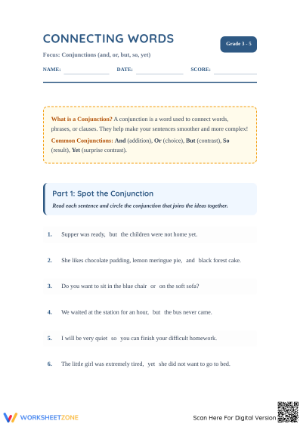
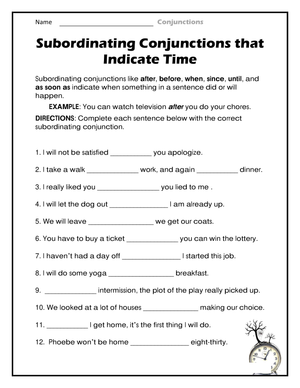
- Choosing a conjunction that matches the logical relationship between clauses
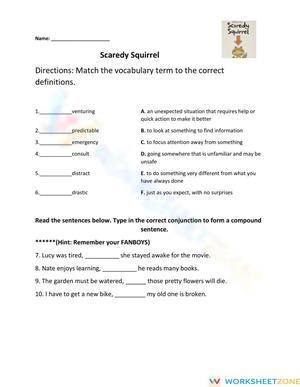
- Combining two short sentences into a single, well-constructed sentence
- Editing comma splices and run-ons by selecting an appropriate connector
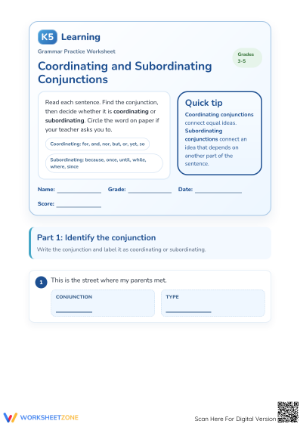
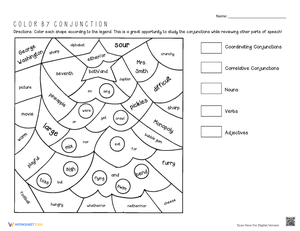
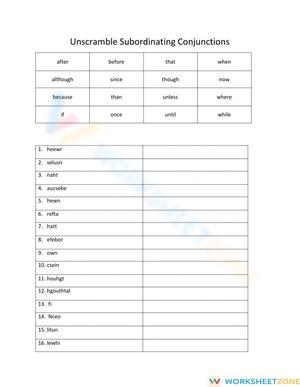
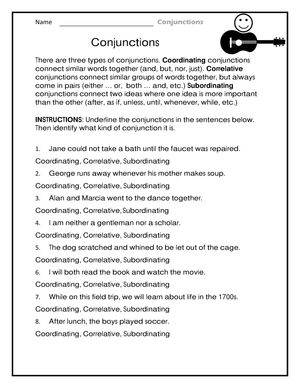
- Distinguishing coordinating from subordinating conjunctions through sentence-level editing tasks
- Applying conjunction choices in brief revision tasks drawn from realistic writing contexts
The conjunctions printable worksheets for 5th grade in this set include enough variety in sentence context that students cannot answer by pattern-matching alone. A sentence built around science content looks different from one rooted in a narrative moment, and choosing the right conjunction in both situations requires actually reading the clause relationship — not reaching for the same familiar word.
Frequent Student Errors Worth Watching For and Correcting
The most consistent pattern is over-reliance on and. Students who fully understand that two ideas contrast will still write "She studied hard, and she didn't pass" when "Although she studied hard, she didn't pass" is the more precise choice. The logical relationship is visible to them; the conjunction that signals it is not yet automatic. Focused practice with contrasting and causal sentence pairs closes that gap faster than broad conjunction review does.
Comma placement is the second reliable trouble spot, and it surfaces differently depending on which conjunction type students are using. Many fifth graders learn that a comma goes before a coordinating conjunction, then apply that rule directly to subordinating constructions — writing things like "Because, she was tired, she left early." These worksheets surface that confusion because students rewrite complete sentences rather than only underlining a word. Teachers who circulate during the task catch the comma problem quickly, before it settles deeper into student writing habits.
How to Build These Worksheets Into Your Lesson Plans
A reliable routine is to open with two oral sentence-combining examples at the board, assign the worksheet for written practice, and close with a short discussion of why two or three student answers work differently from each other. That sequence keeps conjunction work connected to the writing students are already doing instead of framing grammar as its own disconnected event. The whole cycle runs comfortably in 12 to 15 minutes.
These conjunctions printable worksheets for 5th grade also fit naturally at different points across the week. A Monday warm-up worksheet introduces or reintroduces the grammar focus before a writing block. A similar worksheet midweek can run during independent rotations or centers. Three to five items from any worksheet make a workable exit ticket — students answer, then write one sentence explaining why their conjunction fits. That explanation step is where you see whether students are applying real understanding or guessing from context clues.
- Use one worksheet as a Monday warm-up to anchor the week's grammar focus before writing workshop begins.
- Assign a related worksheet midweek for independent practice during rotations or small-group time.
- Pull three to five items as an exit ticket; ask students to explain one answer in writing.
- Follow any worksheet with a brief revision task where students apply the same conjunction decisions to a sentence from their own draft.
Standard Alignment
The Common Core State Standards for English Language Arts place conjunction function in Grade 5 Language standard L.5.1a, which asks students to explain how conjunctions work both in general and within specific sentences. The word "explain" carries real weight in that standard: circling because in a passage meets a lower bar than writing a sentence that uses because to show cause and then describing why that relationship holds. Each worksheet in this set includes at least one task that asks students to make or justify a sentence-level decision, which is what L.5.1a is actually measuring.
Adjusting the Worksheets Across Ability Levels
Students who struggle with sentence meaning benefit from having the logical relationship labeled before they choose a conjunction — a small notation like "(contrast)" beside a sentence pair removes one cognitive demand without removing the grammar task itself. Students working at grade level move through the standard task sequence. Writers who finish quickly can rewrite each sentence using a different conjunction, then annotate how the meaning shifts. That extension asks them to think like an editor, which is precisely the skill Grade 5 writing standards are building toward.
For teachers managing a wide readiness range, the conjunctions printable worksheets for 5th grade in this set work well when two versions of the same task run in the same rotation — one with the relationship labeled, one without. Students do comparable sentence work at different entry points, which means the class discussion that follows can still bring both groups to the same central question: what does this conjunction signal, and how does a reader know?
Frequently Asked Questions
What do 5th graders need to know about conjunctions?
Fifth graders need to recognize how conjunctions connect words, phrases, and clauses, and they need to explain how those connections function in specific sentences. In practice, that means reading the logical relationship — addition, contrast, time, cause, or condition — and selecting a conjunction that communicates that relationship clearly to a reader. Applying that thinking in both targeted sentence tasks and actual writing drafts is the full Grade 5 expectation.
How can teachers use these worksheets for something other than homework?
The most effective uses tend to be brief and purposeful: a warm-up leading directly into a writing block, an exit ticket where students complete two items and explain one choice aloud or in writing, or a reteach resource pulled for a small group after a formative check reveals confusion. Each worksheet is self-contained, so teachers can use selected items rather than assigning the full set at once.
What is the difference between coordinating and subordinating conjunctions?
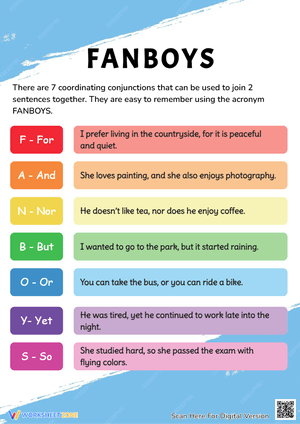
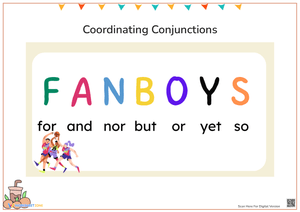
Coordinating conjunctions — for, and, nor, but, or, yet, so — join grammatically equal ideas. Subordinating conjunctions such as because, although, when, and if attach a dependent clause to an independent one and signal a specific relationship of time, reason, contrast, or condition. Grade 5 worksheets address both types through sentence-combining and editing tasks rather than through memorized definitions, which is where the distinction actually sticks.
Are these worksheets a strong match for Grade 5 grammar standards?
They are, provided the tasks ask students to apply or explain conjunction function rather than only identify examples in a passage. Worksheets that include sentence combining, conjunction selection with context, and short revision tasks reflect the actual language of L.5.1a more directly than identification-only formats do — and they generate evidence teachers can actually use to regroup students or plan the next lesson.












 Interactive Worksheet Maker
 Quiz Maker
 Word Search Maker
 Crossword Puzzle Maker
 Word Scramble Generator
 Sentence Scramble Generator
 Handwriting Worksheet Generator
 Name Tracing Generator
 Fill In The Blank Generator