




























Views
Downloads
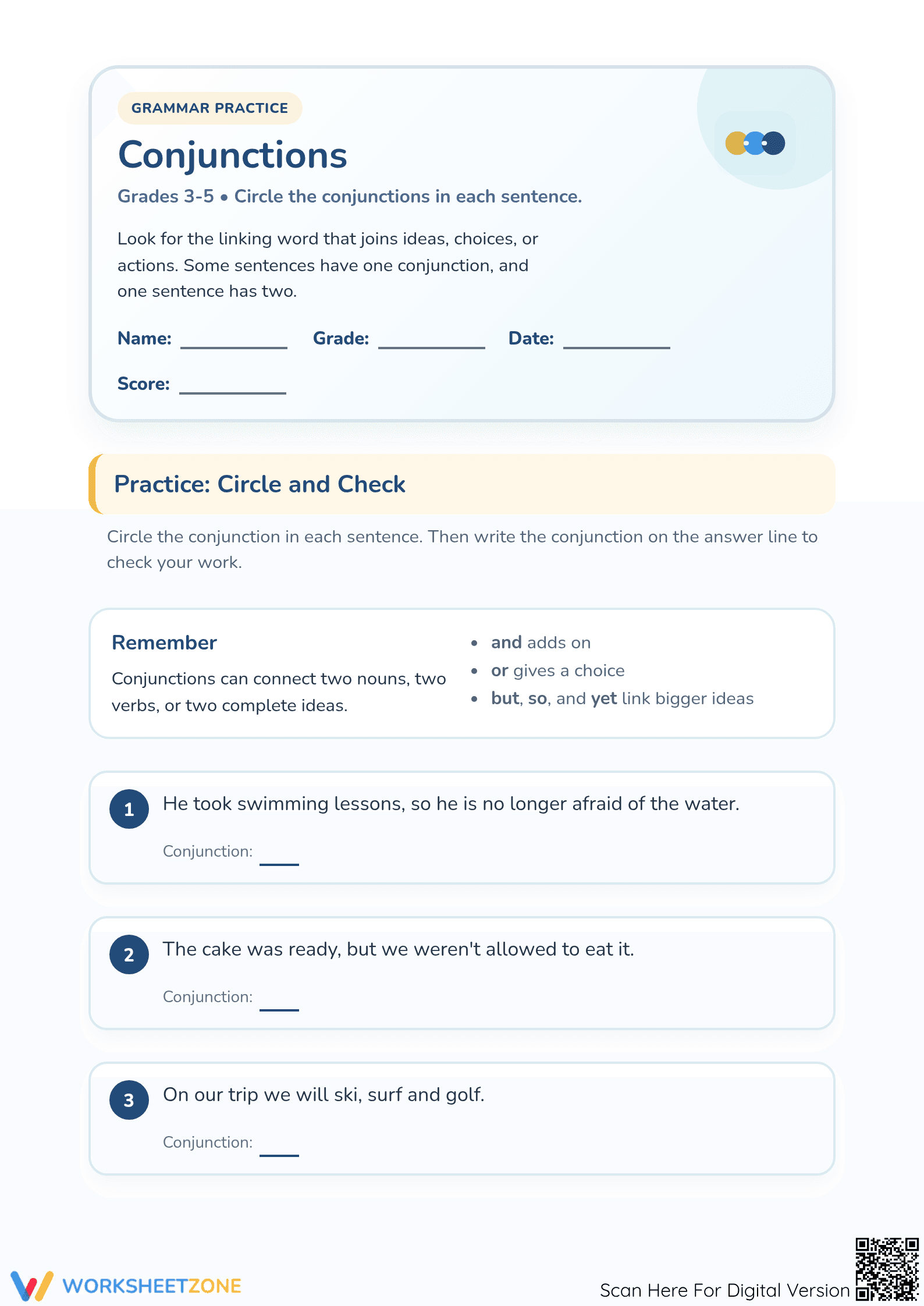


Essential Conjunctions Worksheet | Grades 3-5 ELA

Paste this activity's link or code into your existing LMS (Google Classroom, Canvas, Teams, Schoology, Moodle, etc.).
Students can open and work on the activity right away, with no student login required.
You'll still be able to track student progress and results from your teacher account.
Mastery of conjunctions is vital for building complex sentence structures and improving writing flow. This Grade 3-5 ELA resource provides targeted practice in identifying and applying coordinating conjunctions like 'and', 'but', and 'so'. Students move from recognizing linking words to understanding their specific functions within varied sentence contexts to improve overall composition quality.
At a Glance
- Grade: 3-5 · Subject: English Language Arts
- Standard:
CCSS.ELA-LITERACY.L.3.1.H— Use coordinating and subordinating conjunctions to connect words and phrases- Skill Focus: Coordinating Conjunctions (and, or, but, so, yet)
- Format: 3 pages · 12 problems · Answer key included · PDF
- Best For: Grammar centers and independent practice
- Time: 15–20 minutes
What's Inside
This comprehensive packet spans three pages, ensuring students have ample space to work through 12 unique sentence-based tasks. The first page includes a "Remember" anchor box that defines common conjunctions and their specific uses, such as 'and' for adding information or 'but' for linking bigger ideas. Each problem features a clear sentence followed by a dedicated "Conjunction" line for student responses, facilitating easy grading and self-correction.
Skill Progression
- Guided practice: The "Remember" box provides immediate scaffolding, defining the function of key conjunctions to ensure students understand the semantic logic before they begin the work.
- Supported practice: The first few problems use high-frequency sentences, allowing students to build confidence as they identify 'so' and 'but' in familiar, relatable contexts.
- Independent practice: Later tasks introduce more complex sentences and multiple clauses, requiring students to independently determine which linking word connects the ideas without additional hints or prompts.
This sequence follows the gradual-release model, transitioning students from teacher-supported definitions to autonomous identification and application of function words.
Standards Alignment
This resource is fully aligned with `CCSS.ELA-LITERACY.L.3.1.H`, which requires students to use coordinating and subordinating conjunctions. It also supports `CCSS.ELA-LITERACY.L.5.1.A` by helping students explain the function of conjunctions in particular sentences. Both standard codes can be copied directly into lesson plans, IEP goals, or district curriculum mapping tools for administrative compliance.
How to Use It
Use this worksheet during the "You Do" phase of a grammar lesson on sentence structure. It serves as an excellent formative assessment to check for understanding after a direct instruction session. Teachers should observe students as they complete the first three tasks to ensure they aren't just circling any word, but specifically looking for the link between ideas. The 15-minute completion time makes it an ideal bell-ringer or exit ticket.
Who It's For
This packet is designed for Grade 3, 4, and 5 students who are ready to move beyond simple sentences. It is particularly useful for students needing extra support with writing mechanics or ESL learners developing an understanding of English sentence logic. Pair this with a list of sentence starters or an anchor chart for maximum instructional impact.
According to the RAND AIRS 2024 report on literacy instruction, explicit grammar practice focused on sentence-level mechanics is a key predictor of long-term writing proficiency in elementary students. By isolating the concept of conjunctions—specifically CCSS.ELA-LITERACY.L.3.1.H—this resource aligns with the "Science of Reading" emphasis on syntax and sentence composition. Research by Fisher & Frey (2014) indicates that scaffolded "Remember" prompts, like the ones used in this packet, significantly reduce cognitive load during independent practice, allowing students to focus on the semantic relationship between clauses. NAEP data consistently shows that students who can successfully manipulate conjunctions to create compound and complex sentences score higher on narrative and expository writing assessments. This worksheet provides the repetitive, focused practice necessary to transition these grammatical concepts from short-term recognition to permanent, applicable writing skills used across all academic subjects and grade levels.


