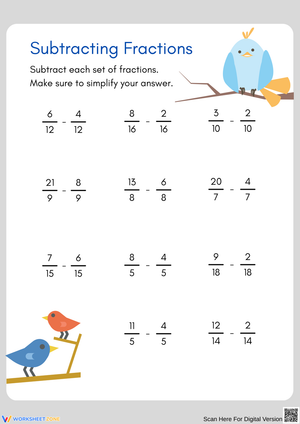
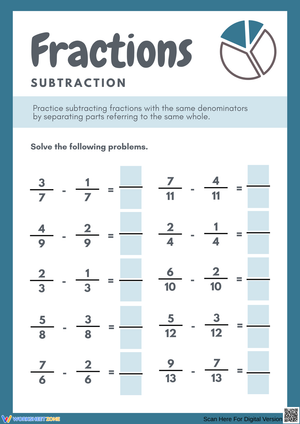
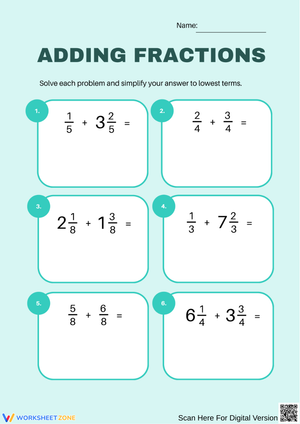
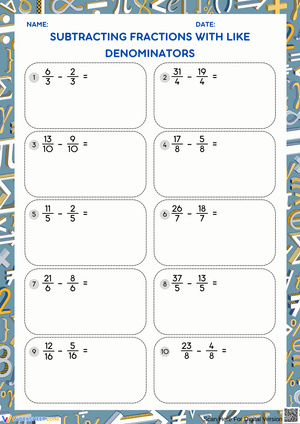
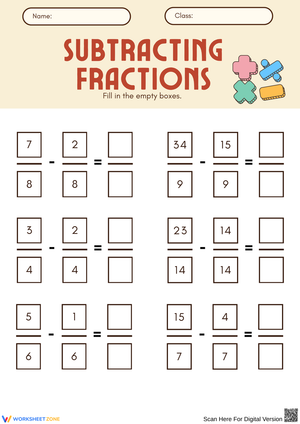
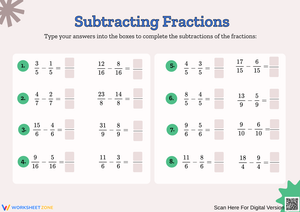
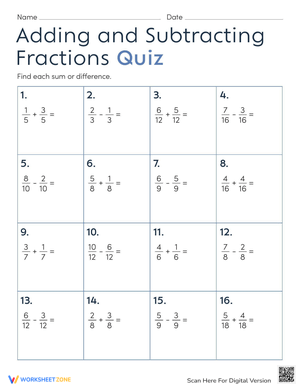
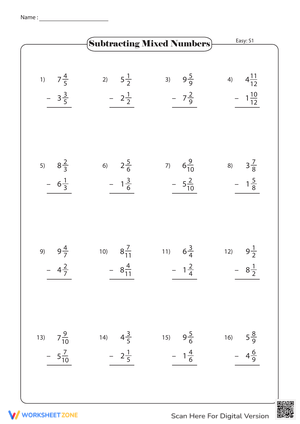
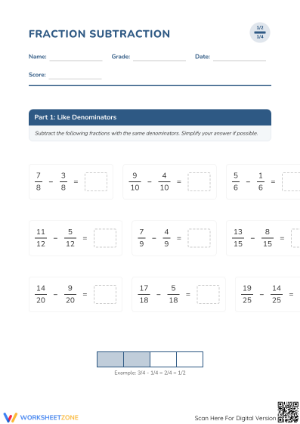
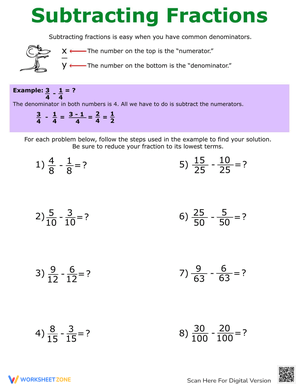
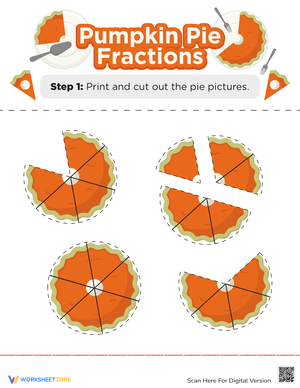
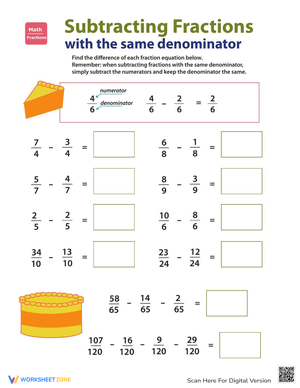
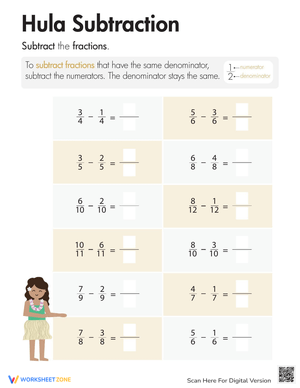
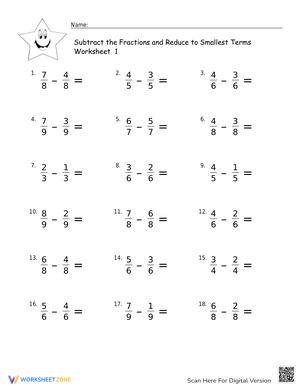
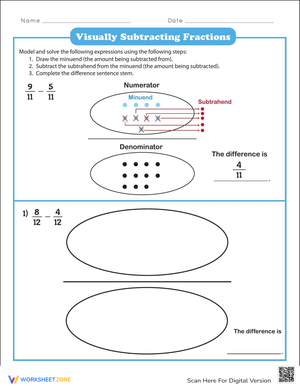
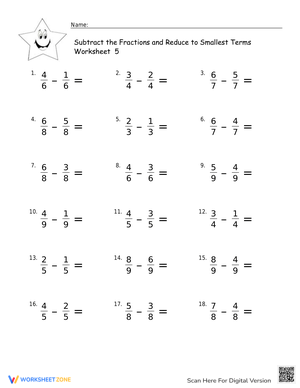
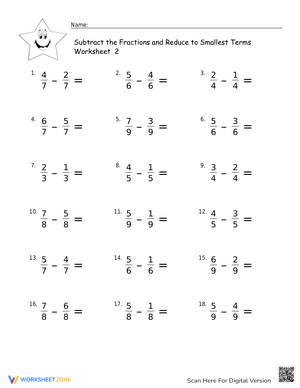
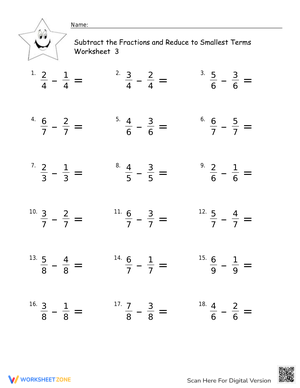
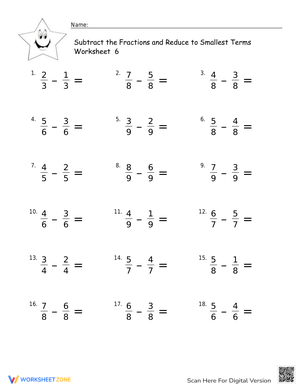
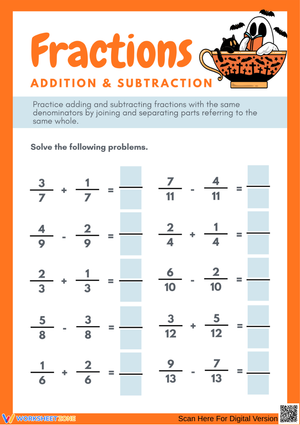
These subtracting fractions with like denominators pdf worksheets for 4th grade give students the sustained practice they need to stop treating the denominator as a second number to operate on — and start reading it as a unit label that names the size of each piece. The set moves from equation-only problems to area-model and number-line formats, with each worksheet targeting a distinct entry point into the same core operation. Teachers get resources that slot into warm-ups, guided practice blocks, and end-of-lesson formative checks without additional prep.
The Specific Skills Each Worksheet Targets
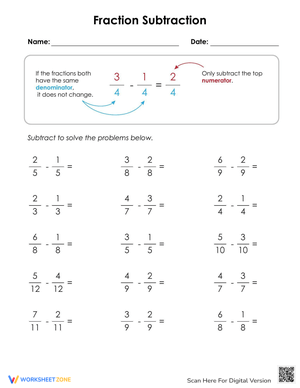
The core operation is simple to state: subtract the numerators, hold the denominator steady. But the skill has more texture than that summary suggests. Students work through equations where both fractions have single-digit numerators, then encounter problems where the difference equals zero — a result that consistently surprises students who expect subtraction to always produce something measurably smaller. Subtraction sentences that resolve to a whole number also appear, pushing students to think about what those expressions actually mean rather than executing a memorized step.
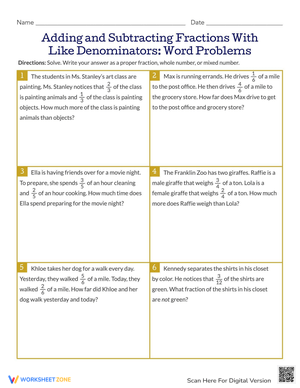
Each worksheet in the set includes at least one word-problem context. The scenarios use everyday situations — sharing food, measuring rope, tracking water in a container — and require students to identify which fraction is the minuend before they can write the subtraction sentence. That identification step is exactly where many students stall, and practicing it repeatedly in a low-stakes format makes a real difference by the time the same structure appears on a unit assessment.
- Symbolic subtraction equations with denominators from 2 through 12
- Number-line problems where students mark the starting point and count back by the subtrahend's numerator
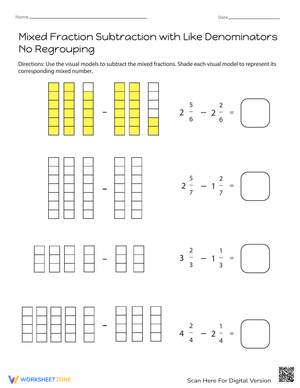
- Shaded area-model problems where students cross out sections and record the remaining fraction
- Word problems requiring students to write the equation before solving
- Mixed result types: proper fraction answers, zero differences, and results that equal a whole number
Mistakes Students Make That These Worksheets Help You Catch
The most consistent error fourth graders make is subtracting both numerator and denominator — writing 5/8 minus 2/8 as 3/0 or 3/6 rather than 3/8. The 3/0 version is a teachable moment because students immediately recognize a zero denominator doesn't make sense. The 3/6 error is harder to catch because it looks plausible at a glance, and the only reliable way to surface it is to ask a student to draw the result on an area model. When a class produces several 3/6 answers on the first worksheet in the set, that's a reliable signal to return to the area-model problems before moving forward.
A second error appears specifically with problems that produce a zero numerator. Students who work through 4/4 minus 4/4 will often write 0/4, which is mathematically correct, but some reverse the values and write 4/0, or they leave 0/4 without recognizing it equals zero. Both are worth discussing as a class rather than simply marking wrong — the conversation about what 0/4 means is genuinely useful instruction time.
Word problems surface a third pattern: students subtract in the wrong order when the larger fraction appears second in the sentence. A prompt like "Marcus had used 3/8 of the paint; the can started at 7/8" leads students who parse left to right to set up 3/8 minus 7/8, which produces a negative result they cannot yet interpret. Teaching students to identify and underline the starting amount or total before writing the equation prevents most of these errors before they happen.
How to Build These Worksheets Into Your Lesson Plans
The area-model worksheet works best as an introductory tool — use it the day you first teach the operation, before students have touched a purely symbolic problem set. Projecting one area-model problem on the board, shading together as a class, and then physically crossing out sections gives students a shared reference they can return to mentally when symbolic problems become confusing. A ten-minute whole-group walkthrough followed by twenty minutes of independent work on that same worksheet completes a clean gradual-release arc within a single lesson.
These subtracting fractions with like denominators pdf worksheets also work well as Monday warm-ups after a weekend gap. Fraction notation fades fast at this age, and three to five warm-up problems on the number-line worksheet re-anchor students before the week's new content begins. Keep the warm-up block to eight minutes or fewer — enough to surface confusion but short enough to preserve the instruction period that follows.
Exit tickets are where this set earns particular value. Select two problems from any worksheet — one symbolic equation, one word problem — and have students complete them in the final five minutes of class. The results sort cleanly: students who solved both correctly are ready to move toward unlike denominators; students who solved the equation but not the word problem need another day on contextual reading; students who missed the equation need the manipulative-based re-teach described below.
Standard Alignment
These subtracting fractions with like denominators pdf worksheets for 4th grade align to CCSS Math 4.NF.B.3, which requires students to understand that a fraction a/b is composed of unit fractions, and that subtracting fractions means removing some of those unit parts from a whole. The standard sits between the Grade 3 introduction to fraction equivalence and the Grade 5 work with unlike denominators — making fourth grade the exact year when procedural fluency with like denominators needs to be firmly established. 4.NF.B.3 appears on most state standardized assessments and is consistently represented in the fraction reasoning items on NAEP Grade 4 samples.
Adjusting the Worksheets for a Range of Learners
For students who are still concrete thinkers, pair any worksheet in the set with a physical set of fraction circles or tiles. The student solves the problem with manipulatives first, records the result, then writes the symbolic equation as a translation of what the tiles showed. That two-step sequence — physical model first, notation second — takes longer per problem, but it closes the gap between students who can handle abstract symbolic work and those who still need a tangible anchor. The worksheet becomes a recording tool rather than a cold abstract task.
These subtracting fractions with like denominators pdf worksheets carry enough variety within each set that above-level students can be directed immediately to the word-problem sections, bypassing equation-only rows that won't extend their thinking. For further challenge, ask those students to write a second word problem using the same equation — a composition task that requires deep enough understanding to reverse-engineer a context from a number sentence.
For intervention groups, restrict the denominator range in early sessions. Limiting problems to halves, thirds, fourths, and sixths removes the extra cognitive work of reading larger denominators before the core rule is stable. Once a student can consistently hold the denominator steady on sixths problems without drifting back to subtraction errors, expand the range incrementally.
Frequently Asked Questions
Why does the denominator stay the same when we subtract fractions?
The denominator names the size of each piece — it tells you how many equal parts the whole was divided into. If you take two slices from a pizza cut into eighths, the remaining slices are still eighths. You have fewer of them, which is what the numerator captures, but the pieces themselves haven't changed size. Subtracting the denominator would imply the whole was recut into a different number of sections, which doesn't happen in the problem.
When should a student use manipulatives instead of moving straight to the worksheet?
Use fraction tiles, paper circles, or printed fraction strips any time a student consistently writes the denominator-subtraction error after two days of instruction. Worksheet practice builds fluency once the concept is solid, but it will not repair a conceptual misunderstanding on its own. Return to physical materials first, then reintroduce the symbolic worksheet once the student can explain the operation using objects and not just recall a rule.
Do fourth graders need to simplify their answers on these problems?
CCSS 4.NF.B.3 does not require simplification as part of the subtraction standard — that work lives under 4.NF.A.1. In practice, most fourth-grade teachers accept unsimplified answers on these worksheets and teach simplification as a separate lesson. If a student spontaneously simplifies correctly, that's a useful readiness signal, but penalizing unsimplified answers at this stage blurs the line between two distinct standards and can create unnecessary confusion.
Can these worksheets support students working below fourth-grade readiness?
The area-model worksheet in particular requires no prior fluency with symbolic fraction notation. A student who can count shaded sections and cross out drawn parts can access those problems before they can reliably read or write a fraction equation. That entry point makes the area-model worksheet useful for intervention groups working slightly behind grade-level expectations, without requiring a separate below-grade resource.













 Interactive Worksheet Maker
 Quiz Maker
 Word Search Maker
 Crossword Puzzle Maker
 Word Scramble Generator
 Sentence Scramble Generator
 Handwriting Worksheet Generator
 Name Tracing Generator
 Fill In The Blank Generator