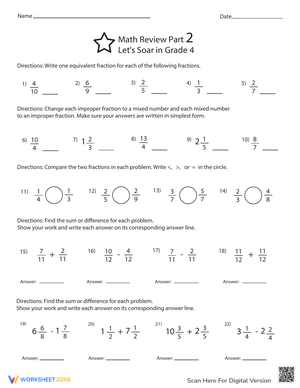
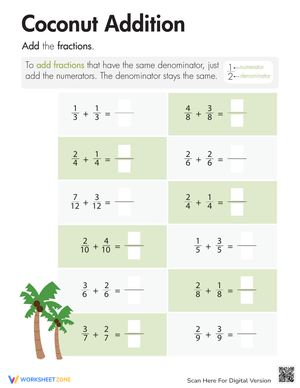
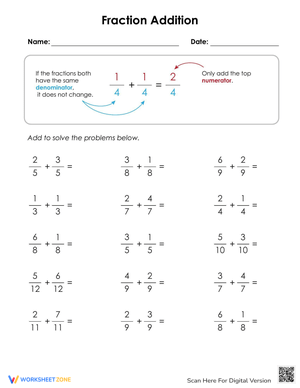
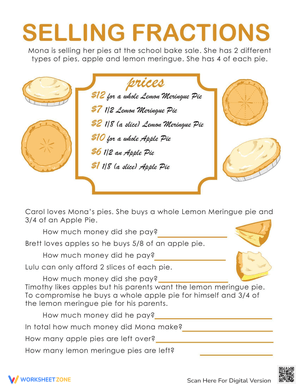
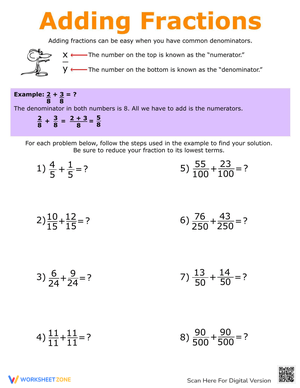
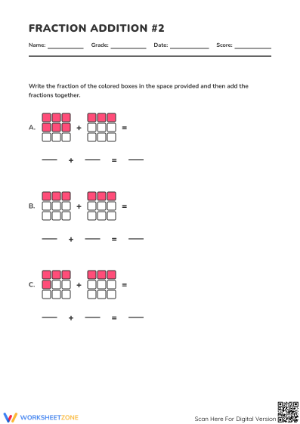
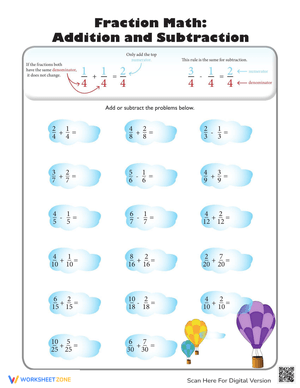
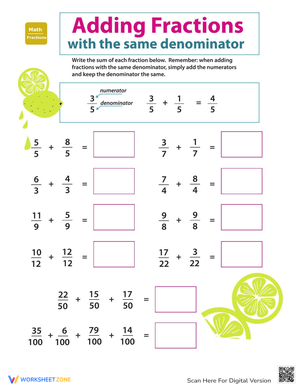
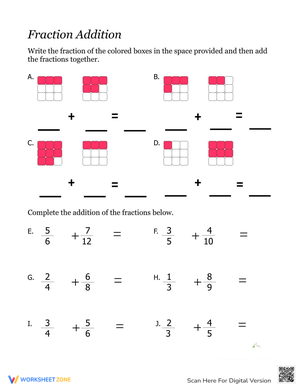
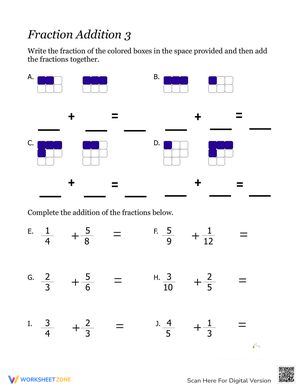
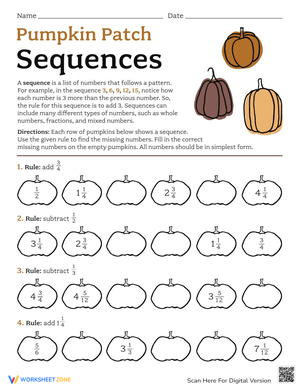
These adding fractions printable worksheets for 4th grade give teachers a focused set of resources that move students from shaded fraction bars to written equations to short word problems — all addressing same-denominator addition, which is the entry point for fraction work in Grade 4. Each worksheet stays on one concept at a time, which keeps student errors trackable and makes reteaching decisions faster.
What Each Worksheet in the Set Covers
The set works through the fraction addition progression that Grade 4 students need: understanding what a denominator names before touching the numerator, seeing addition as combining equal parts of the same whole, and eventually transferring that logic to real-world problems. The resources address these distinct skill areas:
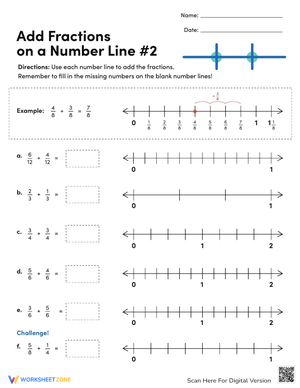
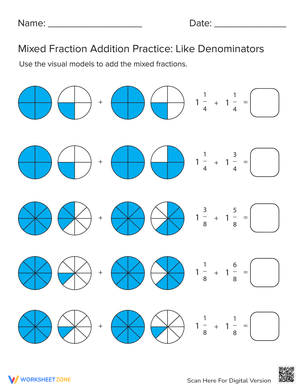
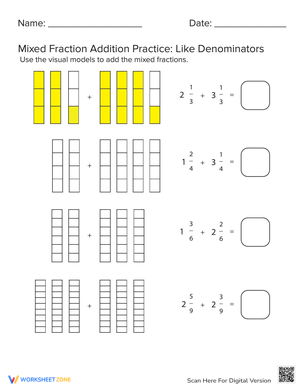
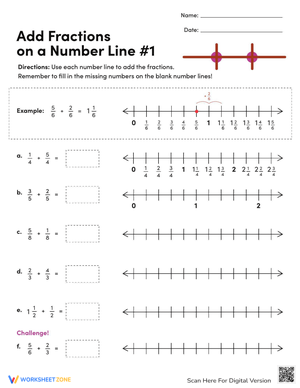
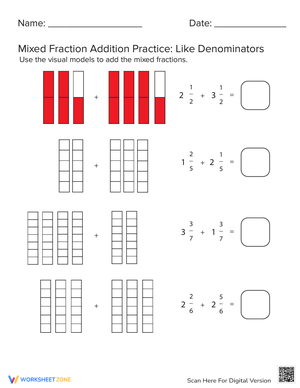
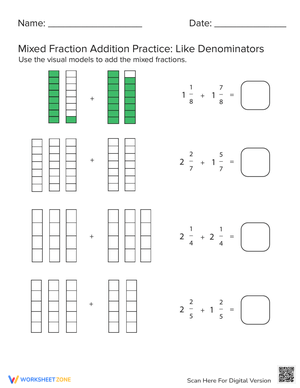
- Visual model completion: Students shade fraction bars or circle diagrams showing each addend, then record the addition sentence the picture illustrates.
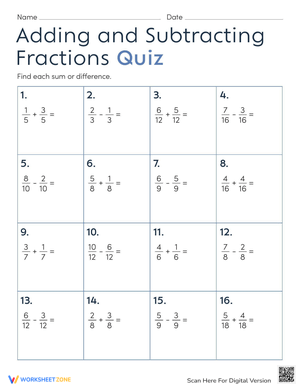
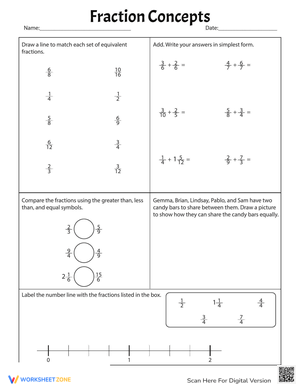
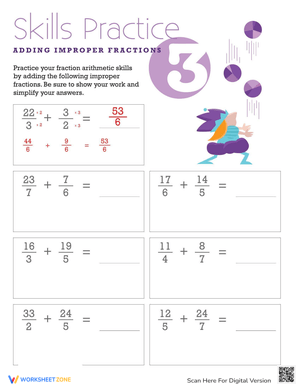
- Like-denominator equations: Computation practice with problems such as 3/8 + 4/8, with space to write the sum and annotate why the denominator remains unchanged.
- Part-whole reasoning tasks: Short prompts that ask students to identify the size of the whole before writing the fraction sentence — a step many students skip and then regret.
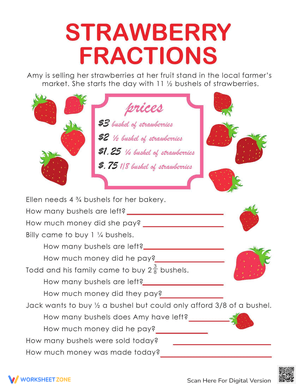
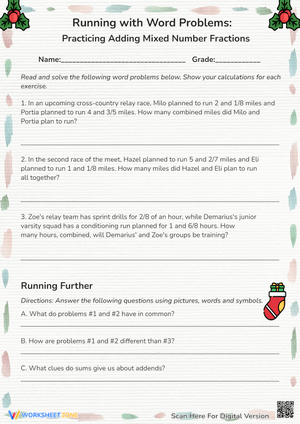
- Single-step word problems: Contexts involving running distances, recipe amounts, or portions of a project, where students must first name what they are adding before computing.
- Extension items: A few problems per worksheet where sums exceed one whole, giving students who are ready a place to push further without disrupting the main skill focus.
Error Patterns Worth Spotting Before You Move On
The error teachers see most often is denominator addition: a student looks at 3/6 + 2/6 and writes 5/12. This is not a careless mistake — it reflects a direct transfer from whole-number addition, where students have spent years combining every visible digit. The visual model interrupts that habit cleanly. When a student has shaded 3 parts on a bar split into 6 equal sections, then shaded 2 more parts on the same bar, they can see that the total of 5 refers to 5 out of 6 sections — the bar never changed. Asking students to shade the model before writing the equation turns a procedural shortcut into a conceptual check.
A subtler pattern shows up on word problems. Students solve the computation correctly but assign the sum to the wrong referent — they add 2/4 and 1/4, get 3/4, and then write a conclusion that does not connect to the problem's actual question. This usually means the student treated the item as a computation exercise and stopped reading once they found the numbers. A brief pre-solving step — underline what the question asks before writing anything — consistently reduces that error in small-group sessions.
Standard Alignment
These worksheets address CCSS 4.NF.B.3, which requires students to understand fraction addition by working with parts of the same whole. Specifically, the standard calls for students to decompose fractions, recognize that the denominator represents the number of equal parts in the whole rather than a quantity being combined, and connect visual models to addition equations. In instructional terms, a worksheet that jumps straight to equations without a visual phase puts the standard's conceptual demands in the wrong order. The resources in this set follow the standard's intent: model first, equation next, explanation or word problem last.
Fitting These Worksheets Into the Week's Instruction
The most effective slot for model-based worksheets is the first few days of a fraction addition introduction, when students are still building the mental image of what addition means in a fractional context. A visual worksheet used as a warm-up right before whole-group direct instruction gives students an anchor before they hear the formal language. Equation worksheets work better mid-unit, during the independent practice segment, when the teacher can circulate and observe whether students are leaving the denominator alone or reverting to adding it. Word problem worksheets earn their place as exit tasks because they require a full transfer of skill — a student who handles 2/5 + 2/5 on a drill worksheet but stumbles on the word problem has shown you exactly where the next small-group lesson needs to go.
The adding fractions printable worksheets for 4th grade set also fits the scattered time slots that most Grade 4 teachers know well: three to five items during morning work on a Monday after a weekend break, one worksheet alongside fraction tiles at a math center, a focused practice worksheet on Thursday so families see real fraction problems rather than abstract number sentences. Distributed across the unit this way, the worksheets function as spaced retrieval practice rather than a single cramming session at the end.
Adapting the Set for Students at Different Readiness Levels
For students who are not yet solid on what a denominator names, the visual model worksheets with larger diagrams and pre-partitioned shapes give them an entry point that does not require abstract symbol work before they are ready. Written prompts like The whole is divided into ___ equal parts direct students to examine the model before writing anything. This removes the guessing step without removing the thinking.
On-level students gain the most from worksheets that pair a completed model with a blank equation — they have to extract the abstract representation from the picture, which requires more active processing than copying a number sentence off a board. For students who have already internalized like-denominator addition, the extension problems per worksheet — answers greater than one whole, or word problems with two-step reasoning — keep the work from feeling repetitive without introducing unlike denominators ahead of the standard sequence.
When looking at the adding fractions printable worksheets for 4th grade set as a whole, sorting by entry point rather than difficulty label helps more students find early success. That reframing matters most at the start of the unit, when the gap between students who secured fraction concepts in Grade 3 and those who did not can feel very wide.
Frequently Asked Questions
What should Grade 4 students practice first — visual models or equations?
Visual models come first, consistently. Students need to connect the fraction addition sentence to a picture of equal parts being combined before the symbolic notation means anything to them. Moving to equations before that image is established tends to produce denominator errors that are hard to correct once they are practiced into habit. Start with shading, naming the whole, and reading what the model shows. The equation then becomes a record of what the picture already demonstrated.
How many problems per session is realistic for Grade 4?
Eight to twelve items is workable for a focused practice session of 15 to 20 minutes. Fewer items with more explanation space — writing why the denominator stays the same, labeling each part of the model — often produce better instructional data than longer drills. When a worksheet has too many items, students rush, and errors become harder to interpret cleanly.
Do these worksheets support fraction intervention as well as on-level instruction?
Yes. The visual-model worksheets work particularly well for intervention because they require conceptual engagement rather than allowing students to follow a memorized rule. For the adding fractions printable worksheets for 4th grade students placed in intervention, the typical pattern is that they can state the like-denominator rule but cannot explain or justify the sum. The model-based worksheets address that directly because the visual representation is the central task, not an optional hint attached to an equation.













 Interactive Worksheet Maker
 Quiz Maker
 Word Search Maker
 Crossword Puzzle Maker
 Word Scramble Generator
 Sentence Scramble Generator
 Handwriting Worksheet Generator
 Name Tracing Generator
 Fill In The Blank Generator