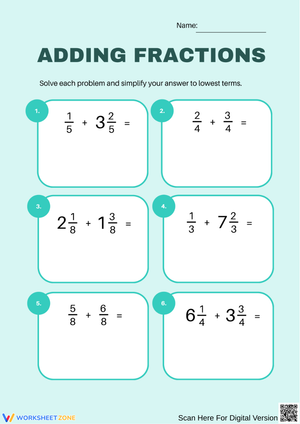
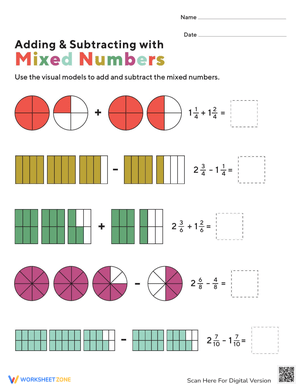
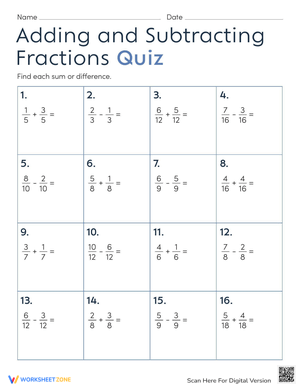
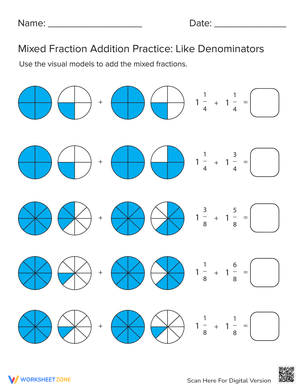
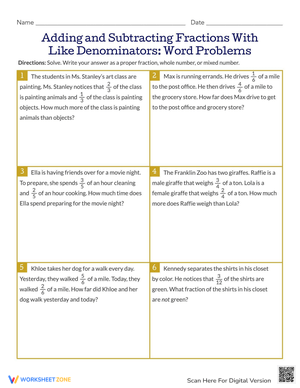
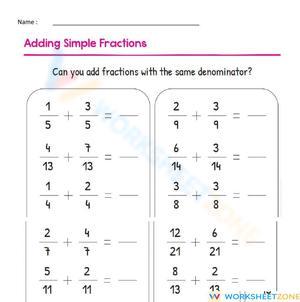
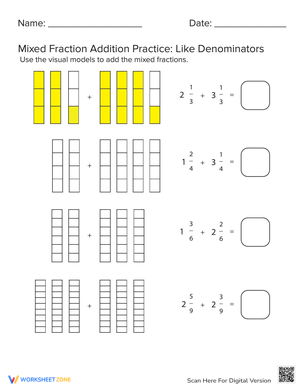
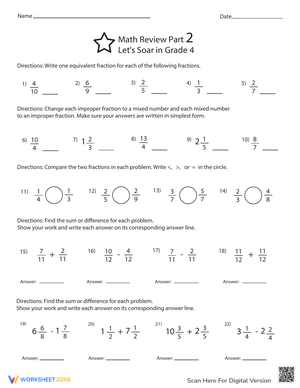
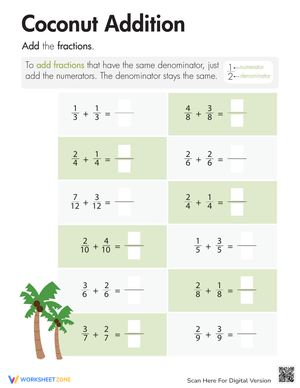
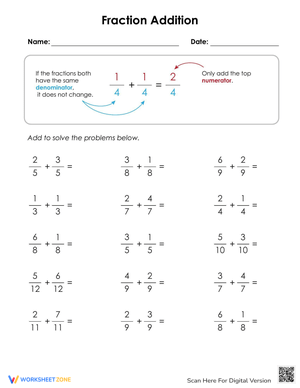
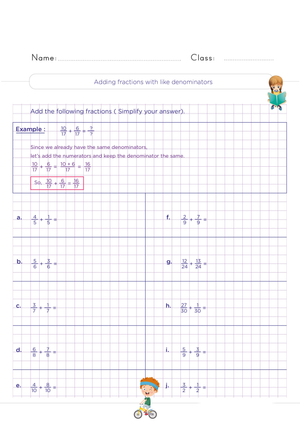
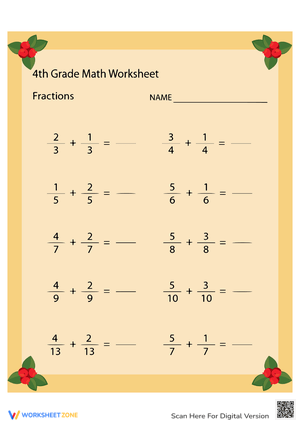
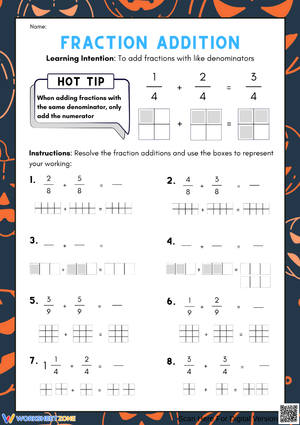
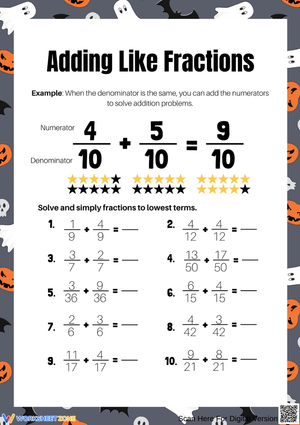
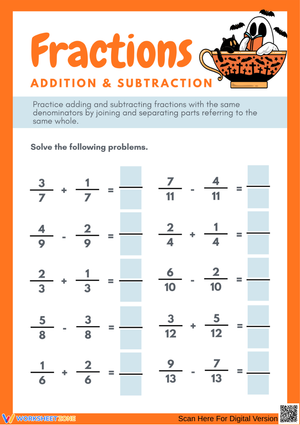
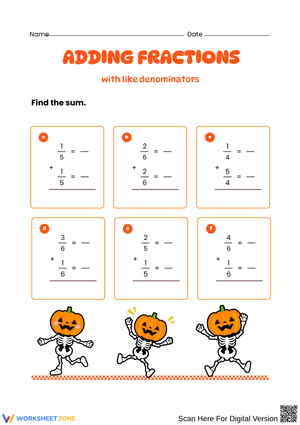
These 4th grade adding fractions with like denominators worksheets give teachers a ready-to-use set that moves students from visual fraction models through abstract computation, ending at sums that require conversion to mixed numbers. The resources follow a skill progression that matches how fourth graders actually build fraction understanding — starting with unit fractions before introducing larger numerators, then pushing into improper fraction results once the core mechanic is stable. The set works as morning warm-ups, guided practice, small-group pull-out work, or homework without modification.
The Specific Skills Covered in the Set
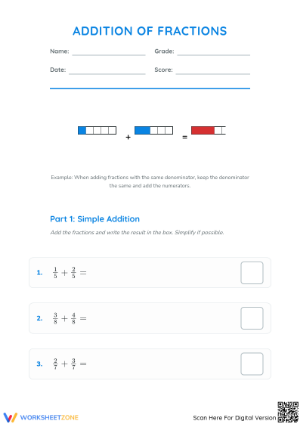
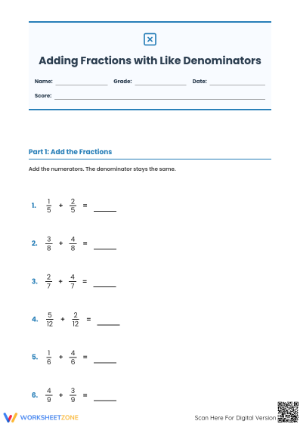
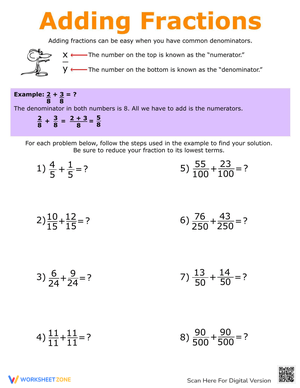
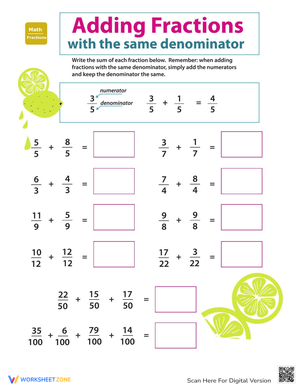
The early worksheets use unit fractions only — adding one-third and one-third, or one-fifth and two-fifths — so students isolate the single conceptual move: add the numerators, hold the denominator. Once that feels stable, the problems shift to proper fractions with larger numerators. Students add combinations like two-sevenths and four-sevenths, which raises the arithmetic demand without introducing any new conceptual layer.
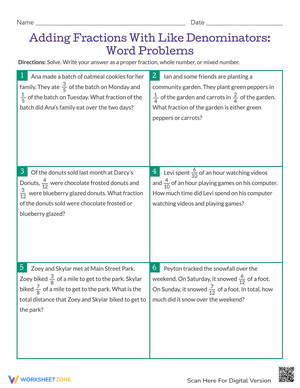
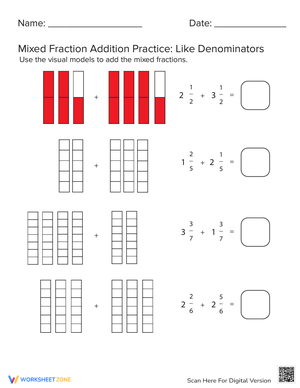
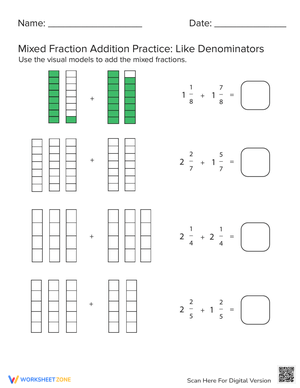
The final tier is where the work deepens. Sums that exceed one whole produce improper fractions, and students must convert — recognizing that six-fourths means one whole with two-fourths remaining, then simplifying to one and one-half. Several worksheets pair this conversion step with fraction bar models so students see the sum land above the 1-whole mark before writing the mixed number. Word problems are distributed across the set, grounding the math in context: measuring ribbon lengths, dividing a pan of cornbread, combining walking distances recorded over two days.
Fitting These Worksheets Into the Lesson Block
The most efficient structure for this topic is three-phase: open the lesson with a brief number talk — "what's three-fifths plus one-fifth?" — then move into guided practice on one of the visual-model worksheets as a class, then release students to the computation worksheets independently. That sequence runs about 35 minutes and creates a natural checkpoint before independent work where you can see which students are still uncertain about why the denominator doesn't change.
For the eight or ten minutes before lunch or dismissal, the shorter computation worksheets — eight to ten problems, no word problems — make clean exit tasks. Students finish, flip the paper over, you collect a quick read on where the class stands. The answer keys make it straightforward to set up self-checking stations: students verify their own work, mark errors, and bring questions to a follow-up small group rather than waiting for whole-class correction time.
The 4th grade adding fractions with like denominators worksheets also translate well to homework, because each worksheet carries a worked example at the top. Parents can follow the model without needing context from the lesson, which reduces the usual friction when fraction concepts first go home.
Fraction Addition Errors That Show Up in the First Few Days
The denominator-addition error is the most consistent pattern we see in student work. A student looks at 2/5 + 1/5, applies whole-number addition logic to every visible digit, and writes 3/10. Restating the rule doesn't fix this — the visual model does. When a student has shaded two parts of a five-part bar and then shades one more of those same parts, the answer 3/10 is visually impossible. Several worksheets place the algorithm directly beside the area model so the contradiction between a wrong numerical answer and an obvious visual is immediate rather than discovered only on returned work.
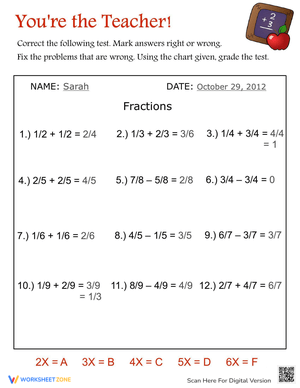
A second error surfaces once students encounter improper fraction sums. They correctly compute six-fourths but then convert it as one and three-fourths — pulling the original addend's numerator (3) into the fractional part of the mixed number rather than computing the remainder. A student who has been adding threes all problem long will sometimes carry that 3 right into the answer without pausing. That error is easy to miss on a quick scan because one and three-fourths looks plausible at a glance. Asking students to verify their mixed number by converting back — does one and three-fourths give you 7/4, not 6/4? — catches it before the misconception settles in.
Standard Alignment
These worksheets address CCSS 4.NF.B.3a, which requires students to understand fraction addition as joining parts that refer to the same whole. In classroom terms, that means treating the denominator as a unit label — eighths, fifths, thirds — rather than a number that participates in the addition. This standard sits at the opening of the 4th-grade fraction progression, before unlike-denominator work, and well before 5th grade's use of equivalent fractions to add fractions with different denominators. Students who understand why the denominator stays constant here move into 5th-grade fraction work with a reasoning base rather than a fragile procedure. The 4th grade adding fractions with like denominators worksheets in this set build that conceptual foundation directly — the emphasis is on understanding the operation, not just executing it.
Using the Set With Students at Different Readiness Levels
Students who are still building number confidence do best starting with the unit-fraction worksheets alongside physical fraction tiles or printed fraction bars they can manipulate. The unit-fraction format reduces arithmetic demand to near-zero, so attention goes entirely to the conceptual move: two pieces of the same size joining into one larger piece. Hold off on the computation worksheets until a student can explain the addition verbally using the tile model — even one sentence is enough to show the concept has landed.
Students ready for more can move through the set quickly and then treat the word problem worksheets as a writing task: construct an original fraction addition story problem with a sum that becomes a mixed number, solve it, and draw the model. That extension asks students to build the mathematics rather than execute it, which is a harder cognitive demand and quickly reveals whether they understand the concept or have only memorized a procedure.
Frequently Asked Questions
Why do you keep the denominator the same when adding fractions?
The denominator names the unit — it tells you what size the pieces are. When you add 1/4 and 2/4, you are counting three pieces that are each one-fourth of the whole. The piece size doesn't change; only the count changes. Adding the denominators would imply the pieces shrank, which the area model immediately disproves. This is why visual models appear consistently across the set — they make the unit-label concept visible before students work with numerals alone.
What do students do when the sum is an improper fraction?
They convert it to a mixed number. If students add 3/4 and 3/4 and arrive at 6/4, they divide 6 by 4: four goes in once with 2 left over, giving 1 and 2/4, which simplifies to 1 and 1/2. The worksheets that introduce this step include fraction bar models showing the sum crossing above the 1-whole mark, which helps students see why a whole number appears in the answer rather than treating conversion as an arbitrary extra step tacked onto the end.
Where does this skill typically fall in the school year?
Most fourth-grade math sequences introduce fraction addition after students have spent time on fraction equivalence and comparing fractions — usually mid-year, somewhere between January and March depending on the pacing guide. Assigning the 4th grade adding fractions with like denominators worksheets before students understand what a denominator represents turns the "keep the denominator" rule into a memorized trick rather than a reasoned procedure, and that fragile foundation is exactly what produces the denominator-addition error most teachers encounter in student work.













 Interactive Worksheet Maker
 Quiz Maker
 Word Search Maker
 Crossword Puzzle Maker
 Word Scramble Generator
 Sentence Scramble Generator
 Handwriting Worksheet Generator
 Name Tracing Generator
 Fill In The Blank Generator