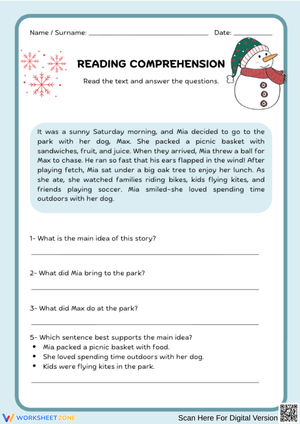
Making inferences worksheets for 4th grade give teachers a practical tool for the comprehension skill that causes the most friction at this grade level — not decoding, not fluency, but the cognitive leap from "what the text says" to "what the text means." Each worksheet in the set pairs a short passage with questions that require students to name their evidence, connect it to their background knowledge, and commit to a conclusion in writing.
What Students Practice Across the Set
The worksheets target five types of inference that 4th graders encounter most often in classroom reading:
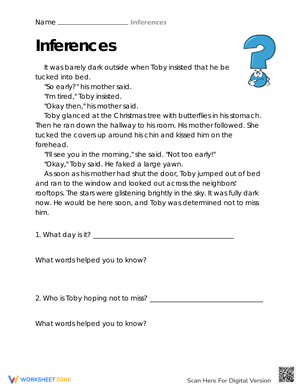
- Character motivation: Students go beyond identifying what a character did to explaining why, using actions, dialogue, and setting details as evidence.
- Mood and atmosphere: Passages describe a scene without labeling the emotional register; students name the mood and cite the specific words that produce it.
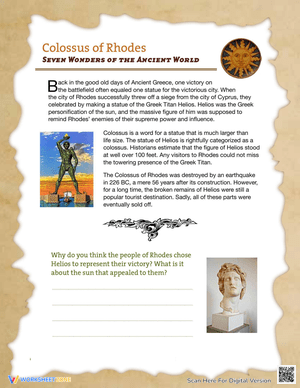
- Cause and effect in informational text: Students infer why a historical event or scientific process unfolded the way it did, working from facts the author provides rather than conclusions the author states outright.
- Author's purpose: Several worksheets use short nonfiction excerpts where students determine whether the author is informing, persuading, or doing something more layered — and must explain what in the text led them there.
- Theme inference: Fiction passages end without a moral stated outright; students construct the theme by tracing what a character gained, lost, or understood by the end.
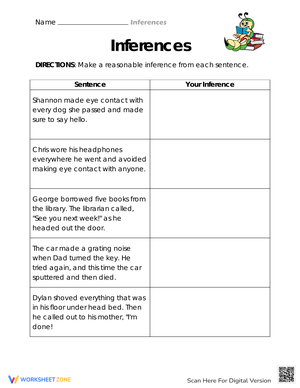
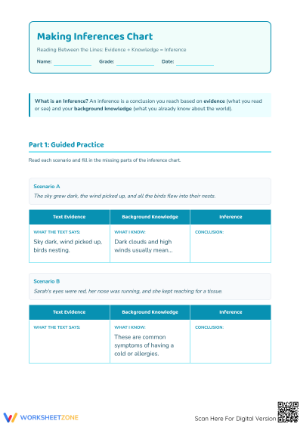
Most questions follow a two-part format: state the inference, then quote or paraphrase the text evidence that supports it. That structure makes reasoning visible — both for students checking their own work and for teachers identifying exactly where thinking breaks down.
Errors That Show Up in Student Work — and What They Reveal
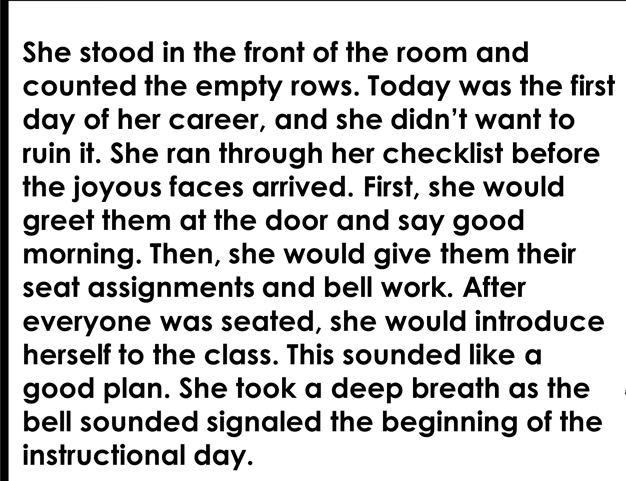
The most persistent problem is treating inference like creative writing. A student who writes "the character is scared" in a passage that never touches on fear cannot complete the evidence column — and that gap is where the real teaching happens. The error isn't a reading failure; it's a signal that the student doesn't yet distinguish between "what I imagine could be true" and "what the text supports." Requiring students to write the exact phrase or detail they used is more effective than simply marking the answer wrong.
A second pattern worth watching: students who find a near-literal match in the text and copy it out. They're not inferring — they're skimming for a sentence that sounds like an answer. One way to catch this is a reverse-inference check: ask the student to identify one detail in the passage that, if changed, would make their conclusion impossible. If they can't name one, they haven't anchored the inference to the text. This check also works well as a quick oral assessment during small-group reading.
A third error shows up specifically on informational passages: students use only their prior knowledge and essentially ignore the text. They write accurate things about the topic — "volcanoes form at tectonic plate boundaries" — but the passage in front of them doesn't say that. What they've produced is schema without text evidence, which isn't inference. The two-column graphic organizer format in several worksheets exposes this reliably, because students have to fill in both columns before they can write a conclusion.
How to Work These Worksheets Into Your Reading Block
Making inferences worksheets for 4th grade fit naturally into the last eight minutes of a small-group lesson, right after a guided reading discussion. At that point students have already engaged with a text, which lowers cognitive load enough for them to apply the inference skill on a fresh but related passage. The worksheets also work well as Monday warm-ups — a short independent task that re-activates reading thinking after the weekend before the week's anchor text goes up on the board.
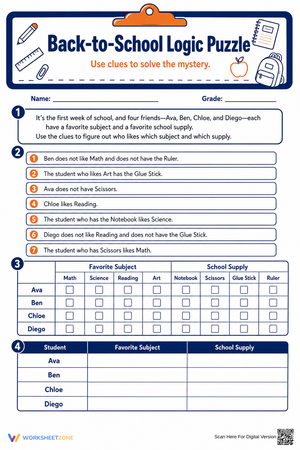
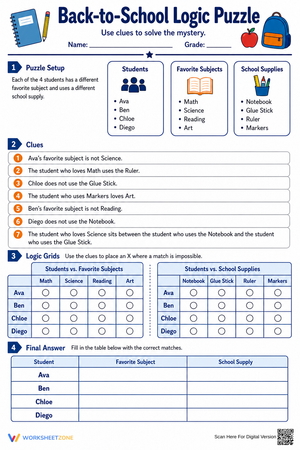
Mystery-themed worksheets are particularly effective for partner work mid-week. The back-and-forth of two students disagreeing about which clue supports which conclusion is often more instructive than a teacher-led explanation. If one student insists the text implies the character is guilty and another disagrees, they're doing exactly the kind of evidence-weighing the standard demands. The teacher's job in that moment is to ask both students to read their text evidence aloud — not to resolve the debate, but to force the argument back into the passage.
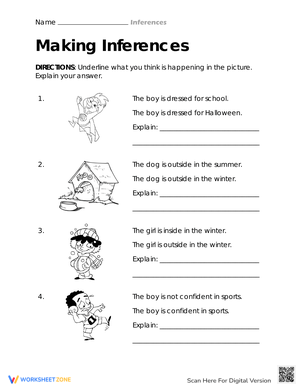
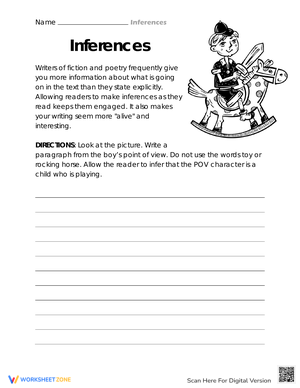
For a full inquiry cycle, use a picture-based inference task as the warm-up at the start of a unit, move to character trait worksheets during guided reading, and close with an informational text inference task as the end-of-unit formative check. That sequence takes students from low-text-load inference to high-text-load inference across two to three weeks without feeling repetitive.
Standard Alignment
These worksheets address CCSS.ELA-LITERACY.RL.4.1 and CCSS.ELA-LITERACY.RI.4.1, both of which require 4th graders to refer to specific details and examples in a text when explaining explicit meaning and when drawing inferences. The distinction between the two standards matters instructionally: RL.4.1 applies to literature, where inference typically centers on character, setting, and theme; RI.4.1 applies to informational text, where inference more often involves cause-and-effect reasoning and author's purpose. The set covers both, which means making inferences worksheets for 4th grade support the same standard across different reading genres without duplicating the practice.
Within a unit plan, these worksheets belong in the practice-and-application phase — after the concept has been introduced through read-aloud and shared reading, but before students are expected to demonstrate the skill independently on unseen grade-level text. They serve as the bridge between whole-class instruction and independent performance, not as an introduction to inference and not as a summative measure.
Adjusting the Set for a Range of Readers
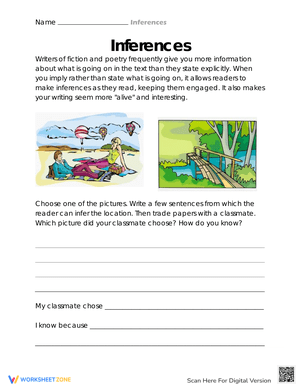
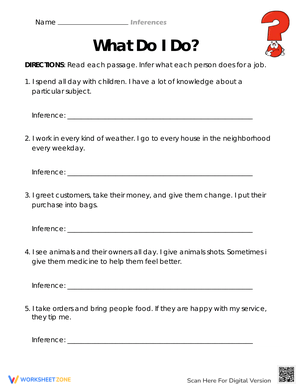
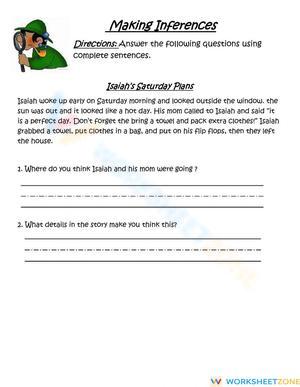
For students who are still in the earlier stages of inferential thinking, the picture-based worksheets reduce text complexity without simplifying the cognitive task. A student can practice the full text-evidence-plus-schema process using an illustration, which removes decoding as a barrier. Once that student can articulate their inference process with a picture, transfer to written passages tends to go faster than it would if they had never practiced the reasoning structure at all.
For students who have already internalized basic inference, the informational text and theme worksheets push harder. Ask these students to generate a second inference that contradicts their first and then explain which one is better supported. That exercise builds critical re-reading habits and mirrors what they'll encounter on state reading assessments, where two answer choices are often both plausible and students have to select the one with stronger textual grounding.
For English language learners or students still building academic vocabulary, the sentence-frame prompts on several worksheets — "I infer that ___ because the text says ___" — give enough structure to get writing started without constraining the inference itself. The frame addresses the production barrier, not the thinking barrier, which keeps the intellectual demand at grade level.
Frequently Asked Questions
What is the difference between an inference and a prediction?
A prediction is forward-looking — it uses current text evidence to guess what happens next. An inference addresses meaning that is already present in the text but unstated. Both require evidence and background knowledge, but a prediction is falsifiable as the story continues, while an inference stands or falls on what the text provides right now. Students often conflate the two because both involve reading between the lines. A useful clarifying question: is the student reasoning about what is happening or about what will happen? The first is inference; the second is prediction.
My students can infer orally but struggle to write their reasoning down. What helps?
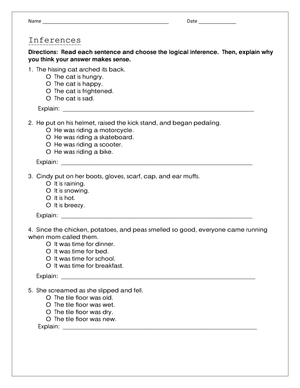
This gap is common at fourth grade — the verbal inference is there, but the written version collapses into a one-word answer or a retelling. The two-part question format in making inferences worksheets for 4th grade addresses this directly by requiring a written statement of the inference and a written quote or paraphrase of the supporting evidence. Students who can speak the inference but not write it usually need the prompt broken into two explicit blanks rather than one open-ended box. The format on these worksheets does exactly that.
How do I assess whether a student is inferring correctly when inference is inherently interpretive?
The standard isn't whether the inference is the only possible one — it's whether the inference is supported by evidence in the text. An answer key for inference tasks lists the most well-supported conclusions, but a different inference that a student can connect to a specific detail is also valid. What isn't acceptable is an inference that contradicts the text or that can't be tied to any specific language in the passage. When assessing, read the evidence column first, not the inference column. The evidence tells you far more about what the student actually did with the text.
How many worksheets from the set should I use in a week?
One or two per week is generally enough for practice purposes. Inference benefits from spaced repetition rather than massed practice — students who work through five inference tasks in a single sitting rarely retain more than students who complete one on Monday, one on Wednesday, and briefly review both on Friday. Use the set across a unit rather than front-loading it in the first few days.












 Interactive Worksheet Maker
 Quiz Maker
 Word Search Maker
 Crossword Puzzle Maker
 Word Scramble Generator
 Sentence Scramble Generator
 Handwriting Worksheet Generator
 Name Tracing Generator
 Fill In The Blank Generator