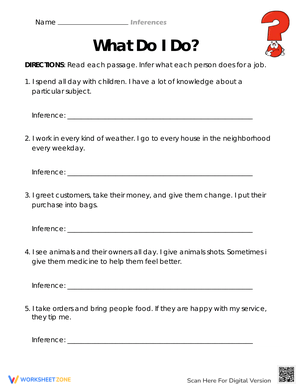
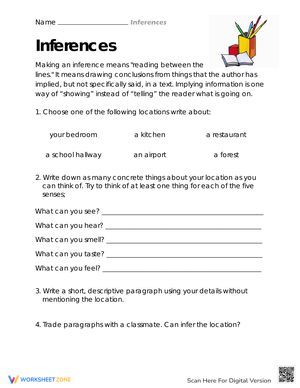
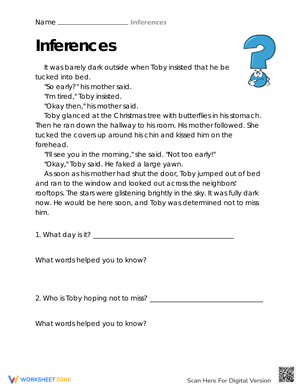
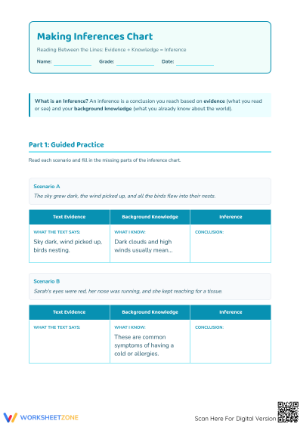
These making inferences in nonfiction printable worksheets for 4th grade give teachers a direct line to one of the most demanding comprehension moves in upper elementary — drawing a conclusion the author implies but never states directly. Each worksheet pairs a short informational passage with structured response tasks that make the reasoning process visible, so a teacher can pinpoint exactly where a student's thinking went sideways.
Why Nonfiction Inference Trips Up Fourth Graders More Than Fiction Inference
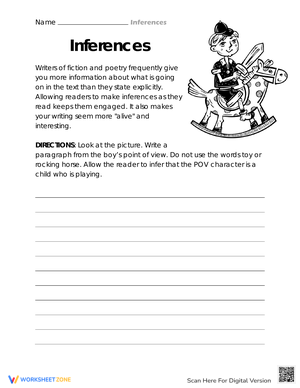
Students who can read a slammed door and a character's crossed arms and correctly infer anger often go completely blank when asked what a nonfiction passage implies. The skills look similar but draw on different raw material. Fiction inference runs on emotional recognition — students map observed behavior to feelings they've lived themselves. Nonfiction inference requires connecting factual text details to domain knowledge they may not hold in equal amounts. A passage describing annual rainfall below ten inches, extreme day-to-night temperature swings, and vegetation with thick, water-storing stems never uses the word desert. Students must pull those three details together and apply prior knowledge of biomes to land on that conclusion. How well they can do that depends heavily on what science content they've already absorbed, which is why nonfiction inference consistently needs more explicit instruction time than teachers usually give it.
What Students Do Inside Each Worksheet
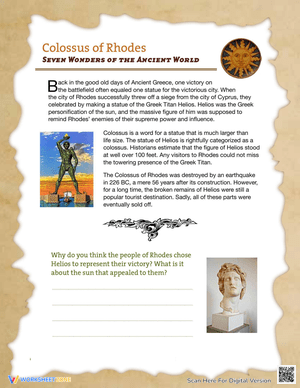
The set targets the specific inference tasks fourth graders encounter on both standardized assessments and in content-area reading. Students underline relevant text evidence, complete a three-column organizer (what the text says / what I already know / my inference), and then write their conclusion in one or two full sentences. Several worksheets center on text features specifically — students interpret a caption, read a labeled diagram, or examine a simple bar chart and write what each feature implies beyond its literal content. Others ask students to identify a second piece of evidence that either supports or complicates the inference they've already written, which pushes thinking past the single-detail answer most students default to early in the year.
Topics span science and social studies content fourth graders regularly encounter in other subjects:
- Animal adaptations and survival strategies
- Weather patterns and extreme weather events
- Landform processes such as erosion and sediment deposition
- Early American settlements and community roles
- Geographic features and regional environments
The making inferences in nonfiction printable worksheets for 4th grade in this set travel well across the school day — the passages connect directly to science and social studies content, so teachers can pull from the set during content-area time as easily as during ELA.
Where Student Thinking Breaks Down
The most common error is conflating prior knowledge with text evidence. A student produces a perfectly reasonable inference — but when asked to point to the passage support, they can't find it because the conclusion came entirely from what they already knew about the topic. The three-column format makes this visible immediately: the "what the text says" column is blank, or it contains a sentence the student recalled from memory rather than pulled from the text in front of them.
A second pattern — most noticeable early in the year — is stopping one level short. Shown a photograph of a flooded street alongside a passage about a coastal storm, students write "it rained" rather than reaching toward what the author is actually communicating: that the storm caused serious damage to the surrounding area. They read the image literally instead of asking why the author chose to include it at that moment in the text. Direct instruction on text features as argumentative choices, not decorations, closes this gap faster than repeated inference practice alone.
A third error appears with high-knowledge readers. A student who already knows a great deal about ocean ecosystems may write an inference that extends well beyond anything the passage implies — they've stopped reading the text and started composing from memory. The three-column organizer catches this too: the text evidence column won't support the sprawling conclusion sitting beside it.
Building These Worksheets Into Your Reading Block
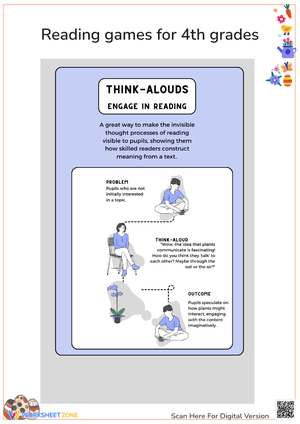
Begin with a whole-class think-aloud that deliberately delays access to the body text. Project the informational passage and cover the paragraphs — leave only the title, subheadings, photographs, and captions visible. Ask students what they can infer from those features before they read a single sentence of the main text. This forces reliance on visual and structural evidence and builds enough initial confidence that the full passage feels less daunting. After students read the body text, model how to return to those early inferences and check whether the new information confirms or revises them. That revision habit is one of the more transferable things students carry away from this kind of practice.
After whole-group modeling, hand out the making inferences in nonfiction printable worksheets for 4th grade and move students into pairs. Partners should argue their inferences out loud before writing them down — a student who has to defend a conclusion to a classmate catches unsupported reasoning faster than one working in silence. When circulating, press every pair with "where in the text?" rather than "is that right?" A completed organizer collected before the end of class gives a clear read on which students are grounding conclusions in evidence and which are guessing from background knowledge alone — and that information drives the next day's instruction directly.
Standard Alignment
The primary standard is CCSS.ELA-LITERACY.RI.4.1, which requires students to refer to details and examples in a text when explaining what the text says explicitly and when drawing inferences from it. In classroom terms, this is the "cite your evidence" expectation that runs underneath almost every reading discussion and written response in fourth grade. The three-column organizer operationalizes RI.4.1 directly: students identify a specific text detail before they write any inference, making the link between evidence and conclusion explicit rather than assumed. The text feature worksheets also address CCSS.ELA-LITERACY.RI.4.7, which calls for students to interpret information presented visually, including charts, diagrams, and photographs alongside connected written text.
Getting the Set to Work for Every Reader in the Room
For students reading below grade level and for English language learners still building academic vocabulary, the three-column organizer gives enough structure on its own. Adding sentence frames directly to the worksheet — "The text states ___, which leads me to think ___" — gives students the language they need without removing the inferential reasoning itself. Pre-marking one or two key phrases in the passage also helps: it shifts the cognitive load away from evidence-hunting and toward making sense of the evidence once found. That's the right place for the challenge to sit.
For students who are ready for more, remove the organizer and give them an open-ended prompt requiring a full paragraph with at least two pieces of text evidence cited. A stronger extension asks them to evaluate which piece of evidence in the passage best supports the inference and explain why another detail, while relevant, is less convincing. That comparative reasoning — ranking evidence by reliability — begins developing the analytical writing skills students will need in fifth grade and that show up on state assessments as constructed-response questions requiring multi-evidence support.
Frequently Asked Questions
What makes nonfiction inference harder to teach than fiction inference at this grade level?
Fiction inference draws on emotional experience, which fourth graders have in abundance. Nonfiction inference draws on domain knowledge — facts about science, geography, or history — that students hold in very unequal amounts depending on their prior schooling and out-of-school experience. When a student lacks background knowledge on a topic, they often can't generate an inference even when the text clues are strong. That's a content-knowledge gap, not a reading-strategy gap, and it's why nonfiction inference instruction works best when paired with sustained content-area teaching rather than treated as a standalone ELA strategy.
Can I use these worksheets as a formative assessment tool?
The making inferences in nonfiction printable worksheets for 4th grade work well as formative checks precisely because the three-column format separates the components of the inference. A student who correctly identifies text evidence but writes a weak conclusion is in a different instructional place than one who skips the evidence column entirely. A completed organizer returns more diagnostic information than a right-or-wrong answer alone, and reviewing a class set before the next lesson takes less time than most teachers expect.
How should I respond when a student's inference is defensible but wasn't the expected answer?
Ask them to point to the text evidence. If they can cite a detail from the passage that genuinely supports their conclusion, the inference stands — even if it wasn't anticipated. Nonfiction inference practice should teach students to anchor conclusions in evidence, not to converge on a single predetermined answer. When an unexpected inference is text-supported, a brief class conversation about it does more instructional work than marking it wrong. Discussing why one piece of evidence makes an inference more reliable than another is exactly the kind of reasoning RI.4.1 demands.












 Interactive Worksheet Maker
 Quiz Maker
 Word Search Maker
 Crossword Puzzle Maker
 Word Scramble Generator
 Sentence Scramble Generator
 Handwriting Worksheet Generator
 Name Tracing Generator
 Fill In The Blank Generator