




























Views
Downloads



Printable Making Inferences Chart Worksheet | Grade 4-6

Paste this activity's link or code into your existing LMS (Google Classroom, Canvas, Teams, Schoology, Moodle, etc.).
Students can open and work on the activity right away, with no student login required.
You'll still be able to track student progress and results from your teacher account.
Strengthen critical reading habits with this comprehensive three-page worksheet designed to help students master the art of drawing conclusions. By explicitly breaking down the process into observable text evidence and personal background knowledge, students learn to articulate the logical steps required to reach an accurate inference within nonfiction and situational contexts.
At a Glance
- Grade: 4–6 · Subject: English Language Arts
- Standard:
CCSS.ELA-LITERACY.RI.4.1— Refer to details and examples in a text when drawing inferences- Skill Focus: Evidence-based inferencing
- Format: 3 pages · 5 tasks · Answer key included · PDF
- Best For: Reading comprehension practice and small groups
- Time: 35–45 minutes
This resource features a structured graphic organizer that guides students through five distinct scenarios. The multi-page format provides ample writing space for learners to record "What the Text Says" alongside "What I Know," ensuring they don't skip the vital step of justifying their conclusions with specific evidence. A complete answer key is provided to facilitate quick grading or student self-correction.
Skill Progression
- Guided Practice: Students begin with three scaffolded scenarios where parts of the inference chart are pre-filled, allowing them to focus on either identifying the missing evidence or articulating the final conclusion.
- Supported Practice: In the "Mystery Package" section, learners read a short narrative passage and must independently extract multiple pieces of evidence to support a central inference about the story's outcome.
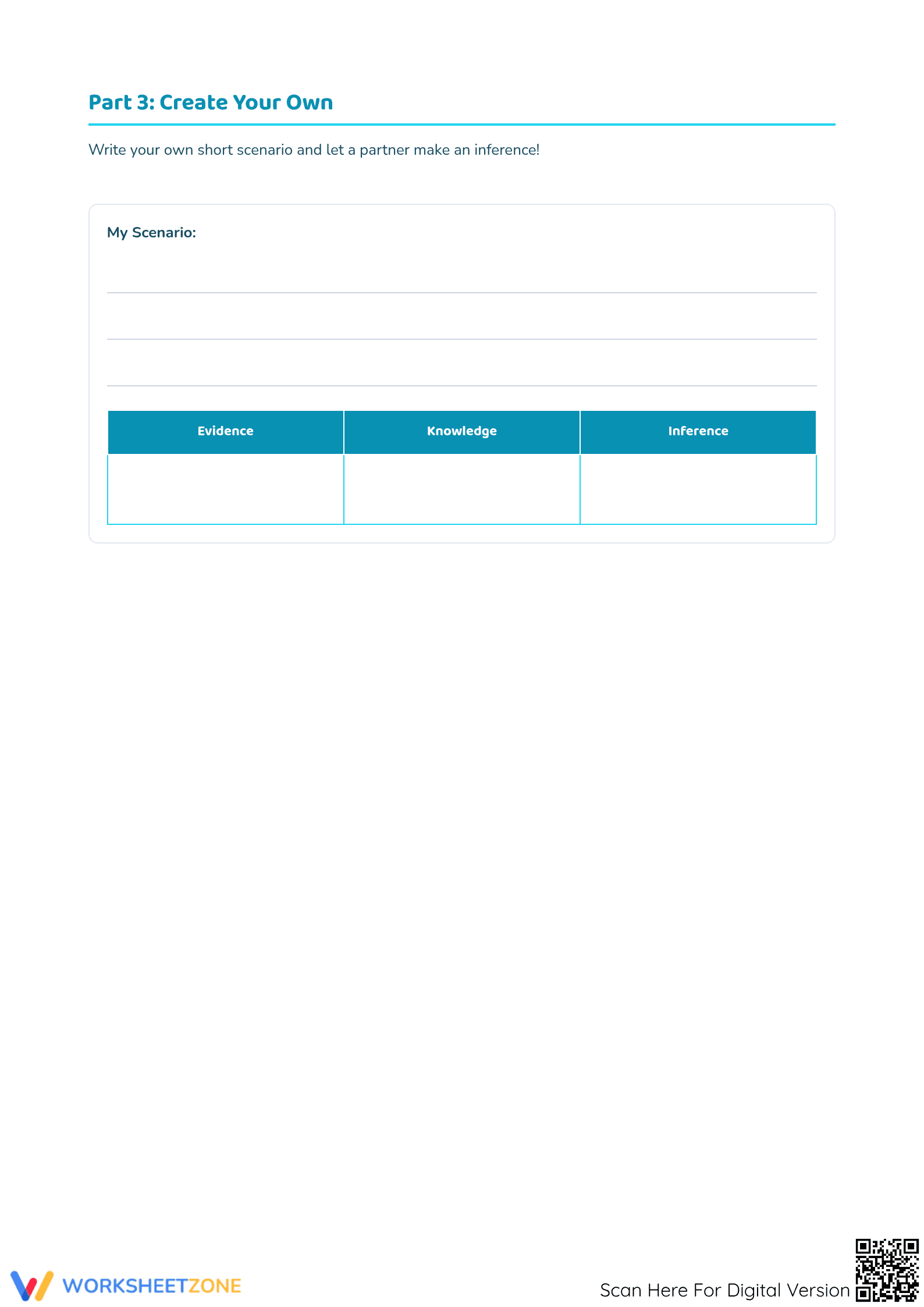
- Independent Application: The final "Create Your Own" section challenges students to reverse-engineer the process by writing their own scenario for a peer to solve, demonstrating high-level mastery of the concept.
This scaffolded approach follows the gradual release of responsibility model, moving students from heavy teacher support to total independent creation.
Standards Alignment
This worksheet aligns directly with `CCSS.ELA-LITERACY.RI.4.1` (and its 5th and 6th-grade equivalents), which requires students to refer to details and examples in a text when explaining what the text says explicitly and when drawing inferences. Both standard codes can be copied directly into lesson plans, IEP goals, or district curriculum mapping tools to document evidence-based reading instruction.
How to Use It
Utilize this chart during the "We Do" phase of a direct instruction lesson on nonfiction analysis. Teachers can project the first page and model the "Sky Dark" scenario to show how background knowledge about weather patterns connects to the text's description. Use the independent practice section as a formative assessment to observe which students struggle to distinguish between literal evidence and inferred conclusions. Expect completion within 40 minutes for most upper elementary students.
Who It's For
This resource is optimized for 4th, 5th, and 6th-grade students who are transitioning from literal comprehension to deeper text analysis. It serves as an excellent differentiation tool for English Language Learners (ELLs) by providing sentence frames and a clear visual hierarchy. Pair this worksheet with a nonfiction passage from a science or history text to apply these skills to content-area reading.
The ability to synthesize explicit text evidence with external knowledge is a foundational pillar of academic literacy. This worksheet addresses CCSS.ELA-LITERACY.RI.4.1 by guiding students to isolate "what the text says" from "what I know," reducing common errors where learners make guesses without textual support. By practicing with short, high-interest scenarios before moving to longer texts, students build the cognitive stamina required for deeper text analysis. This systematic approach ensures that drawing conclusions becomes a repeatable strategy, supporting long-term growth in reading comprehension and analytical writing.


