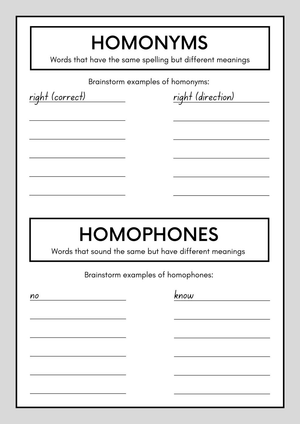
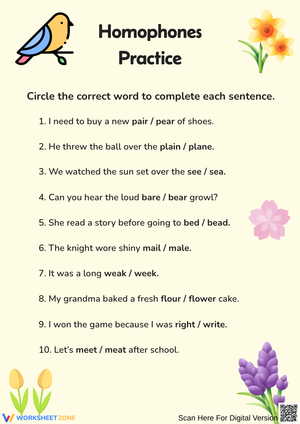
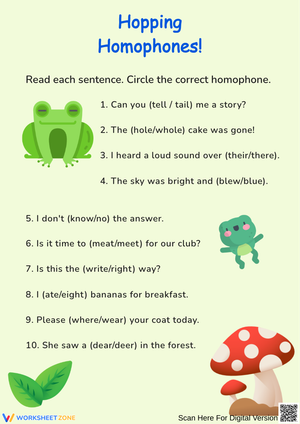
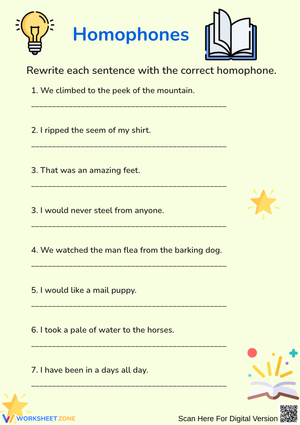
4th grade homophones worksheets give teachers a focused, efficient way to address one of the most persistent accuracy problems in Grade 4 writing — words that students pronounce correctly in conversation but swap without noticing on the page. This set covers the high-frequency pairs and triplets that appear most often in student work at this level: to/too/two, their/there/they're, your/you're, hear/here, weak/week, and pair/pear, among others. Each worksheet targets meaning-in-context because that is where the instructional work actually lives — not in memorized definitions, but in the split-second decision a student makes mid-draft.
The Work Each Worksheet Asks Students to Do
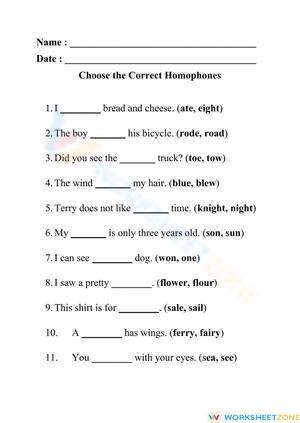
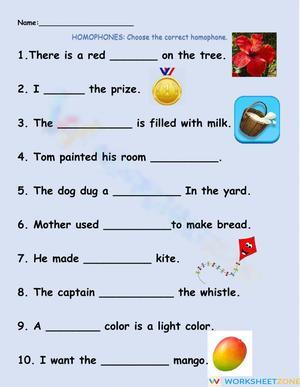
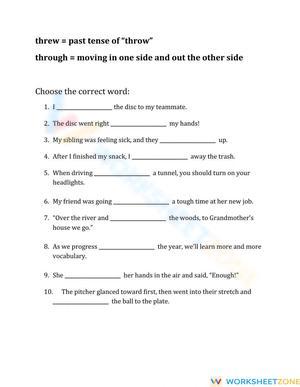
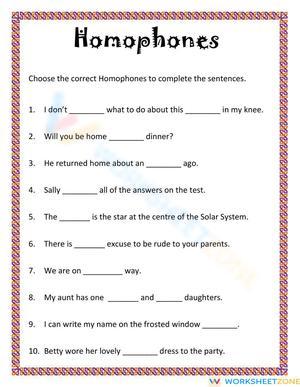
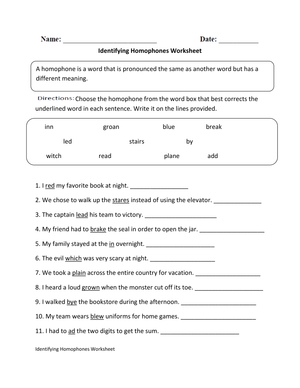
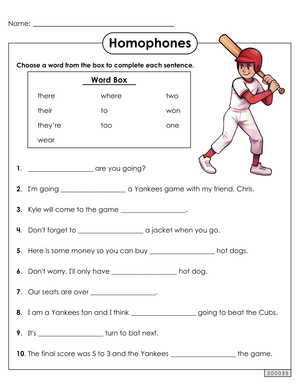
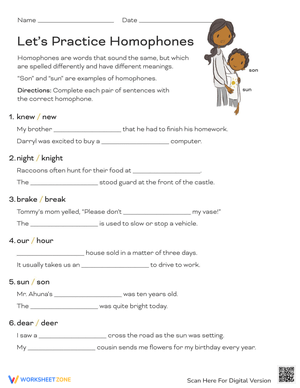
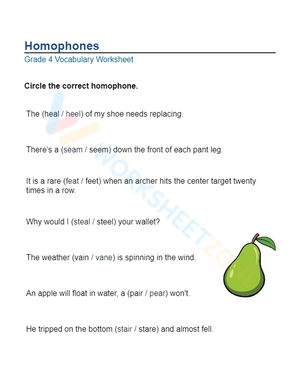
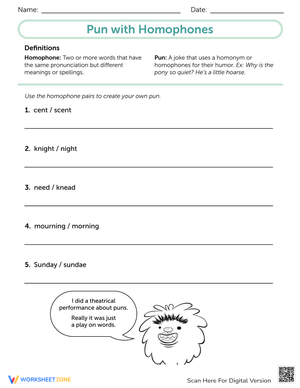
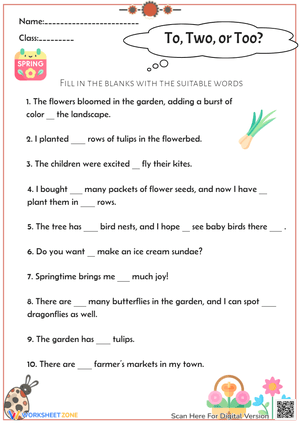
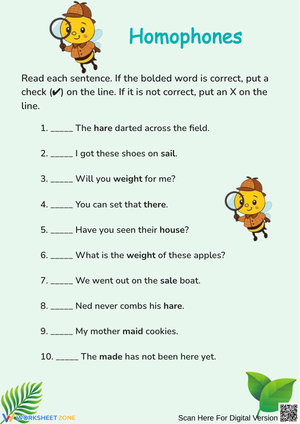
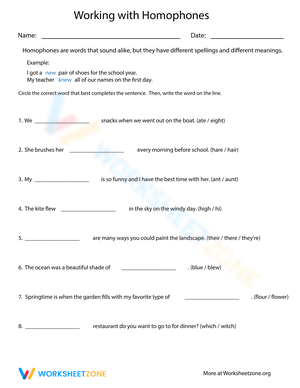
The set moves through several task types. Multiple-choice context sentences ask students to select the correct homophone from two or three options, with the surrounding sentence providing clear meaning clues. Fill-in-the-blank items require students to recall the right word independently rather than recognize it from a list. Error-correction tasks present a sentence with the wrong homophone inserted — students find it, replace it, and often explain why. Original sentence-writing prompts close the loop by asking students to demonstrate understanding through production rather than identification.
Matching activities appear in some worksheets as an entry point, but the more demanding work comes from context-based items. A student who correctly links their to "possessive" on a definition task will still write "their going to the game" in a first draft — which is exactly why 4th grade homophones worksheets need to move past the matching format if the goal is accuracy that transfers into actual writing.
Student Error Patterns Worth Knowing Before You Assign These
The most reliable predictor of homophone errors at Grade 4 is drafting speed, not vocabulary knowledge. Students who show perfect accuracy during a focused review exercise will substitute you're for your mid-paragraph because working memory is occupied with organizing ideas at the same time. That is a different problem than not knowing the distinction, and it calls for a different instructional response than reteaching the definition.
A second pattern is overgeneralization. After learning that there indicates location, some students apply it broadly — to possessives and contractions — because the location rule felt solid and they stop before learning all three forms. The resulting sentence — "There going to there house" — comes from a student who grasped one meaning, not from a student who learned nothing. Error-correction items on these worksheets surface this pattern quickly because students have to read for sense rather than rely on visual familiarity with the word shape.
Smart Ways to Build These Worksheets Into Your Weekly Routine
A five-day rotation works without consuming much time. Introduce two or three pairs Monday through a brief whole-class discussion with example sentences on the board. Tuesday, assign a context-sentence worksheet for independent practice. Wednesday, run an error-correction worksheet as a center or partner activity and ask students to verbally justify at least one answer to a peer. Thursday, have students reread a current writing draft and circle any spots where a target homophone appears — a bridge from isolated practice to real editing. Friday, a short sentence-writing check shows which students are ready to move on.
These worksheets also fit the last eight minutes before dismissal, the Monday warm-up after morning meeting, and substitute folders where clear instructions matter most. Error-correction items work especially well in low-transition slots because they are self-contained and brisk. For small-group time, pull students who are confusing the same pairs and work through a single worksheet together while other students complete different types independently — the format is consistent enough that no one needs extended verbal setup to get started.
Standard Alignment
CCSS.ELA-LITERACY.L.4.1.G specifically asks students to correctly use frequently confused words, citing to/too/two and there/their as direct examples. The worksheets address that standard through contextual practice — word choice in service of meaning — rather than through spelling drills. That distinction matters for alignment purposes because L.4.1.G sits inside the Language Conventions domain, where the emphasis is on using language correctly during writing, not on isolated vocabulary identification in a controlled task.
The set also supports W.4.4 and W.4.5, which address clarity and the revision process in student writing. When a student completes an error-correction worksheet and then applies the same thinking to a draft, that is precisely the progression the writing standards describe. Used this way, 4th grade homophones worksheets function as a bridge between language conventions work and the editing phase — not a detour from the writing block, but a direct input into it.
Adjusting These Worksheets for a Range of Learners
Students don't confuse the same words for the same reasons, and differentiated assignments let teachers address those differences without building entirely separate lessons.
- Students who need extra support: Pair them with worksheets that offer two-option multiple choice and a word bank printed near each item. Reducing the number of choices is not about lowering expectations — it removes guessing so you can see whether a meaning gap is actually present or whether the student just needs more processing time.
- On-level students: Fill-in-the-blank and error-correction formats work well here. Context clues are available, but students have to locate them independently rather than being pointed toward them.
- Students ready for a challenge: Move them into the original sentence-writing tasks and ask them to underline the context clue in each sentence that signals which homophone they chose. Naming the clue is a stronger indicator of genuine understanding than simply getting the answer right.
Task length is another variable worth adjusting. One shorter worksheet may be enough for a student who already demonstrates consistent accuracy — more items won't deepen the learning. A student still working through the basic pairs may need a full worksheet plus a brief teacher check-in to identify exactly which words remain uncertain.
Frequently Asked Questions
What homophone pairs are covered across the set?
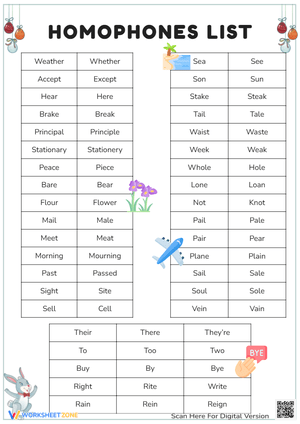
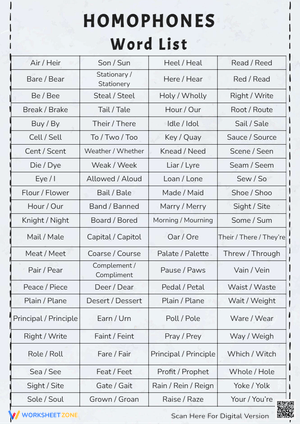
The worksheets cover high-frequency pairs and triplets that appear most often in Grade 4 reading and writing: to/too/two, their/there/they're, your/you're, hear/here, weak/week, pair/pear, right/write, and knot/not, among others. Priority goes to words students are likely to encounter — and misuse — in their own writing rather than to obscure or low-frequency pairs.
Do the worksheets include answer keys?
Yes. Each worksheet comes with a full answer key, which makes the set practical for literacy centers, substitute folders, early-finisher work, and homework — any setting where immediate teacher review isn't possible at the moment of completion.
How do these fit into an existing ELA block?
Most teachers use 4th grade homophones worksheets as warm-up activities, as independent practice following a mini-lesson, or as a quick formative check at the end of a unit segment. The task formats are self-explanatory enough that students can begin without extended verbal instructions, which matters during transitions and center rotations when teacher attention is split.
Which worksheet type gives the clearest picture of student mastery?
Sentence-writing tasks — where students produce their own examples rather than choose from options — reveal more than multiple-choice checks. A student who writes an accurate, contextually sound sentence using your in one item and you're in another is demonstrating the kind of applied understanding that carries into real writing. Use production-level tasks as a formative assessment after the recognition and editing work is complete.












 Interactive Worksheet Maker
 Quiz Maker
 Word Search Maker
 Crossword Puzzle Maker
 Word Scramble Generator
 Sentence Scramble Generator
 Handwriting Worksheet Generator
 Name Tracing Generator
 Fill In The Blank Generator




 BACK TOSCHOOL