


























Views
Downloads

Grade 4 Homophones — Printable No-Prep Worksheet
Paste this activity's link or code into your existing LMS (Google Classroom, Canvas, Teams, Schoology, Moodle, etc.).
Students can open and work on the activity right away, with no student login required.
You'll still be able to track student progress and results from your teacher account.
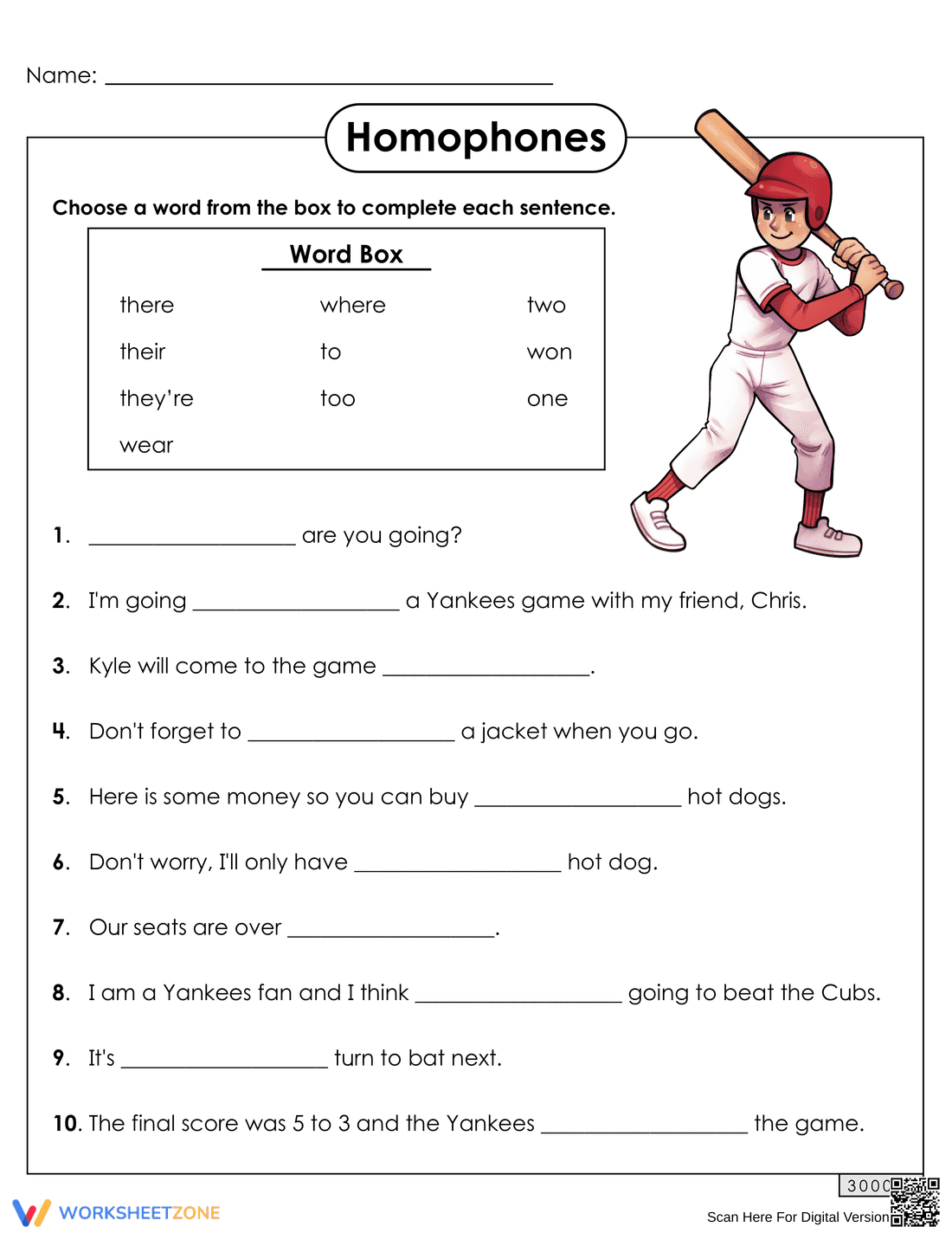
This printable Grade 4 ELA worksheet helps students master frequently confused words by selecting the correct homophone for context-rich sentences. Students read baseball-themed sentences and choose the proper spelling from a provided word bank, building essential vocabulary and grammar skills for clear, accurate writing.
At a Glance
- Grade: 4 · Subject: ELA
- Standard:
CCSS.ELA-LITERACY.L.4.1.G— Correctly use frequently confused words in context- Skill Focus: Homophones
- Format: 2 pages · 10 problems · Answer key included · PDF
- Best For: Independent practice
- Time: 10–15 minutes
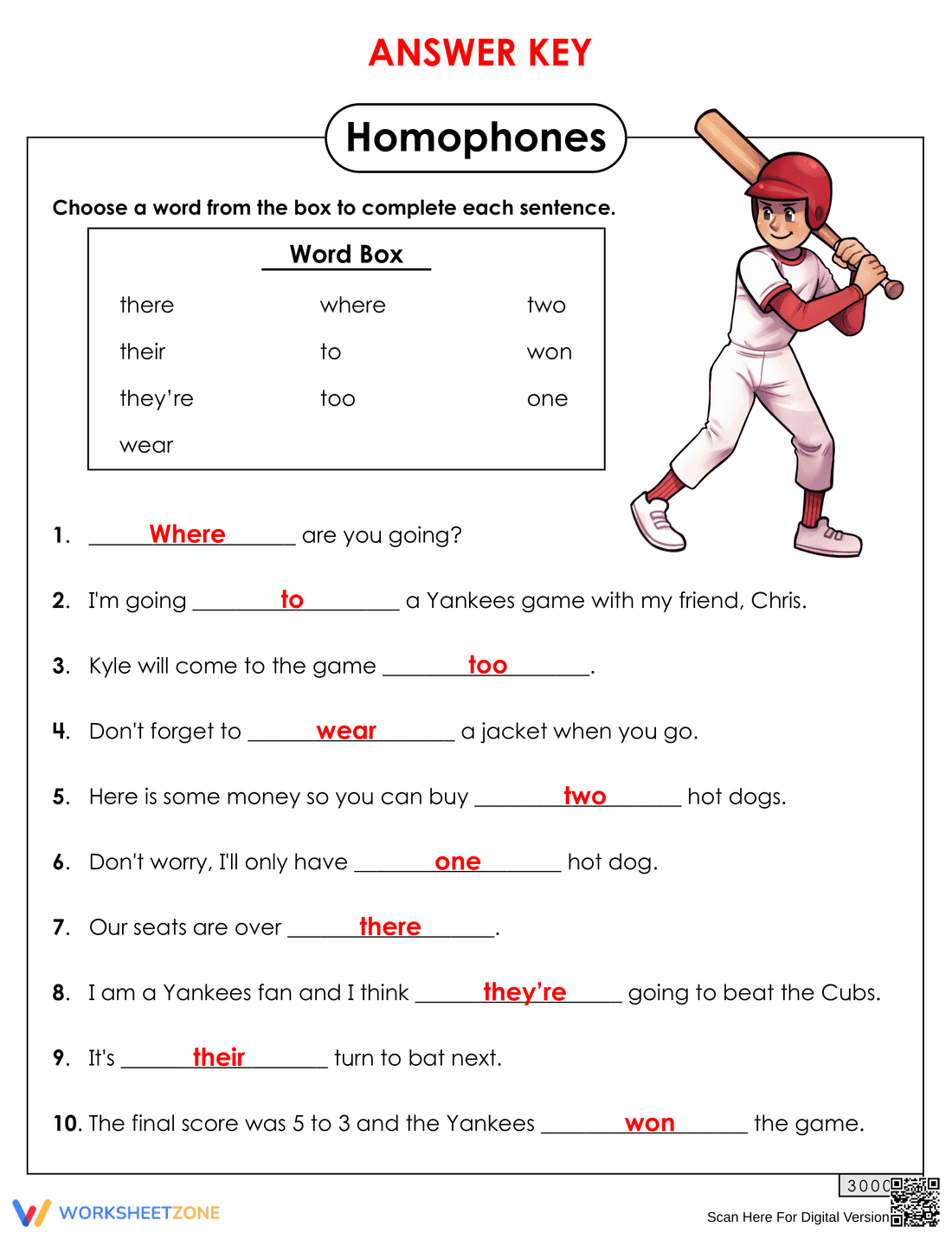
This resource features a single-page student worksheet containing 10 fill-in-the-blank sentences. A convenient word box at the top provides the target homophones, including common sets like there/their/they're and to/too/two. The sentences follow an engaging baseball theme to maintain student interest. A complete, color-coded answer key is included on the second page for rapid grading.
Zero-Prep Workflow
- Print (1 minute): Generate the PDF and print the student page. The black-and-white design saves ink.
- Distribute (1 minute): Hand out the worksheet. The clear instructions and word bank mean students can begin immediately.
- Review (3 minutes): Use the included answer key to quickly check student work or project it for self-correction.
Total teacher prep time is under two minutes. The self-explanatory format makes this an excellent, reliable option for emergency sub plans.
Aligned to CCSS.ELA-LITERACY.L.4.1.G: Correctly use frequently confused words (e.g., to, too, two; there, their). This worksheet provides targeted practice on distinguishing meaning and spelling for identical-sounding words. Both standard codes can be copied directly into lesson plans, IEP goals, or district curriculum mapping tools.
Deploy this worksheet during independent practice after a direct instruction mini-lesson on homophones. It also serves well as a morning work activity or a quick formative assessment. While students work, observe whether they rely heavily on the word bank or if they can automatically recall the correct spelling based on the sentence context. Expected completion time is 10 to 15 minutes.
This resource is designed for fourth-grade general education students developing their foundational grammar skills. It provides built-in scaffolding via the word box, making it accessible for English Language Learners and students needing vocabulary support. Pair this worksheet with a visual anchor chart illustrating the different meanings of there, their, and they're.
Mastering frequently confused words is a critical component of writing fluency and overall literacy development. According to EdReports 2024, explicit practice with vocabulary in context significantly improves reading comprehension and written expression. This worksheet directly supports CCSS.ELA-LITERACY.L.4.1.G by requiring students to correctly use frequently confused words in context. By evaluating the syntactic and semantic clues within each baseball-themed sentence, learners must actively distinguish between homophones rather than relying on rote memorization. This targeted application helps solidify the orthographic mapping necessary for accurate spelling during independent writing tasks. Providing structured opportunities to differentiate words like "wear" and "where" reduces common grammatical errors in later grades, ensuring students can communicate their ideas clearly and effectively across all academic subjects. Consistent practice with these specific word sets builds lasting linguistic confidence.


