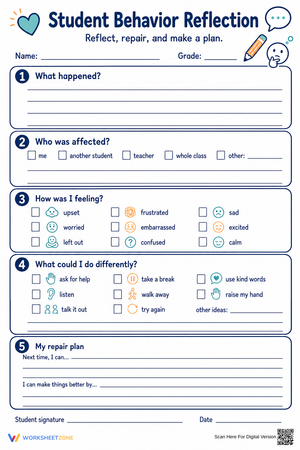
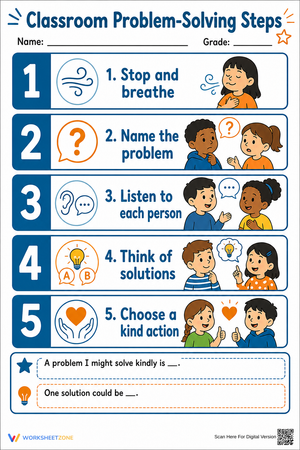
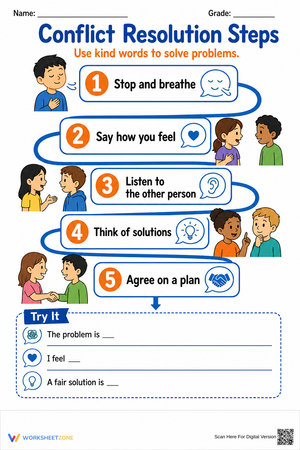
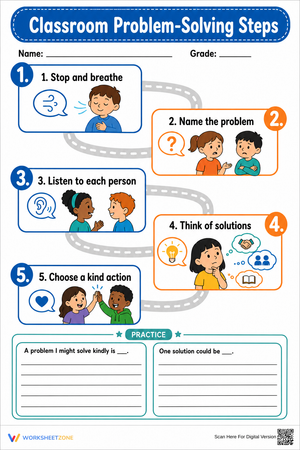
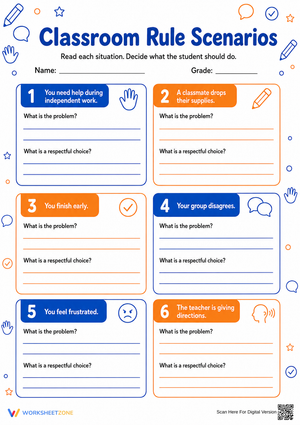
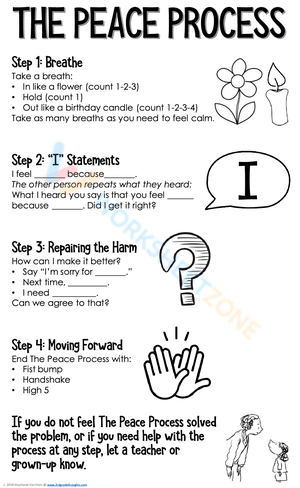
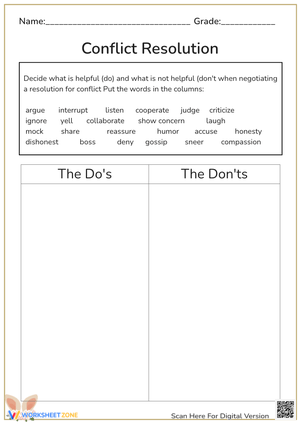
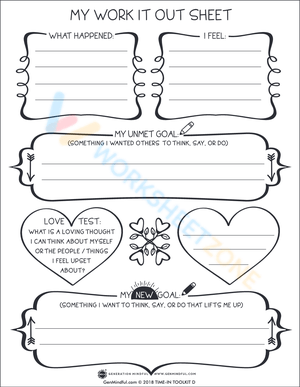
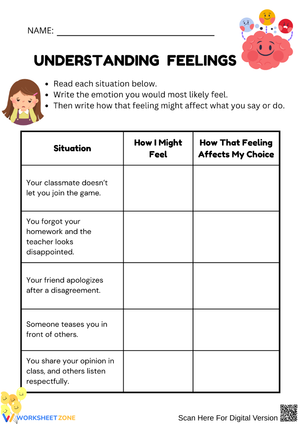
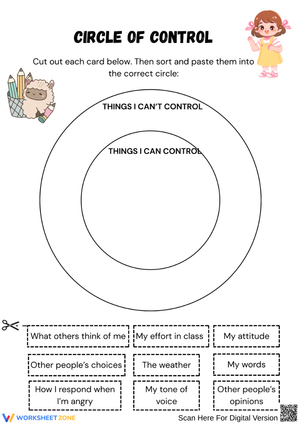
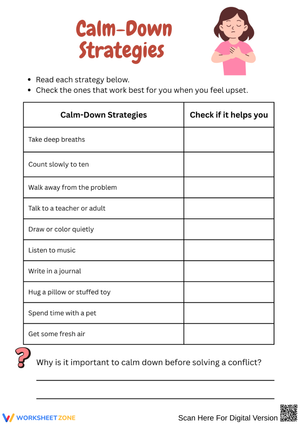
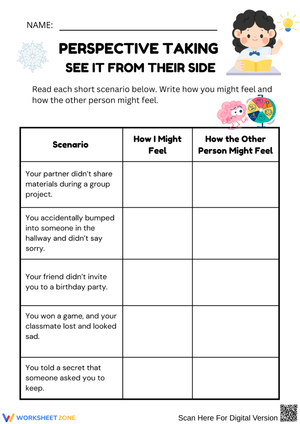
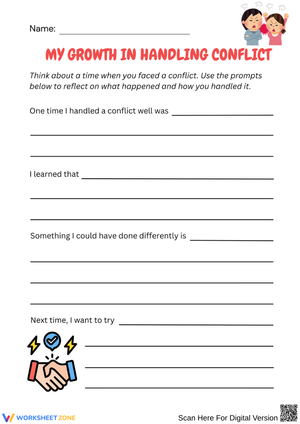
These conflict resolution worksheets printable for 4th grade give teachers a ready set of practice resources for one of the most socially charged years in elementary school — the point at which peer friendships grow more complex, group identity starts to matter, and small misunderstandings can harden into lasting grudges. Each worksheet targets a specific, named skill: constructing "I" statements, sorting conflicts by problem size, planning responses using a stop-breathe-think sequence, or analyzing a conversation for active listening versus dismissal. Teachers get something usable without a lesson plan rewrite.
What Students Work Through
The set covers four overlapping skill areas, each with enough scenario variety that the same class can revisit a worksheet type across the year and still work with fresh material. These conflict resolution worksheets printable for 4th grade are organized so the skills build on each other — emotional identification comes before response planning, and response planning comes before full scenario resolution — but each worksheet also stands on its own for a targeted mini-lesson or counselor session.
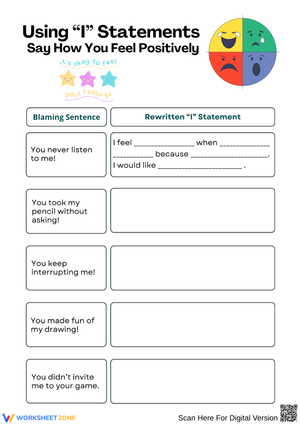
- "I" statement construction. Students read a peer conflict scenario and write a complete statement using the four-part frame: what they feel, what triggered it, why it matters, and what they need. The blank-frame format forces students to name an emotion more specific than "mad" — which, for most 9- and 10-year-olds, is harder than it looks.
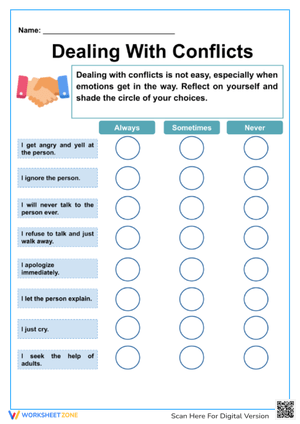
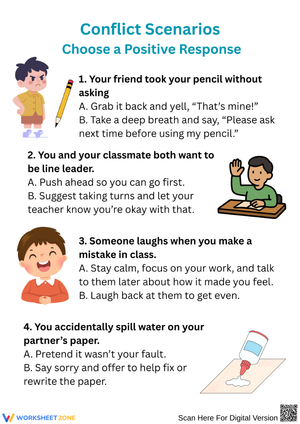
- Problem-size sorting. Students label a mix of scenarios as small, medium, or large, then match each label to an appropriate response type. The critical skill here is separating the size of the problem from the intensity of the feeling — a distinction most 4th graders have not been explicitly taught.
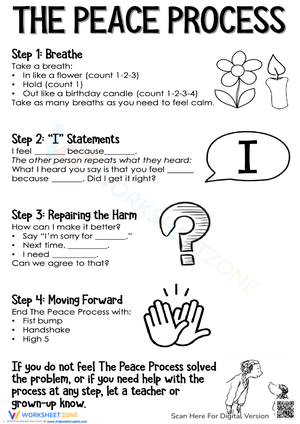
- Stop-Breathe-Think response planning. Students read a conflict scenario and write what they would do at each of the three steps: what they stop, which breathing technique they use, and what solution they land on after reflection. The format slows the automatic reaction loop before it can run.
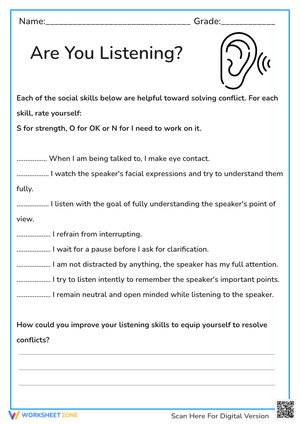
- Active listening annotation. Students mark a printed conversation script, identifying which lines show genuine listening and which show dismissal, then rewrite the dismissive lines. This worksheet works especially well after a partner role-play when student responses are still fresh.
Error Patterns Worth Watching When You Assign These Worksheets
The most reliable error in "I" statement work is what teachers sometimes call the pronoun swap: students start correctly — "I feel left out when you don't save me a seat" — and then collapse into character judgment in the third clause: "because you're always mean to me." That shift from describing an action to evaluating a person is exactly the move that escalates real arguments, and it shows up in written practice consistently enough to be worth addressing directly before students try the skill live. Pointing to it by name during instruction, and having students circle blame language in sample statements before writing their own, significantly reduces how often it appears.
Problem-size sorting produces a different pattern. Students who are conflict-averse tend to downgrade everything — a peer physically shoving them will sometimes get labeled "small" because they don't want to appear dramatic. Students who are more reactive do the opposite, rating an accidental bump as a crisis. Both error patterns are diagnostic. They tell a teacher who needs help with assertiveness and who needs help with proportion — which matters far more than a right-or-wrong score on the worksheet itself.
In the Stop-Breathe-Think worksheet, the "Think" step consistently reveals avoidance. Students write "I would just walk away" for nearly every scenario, including ones that clearly require a spoken response. Walking away is sometimes the right call, but when it appears as the only strategy across a full worksheet, it signals a student who has learned to exit conflict rather than work through it.
Building These Worksheets Into Your Lesson Rhythm
The strongest placement for the problem-size sorting worksheet is Monday morning meeting, before any specific conflict has flared. When the whole class sorts hypothetical scenarios together in a low-stakes discussion, they build shared language — "that's a medium problem" can become a phrase peers actually use on the playground without it sounding borrowed from a teacher script. Project one scenario at a time, ask students to hold up one, two, or three fingers for their rating, then spend 90 seconds on any split votes. The disagreements are the lesson.
Use the "I" statement worksheet right after a collaborative group activity, not during an active conflict. The 10 minutes following partner work — when frustrations are still fresh but no one is in crisis — gives students real emotional material without the charge that shuts down reflection. Have partners swap worksheets and check each other's statements specifically for the blame-shift error: does the third clause describe an action or judge a character? That peer review step takes three minutes and produces more honest feedback than a teacher correction does for this particular skill.
Conflict resolution worksheets printable for 4th grade also hold up well as structured debrief tools during counselor sessions. Rather than narrating an incident in unstructured terms, a student marks the problem-size scale and explains their rating. The written response gives the classroom teacher a more useful entry point when following up than a secondhand summary does. Some teachers send the "I" statement worksheet home after a recurring class conflict with a brief note explaining the strategy — parents can reinforce the language without needing to mediate the situation themselves.
Standard Alignment
These worksheets map to the CASEL framework's Relationship Skills competency, specifically the sub-skills of communicating clearly, listening actively, cooperating, and resolving conflicts constructively. At the 4th-grade level, CASEL expects students to move beyond basic turn-taking and begin practicing perspective-taking and deliberate communication strategies — the developmental window these resources target directly. The "I" statement and problem-size worksheets also address CASEL's Social Awareness competency, since completing them accurately requires students to consider how their words land on another person. Many districts have additionally mapped SEL expectations to state standards at the grades 3–5 band; the scenario content on each worksheet can be adjusted to align with locally mandated language without changing the underlying skill structure.
Making Each Worksheet Work Across a Range of Readiness Levels
For students who need more support, the "I" statement worksheet works best with an emotion word bank printed at the top. Without it, students who have limited emotional vocabulary spend their cognitive effort on word retrieval and never reach the harder work of describing the triggering action. A bank of 12 to 15 words — including terms like "overlooked," "irritated," and "embarrassed," which are more specific than the usual happy/sad/mad list — shifts the task from vocabulary recall to applied thinking.
Students who are further along can be pushed past the fill-in frame entirely. Ask them to write a two-turn exchange: their own "I" statement, a peer's likely first response, and then a follow-up reply that keeps the conversation moving toward resolution. This extension tests whether the student can hold the strategy across a real back-and-forth, not just produce a single sentence. For the problem-size worksheet, mixed-ability pairs often produce better results than individual work — a student who consistently overreacts paired with one who consistently underreacts will genuinely disagree about labels, and that disagreement is the whole point of the exercise.
Frequently Asked Questions
How do these worksheets fit into an 8- to 10-minute morning meeting?
The problem-size sorting worksheet runs cleanly in that window as a quick whole-group activity. Project one scenario at a time, have students signal their rating (one, two, or three fingers for small, medium, or large), then spend 90 seconds on any split votes. The teacher gets useful formative information about which students are consistently miscalibrating their responses — the ones who rate everything a three, or the ones who rate everything a one, stand out immediately.
Can a school counselor use these resources in pull-out sessions?
Yes. The Stop-Breathe-Think planning worksheet and the "I" statement frame both work well in individual or small-group counseling contexts. They give structure to conversations that can otherwise stay narrative and unfocused, and the written responses serve as a record the classroom teacher can review. Using conflict resolution worksheets printable for 4th grade in a counseling setting also lets the student practice the same language the rest of the class is learning, which reduces friction when returning to the classroom after a pull-out session.
What if students complete the worksheets quickly without real reflection?
Speed is a signal, not a success marker. Students who write single-clause "I" statements — "I feel sad. You were mean. Stop." — have completed the form, not learned the skill. A brief share-out where two or three students read their statements aloud quickly reveals whether the statements actually communicate clearly. Peer reaction is faster and more honest feedback than teacher correction for this skill, and it preserves the social dimension that makes the practice meaningful.
Do the conflict scenarios cover different social settings, or are they all recess-based?
The scenarios are distributed across three distinct contexts: classroom situations (group work disputes, shared materials), lunch and recess (exclusion, rule disagreements during games), and conflicts that originate outside school and carry in — something said in a group chat that becomes a hallway confrontation. That spread matters because a 4th grader who handles a classroom disagreement calmly may have no strategy for a lunch-table exclusion, and treating all peer conflict as one category misses that distinction entirely.












 Interactive Worksheet Maker
 Quiz Maker
 Word Search Maker
 Crossword Puzzle Maker
 Word Scramble Generator
 Sentence Scramble Generator
 Handwriting Worksheet Generator
 Name Tracing Generator
 Fill In The Blank Generator