


























Views
Plays
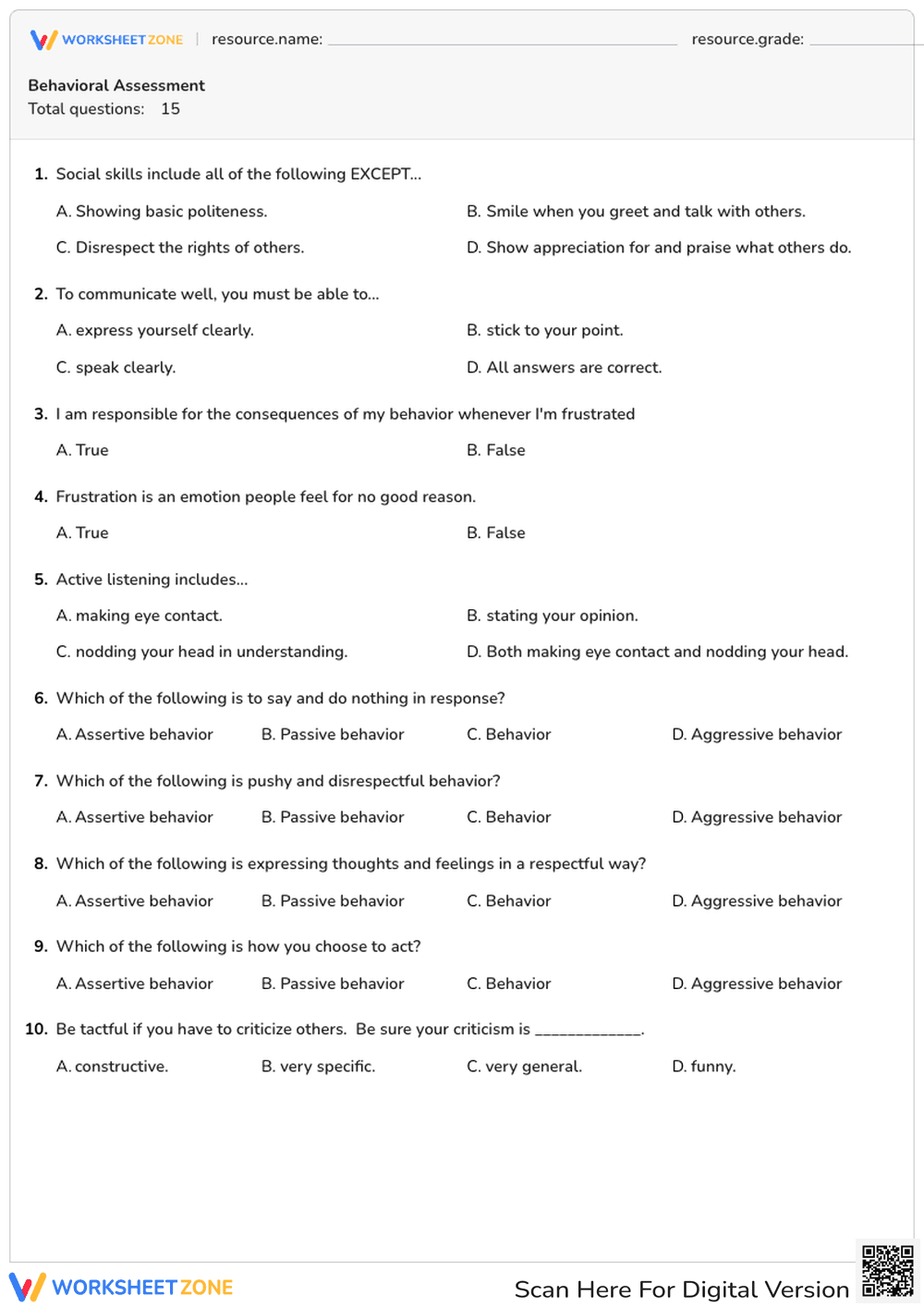


Behavioral Assessment Worksheet | Grade 5 Essential
Paste this activity's link or code into your existing LMS (Google Classroom, Canvas, Teams, Schoology, Moodle, etc.).
Students can open and work on the activity right away, with no student login required.
You'll still be able to track student progress and results from your teacher account.
This Grade 5 behavioral assessment provides a comprehensive check of student understanding regarding social interactions and emotional regulation. By evaluating 15 specific scenarios, students demonstrate their ability to distinguish between assertive and aggressive behaviors while identifying healthy communication strategies. It serves as a vital tool for measuring social-emotional growth in the classroom environment.
At a Glance
- Grade: 5 · Subject: Social Skills
- Standard:
CCSS.ELA-LITERACY.SL.5.1— Engage effectively in collaborative discussions and follow rules for social exchange- Skill Focus: Conflict Resolution & Communication
- Format: 3 pages · 15 problems · Answer key included · PDF
- Best For: Formative SEL assessment and classroom management
- Time: 15–20 minutes
What's Inside: This resource contains three pages of structured assessment questions. The tasks include multiple-choice questions and true-false statements covering active listening, accepting criticism, and identifying behavioral types. Visual aids are included for questions 11 through 15 to help students contextualize social scenarios, such as raising a hand in class or working effectively within a team.
Zero-Prep Workflow: This worksheet is designed for immediate classroom implementation. Teachers can print the three-page PDF in less than 30 seconds. Distribution takes approximately one minute, and because the questions are structured for clarity, students can begin working independently. Reviewing the 15 answers as a group provides an excellent opportunity for reflection, with minimal teacher preparation time required.
Standards Alignment: The primary standard addressed is `CCSS.ELA-LITERACY.SL.5.1`, which requires students to engage effectively in collaborative discussions and follow agreed-upon rules for social exchange. By identifying the best way to work with others and how to accept criticism, students meet the behavioral expectations outlined in the Speaking and Listening strand. This standard code can be copied directly into lesson plans, IEP goals, or district curriculum mapping tools.
How to Use It: Use this assessment as a formative tool after a unit on social-emotional learning or as a diagnostic at the start of the school year. It is effective during Morning Meeting or as a quiet activity during transitions. Teachers should observe which students struggle with the distinction between assertive and aggressive behavior to provide targeted support. Completion typically takes 15 to 20 minutes.
Who It's For: This resource is tailored for students in Grade 4, Grade 5, and Grade 6 who are developing interpersonal skills. It is an excellent fit for general education classrooms, special education settings, or school counseling sessions. It pairs naturally with an anchor chart on I-statements or a direct instruction lesson on active listening techniques.
According to research by Fisher & Frey (2014), the explicit teaching and assessment of social-emotional competencies are critical for academic success and classroom cohesion. This behavioral assessment aligns with evidence-based practices by requiring students to identify and categorize social behaviors such as active listening and assertive communication. By utilizing the 15 structured tasks, educators can gather measurable data on student mastery of `CCSS.ELA-LITERACY.SL.5.1`. The inclusion of visual prompts supports diverse learners in recognizing social cues, a key component of the NAEP framework for social-emotional development. This assessment provides a reliable method for tracking progress in conflict resolution and emotional regulation, ensuring that students are equipped with the necessary skills for collaborative learning environments. Such assessments are essential for creating a positive school climate and reducing behavioral disruptions through proactive skill-building.


