These circle of control pdf worksheets for 4th grade give students a practical framework for one of the harder emotional regulation moves: letting go of what they cannot change while still taking ownership of what they can. The set pairs scenario-sorting tasks with reflection prompts and a short action-planning section, moving the activity beyond a diagram fill-in into something students can actually use when the day goes sideways. Teachers who introduce this during morning meeting or a dedicated SEL block often find the vocabulary — "Is that in your circle?" — becoming part of how the class talks through conflict for the rest of the year.
What Students Practice in the Set
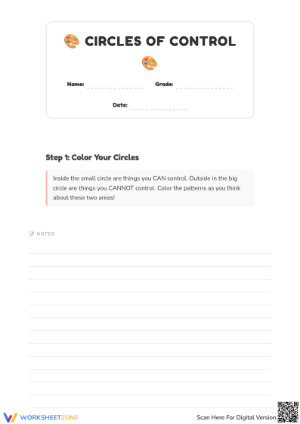
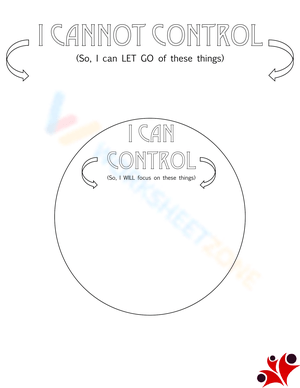
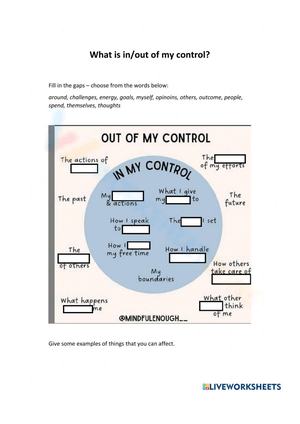
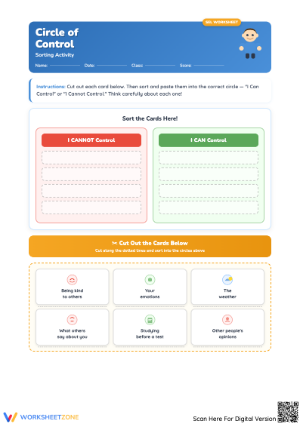
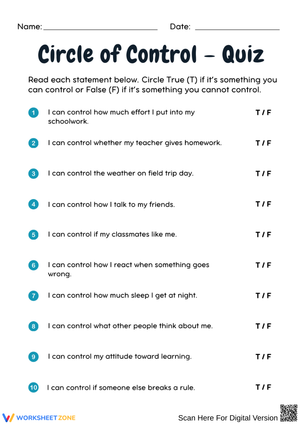
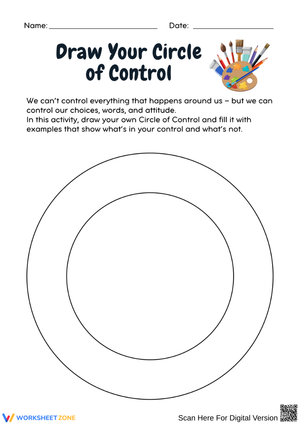
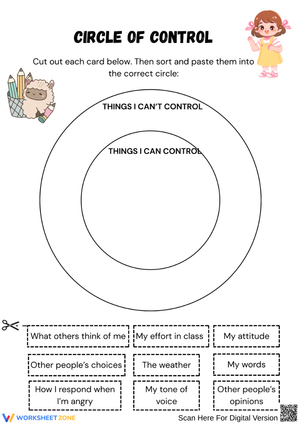
Each worksheet centers on the two-circle diagram: an inner ring for things within a student's control — effort, word choice, how they respond to a mistake — and an outer ring for things outside it, like the weather, a peer's mood, or what questions will appear on a test. The tasks build from recognition to application.
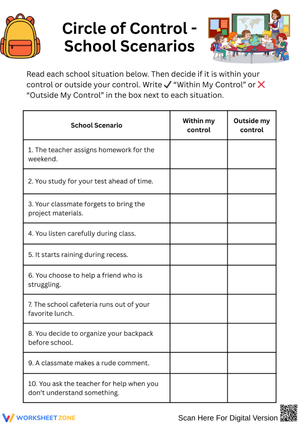
- Scenario sorting: students read situations drawn from the 4th-grade school day — a friend ignoring them at lunch, a teacher changing the seating chart — and decide which circle each belongs in.
- Self-generated examples: blank spaces inside and outside the diagram where students write or draw from their own experience rather than only reacting to provided scenarios.
- Reflection questions: written responses that ask students how it feels to focus on what they can change, and what gets harder when they keep their attention on the outer ring.
- Action commitment: a brief planning section where students name one specific thing they will focus on during the week ahead.
How to Work These Worksheets Into Your Lesson Plans
Before students touch any of the circle of control pdf worksheets for 4th grade, consider running a physical version first. Put a hula hoop on the floor and read scenarios aloud — "choosing how to react when you get a hard grade," "whether your friend decides to play with you at recess" — and have students step inside or outside the hoop accordingly. That five minutes of movement creates a concrete mental picture that makes the sorting task faster and more confident for nearly every student in the room, including those who would otherwise sit with a blank diagram.
The written activity works best immediately after the physical introduction, while the sorting logic is still warm. Students who need more time with the hoop can stay on the floor a bit longer while others move to their seats. For the reflection questions, a quick think-pair-share before writing cuts the blank-page hesitation that slows many 4th graders down.
The action-planning section earns its value across the week rather than in a single sitting. A 90-second check-in on Friday — "How did focusing on your circle go?" — turns what could be a one-time activity into a running classroom thread. When a student says unprompted, "I can't control that," during a conflict the following Monday, the lesson has done what it was meant to do.
Mistakes Students Make That These Worksheets Help You Catch
The most consistent confusion at this grade is between having a feeling and deciding what to do with it. Fourth graders often place "my anger" or "feeling nervous before a test" in the outer circle — things outside their control — which is partly accurate but misses the core lesson. The inner circle is about responses, not the absence of emotion. Catching this during the debrief lets teachers reframe the whole concept: the feeling isn't what lives in the circle, but the next move is.
A second error shows up in how students describe items they put inside the inner circle. Writing "making my friend stop being mean to me" as something they control is a natural mistake — the student understands the spirit of the concept but conflates their own actions with another person's response. Left uncorrected, this sets up frustration when inner-circle effort doesn't produce the expected outcome. The distinction between "what I say and do" and "how someone else responds" is worth making explicit before students finish the reflection section.
Some students — particularly those whose home environments have been unpredictable — resist placing anything meaningful in the inner circle at all. Their lived experience has given them real evidence that effort and outcome don't reliably connect. That resistance isn't an error in the sorting task; it's accurate to their experience. Addressing it requires widening the conversation rather than correcting the worksheet.
Standard Alignment
These worksheets address two core competencies from the CASEL (Collaborative for Academic, Social, and Emotional Learning) framework. The Self-Awareness competency asks students to identify and label their emotions and recognize how those emotions shape their behavior — the reflection prompts in each worksheet directly target this skill. The Self-Management competency covers impulse control, stress-management strategies, and the ability to set and follow through on personal goals — the scenario sorting and action-planning sections build both of these skills in sequence.
Fourth grade is the appropriate developmental entry point for this specific format because students at this age can hold two ideas simultaneously — I feel something and I can choose my next action — with enough reliability to make the circle a genuinely usable thinking tool. The written reflection and action-planning components become productive here in a way they are not in earlier grades, because 4th graders have enough metacognitive vocabulary to say what they are thinking, not just what they are feeling.
Adjusting the Worksheets for a Range of Learners
Students who are new to SEL vocabulary or who process abstract ideas more slowly do better when the scenario list stays tight — four or five situations drawn from their specific classroom rather than a longer general list. Fewer sorting decisions keeps the activity focused and prevents the kind of cognitive overload that causes students to shut down before they reach the reflection section.
For students who move through the sorting task quickly, the reflection questions are where the real work lives. Ask them to write about a time they placed something in the inner circle that turned out not to belong there — recognizing that displacement and explaining the reasoning demands more careful thinking than any sorting task does.
For English language learners, pairing each scenario with a quick sketch or icon alongside the text makes the sorting task accessible without watering down the concept itself. Students demonstrate genuine understanding of the framework even when reading level is a barrier to the written portions.
Frequently Asked Questions
Can school counselors use these worksheets in individual or small-group sessions?
School counselors regularly use circle of control pdf worksheets for 4th grade in pull-out sessions, particularly when supporting students working through anxiety, social conflict, or academic frustration. The structured format gives the counselor and student a shared object to look at together, which makes the conversation easier for students who find it hard to talk directly about feelings. The action-planning section is especially useful in counseling because it ends the session with a concrete commitment rather than stopping at reflection.
When in the school year does this lesson land best?
Most effectively introduced in the first three weeks of September, before the social dynamics of the class fully solidify. Establishing the shared vocabulary early means the teacher can reference "what's in your circle" during real conflicts rather than introducing the language mid-argument for the first time.
How does the set support students who are dealing with anxiety?
These circle of control pdf worksheets for 4th grade surface two distinct anxiety patterns in the same activity. Students whose anxiety shows up as overcontrol — trying to manage everything around them — benefit most from the outer circle work: recognizing what they genuinely cannot influence is a relief, not a defeat. Students whose anxiety looks more like helplessness need the inner circle work: building a concrete list of things they actually do control. The worksheet makes both patterns visible, which helps teachers decide where to direct follow-up support.
What is the clearest sign that students have internalized the concept?
Not performance on the worksheet itself — the clearest signal is whether students use the language unprompted during stress or conflict. When a student says "I know I can't control that" in the middle of a difficult moment, the concept has moved from a classroom activity into an actual thinking habit. The written action-commitment section gives teachers a paper record to follow up on, but real-time language use is the stronger formative indicator.












 Interactive Worksheet Maker
 Quiz Maker
 Word Search Maker
 Crossword Puzzle Maker
 Word Scramble Generator
 Sentence Scramble Generator
 Handwriting Worksheet Generator
 Name Tracing Generator
 Fill In The Blank Generator