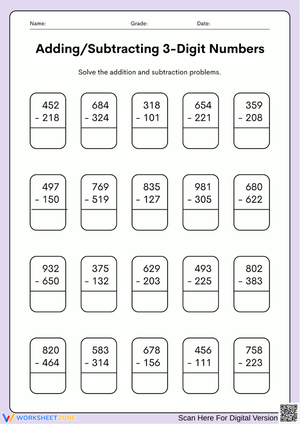
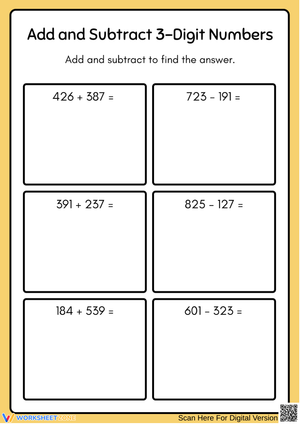
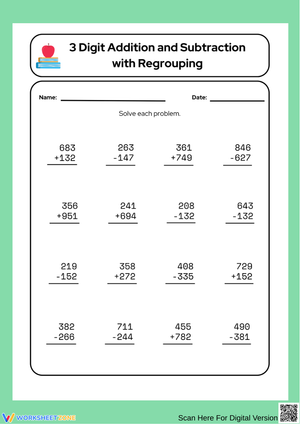
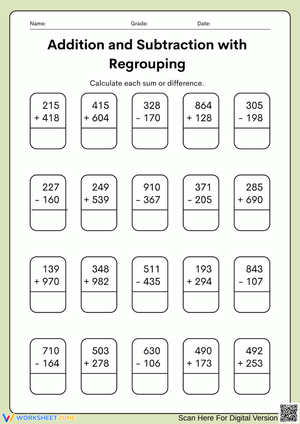
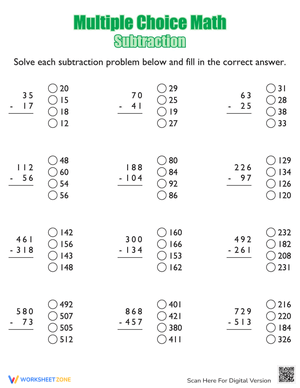
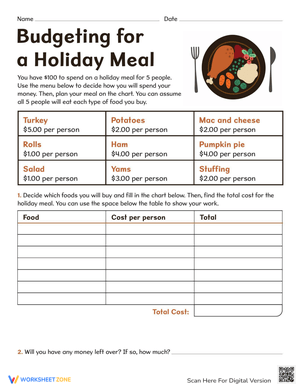
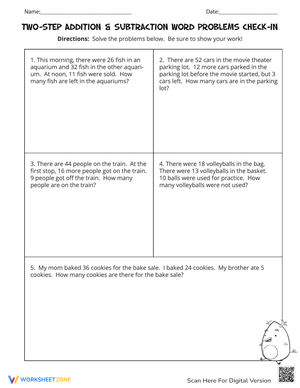
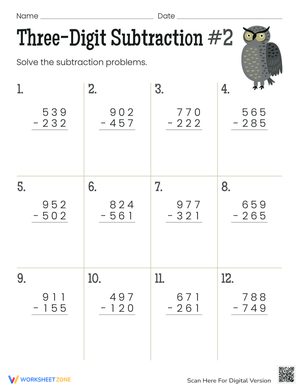
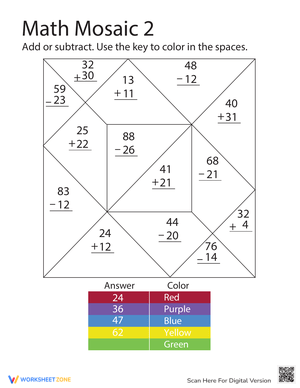
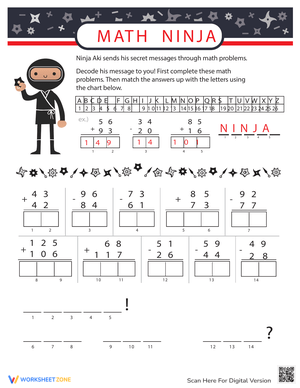
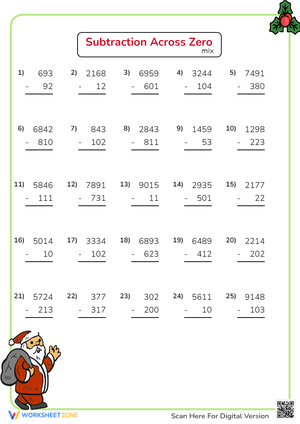
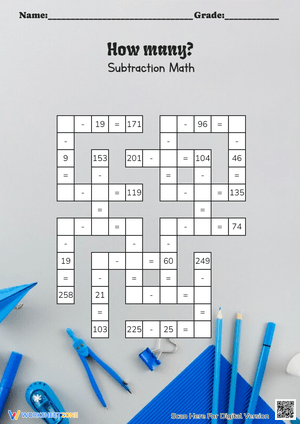
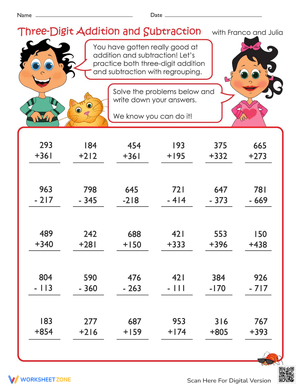
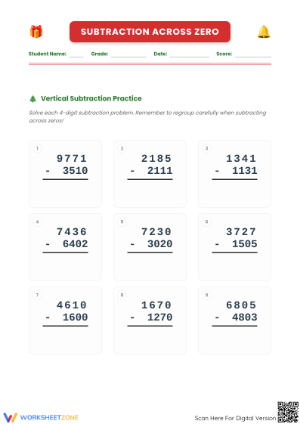
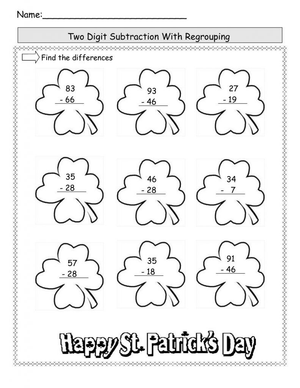
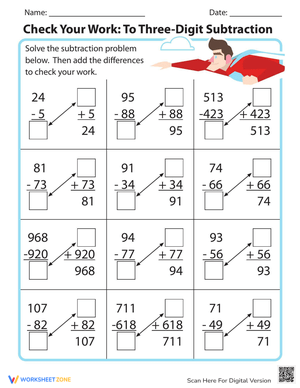
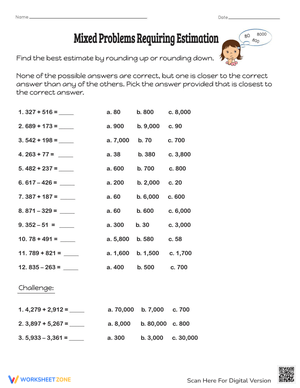
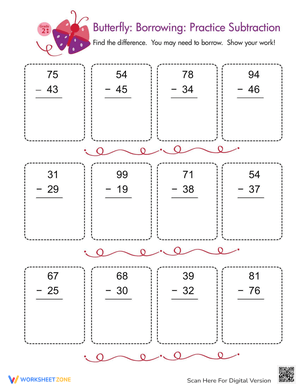
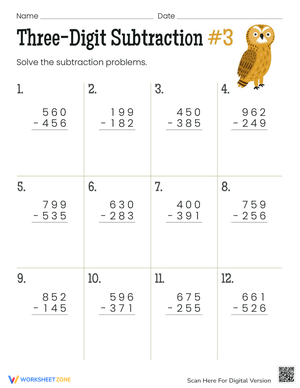
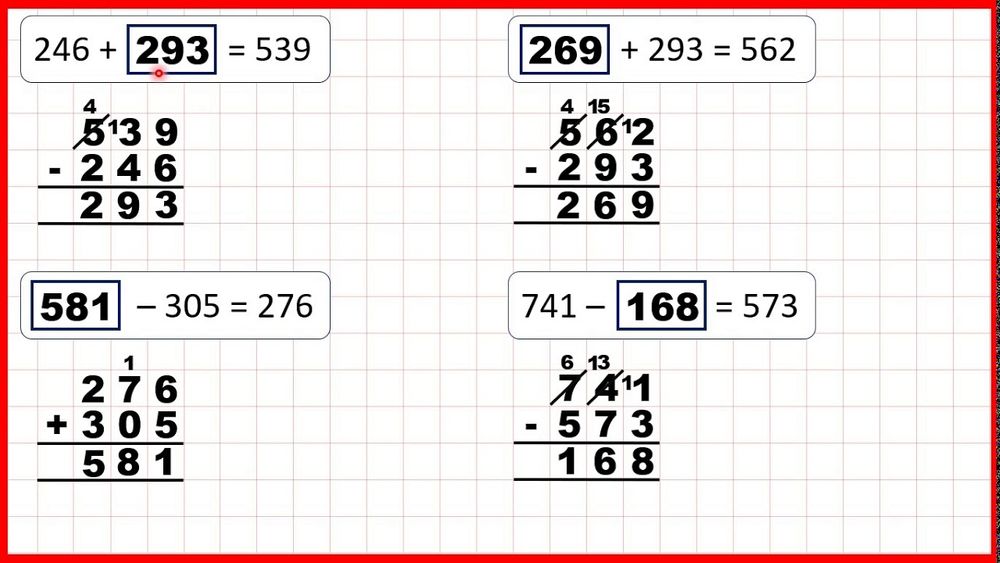
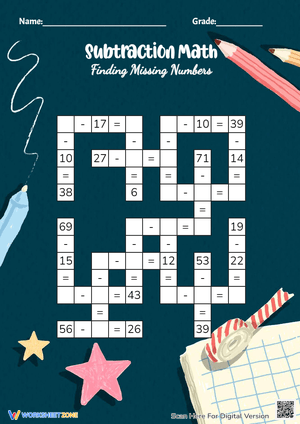
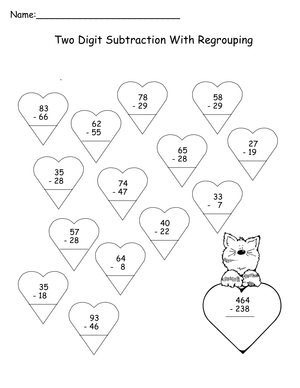
These multi digit subtraction pdf worksheets for 3rd grade cover subtraction within 1,000 across six distinct skill types, giving teachers printable materials ready to use from the opening lesson of a unit through final mixed review. Each worksheet targets one specific problem type — no-regrouping two-digit work, regrouping two-digit problems, three-digit subtraction with and without regrouping, missing-number equations, and word problems — so the resources fit cleanly into a lesson sequence without forcing teachers to pull from a mixed set before students are ready for it.
The Specific Skills Each Worksheet Targets
The set opens with two-digit subtraction without regrouping — not throwaway review but a practical place-value check. Before students regroup, they need to track ones and tens columns accurately and consistently. Two-digit regrouping comes next, and that transition is where most third graders develop the written habits that carry forward: marking the regrouped digit above the column, crossing out the original value, working right to left across the problem.
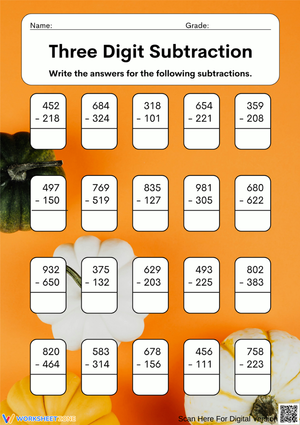
- Three-digit subtraction without regrouping: requires column-by-column accuracy across hundreds, tens, and ones before borrowing complexity is introduced
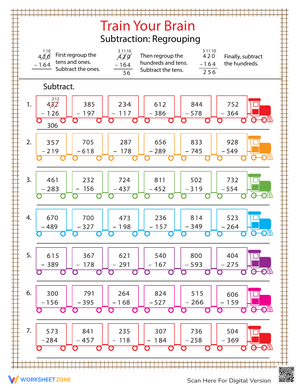
- Three-digit subtraction with regrouping from the tens place: the most frequently practiced Grade 3 scenario and where standard algorithm fluency typically solidifies
- Three-digit subtraction with regrouping across the hundreds: requires two sequential borrowing steps and is where students who handled single-step regrouping confidently often stall
- Missing-number equations: problems structured as 634 − ? = 278 confirm whether students understand subtraction's inverse relationship with addition, not just the algorithm's mechanical steps
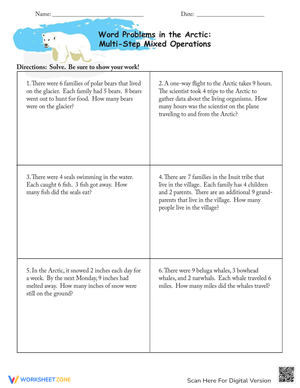
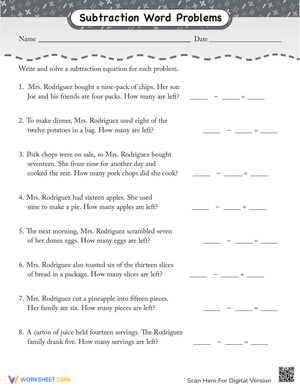
- Word problems: contextual tasks where students identify the operation, set up the equation, and show regrouping work explicitly
Mixed-review worksheets close the set and ask students to determine whether regrouping is necessary before beginning each problem — a habit that cuts careless errors more reliably than additional computation drills.
Smart Ways to Work These Worksheets Into Your Weekly Plan
The clearest classroom use is matching the skill type on each worksheet to the lesson goal for that day. On the day you first model regrouping from the tens place, assign only the worksheet targeting that step for independent practice — not a mixed review. That narrow focus lets you read the room: which students are executing the borrowing step correctly, which are forgetting to reduce the digit they borrowed from, and which still need a place-value drawing before they can work with the algorithm alone.
When teachers build routines around multi digit subtraction pdf worksheets for 3rd grade sorted by skill type, small-group reteach becomes faster and more targeted. Keep three labeled stacks — one for regrouping in the ones place only, one for regrouping from the tens into the hundreds column, and one for fully mixed three-digit problems. A student who aced the first stack but stumbles on the second has a specific gap, not a general "subtraction problem," and the right worksheet is already in the right pile. For Monday warm-ups after a weekend break, a short no-regrouping review worksheet reactivates subtraction routines without asking students to tackle a new concept before the day has settled. Exit-check strips — two or three problems cut from a worksheet — take under five minutes at the end of the math block and give an honest read on whether the lesson's main teaching point held.
Student Errors Worth Anticipating Before You Assign
The most persistent three-digit subtraction error is not forgetting to regroup — it is forgetting to reduce the digit that was borrowed from. A student works through 523 − 247 and correctly borrows from the tens to solve the ones column (making 13 − 7 = 6), but leaves the tens digit as 2 rather than crossing it out and writing 1. The ones answer is right; every column after that is wrong. Students who make this error often don't catch it because they check digit by digit and never ask whether the final answer is reasonable relative to the numbers they started with.
A second pattern appears in problems with a zero in the middle — something like 603 − 358. A student correctly borrows for the ones place, then faces 0 − 5 in the tens column. If they forget that the hundreds digit was already reduced during the first borrow, they subtract 5 − 0 instead of borrowing again. The answer can look plausible at a glance, which is exactly why the error persists across several worksheets before a teacher notices it in the work.
Missing-number problems expose a third issue: students who have procedural fluency without conceptual understanding. Asked to find the missing value in 452 − ? = 128, many attempt the standard subtraction algorithm on both sides rather than recognizing that the inverse relationship points toward addition as the check. If a student stumbles on every missing-number worksheet while straight computation practice is accurate, that gap is worth addressing directly before the unit closes.
Standard Alignment
CCSS.MATH.CONTENT.3.NBT.A.2 requires third graders to fluently add and subtract within 1,000 using strategies rooted in place value, properties of operations, and the relationship between addition and subtraction. "Fluently" carries a specific instructional weight here: it means accurate and efficient — not merely correct when given unlimited time. That distinction explains why the set builds toward mixed-review and missing-number worksheets rather than ending with straight three-digit computation. The standard asks students to understand the structure of subtraction, not only to execute the algorithm under familiar conditions.
Adjusting the Set for Mixed-Readiness Classrooms
Students still consolidating place-value understanding start with two-digit no-regrouping worksheets while drawing quick base-ten sketches next to each problem — four tens and seven ones, then crossing out — before writing the standard algorithm. That physical step gives meaning to the marks above the column rather than leaving regrouping as an abstract gesture that students copy without understanding.
For students working at or near grade level, a simple labeling prompt helps at the start of three-digit worksheets: write "H," "T," and "O" above the columns on the first two problems before the labels are dropped for the rest. It costs ten seconds and cuts a noticeable number of column-confusion errors in the ones and tens place. Students who have already internalized column position stop using the prompt on their own within two or three worksheets.
Because multi digit subtraction pdf worksheets for 3rd grade in this set span from two-digit no-regrouping entry points to missing-number three-digit tasks, the same resource set supports three or four instructional groups without requiring separate materials. Students moving ahead of grade-level expectations can pair the missing-number worksheets with a short written explanation — two sentences on how they handled the regrouping step — which quickly separates genuine understanding from learned pattern recognition.
Frequently Asked Questions
What order should I use these worksheets in a subtraction unit?
Start with two-digit no-regrouping for place-value review, then move to two-digit regrouping before introducing three-digit problems. Separate three-digit regrouping from the tens and regrouping across the hundreds into distinct practice sessions rather than combining both types at once. Save the mixed-review and missing-number worksheets for the second half of the unit, once students have enough fluency to make strategy decisions independently.
My students can complete the steps but can't explain their thinking. Do these worksheets address that?
The word-problem and missing-number worksheets target that gap directly. Missing-number problems — finding the value in 634 − ? = 278 — require students to reason about the relationship between the numbers rather than execute a memorized sequence. Pairing those worksheets with a brief verbal or written explanation during small-group work builds the explanation habit more reliably than adding a writing requirement to straight computation practice.
Can these worksheets serve as informal assessments rather than just practice?
Yes. A mixed-review worksheet spanning no-regrouping, single-step regrouping, cross-hundred regrouping, and a word problem functions as a practical informal check on where students stand. For a sharper picture, teachers using multi digit subtraction pdf worksheets for 3rd grade from different skill-type stacks together — pairing a no-regrouping worksheet with a full three-digit regrouping worksheet — can compare error patterns across the two and identify whether the difficulty sits with the concept or with the algorithm's execution under less predictable conditions.













 Interactive Worksheet Maker
 Quiz Maker
 Word Search Maker
 Crossword Puzzle Maker
 Word Scramble Generator
 Sentence Scramble Generator
 Handwriting Worksheet Generator
 Name Tracing Generator
 Fill In The Blank Generator