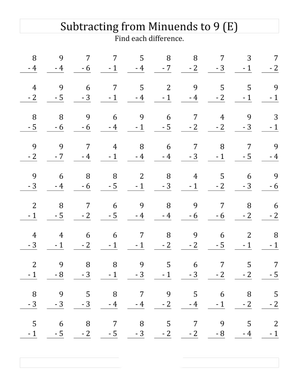
These subtraction printable worksheets for 3rd grade address what actually slows students down in the unit — not two-digit equations, which most entering third graders handle reasonably well, but three-digit subtraction with regrouping, and especially the multi-step borrowing that becomes unavoidable in problems like 600 − 247 or 803 − 568. The set works across five formats and covers subtracting within 1,000, giving teachers ready-to-print practice for every point in the instructional progression.
Student Mistakes Worth Anticipating Before You Distribute
The most common error in three-digit subtraction shows up not in the computation itself but in the setup: students subtract the smaller digit from the larger one regardless of which is on top. Ask a student to solve 532 − 278 and a significant portion will write 2 − 8, decide 8 is bigger, flip it, and record 6 in the ones column. They get 346 instead of 254, and they are confident in it. The error is invisible to them because they followed a rule — "subtract the smaller from the bigger" — that worked fine in earlier grades when the top number was always larger in every column.
Regrouping across zeros is the other consistent trouble spot. In a problem like 500 − 163, students cannot borrow from the tens column because it holds zero. The correct sequence — borrow from the hundreds to give the tens column a value of 10, then borrow from the tens to give the ones column a value of 10 — involves two trades before the first digit can be subtracted. Under any time pressure or without structured guidance, many students skip one trade or abandon the algorithm entirely. Worksheets that isolate this specific case give teachers clear data on exactly where in the borrowing sequence each student breaks down, which is far more useful than a mixed-practice score.
What Each Worksheet Covers
The formats in this collection are not interchangeable — each one places a different cognitive demand on the student.
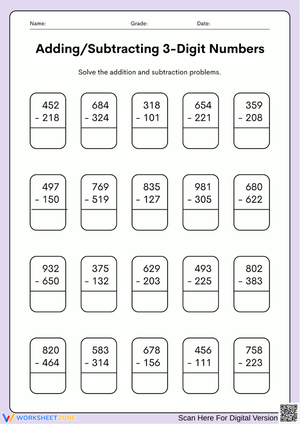
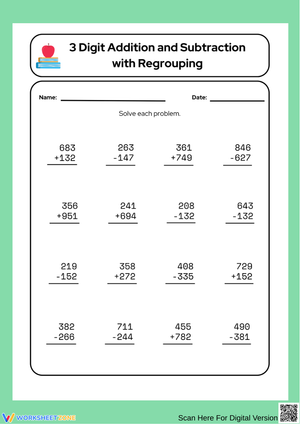
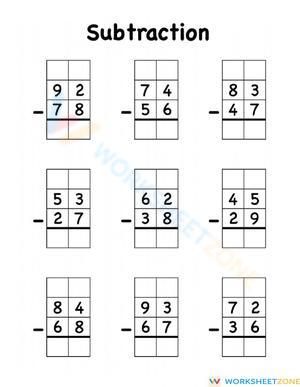
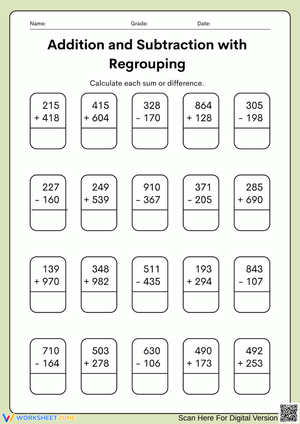
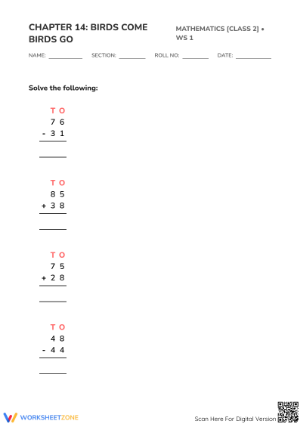
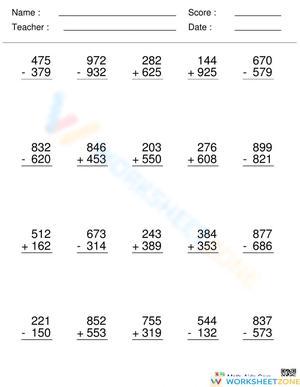
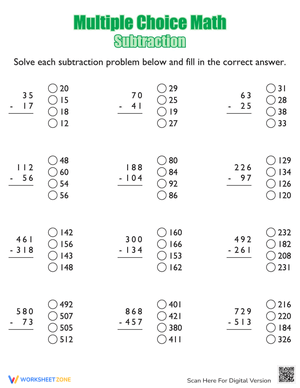
- Vertical three-digit equations: Column-aligned subtraction with and without regrouping, ordered to gradually increase the number of place values that require borrowing. The format supports students who need visual structure to keep digits aligned during the algorithm.
- Horizontal presentation: The same computation written in a single line. Students must either rewrite the equation in column form or use mental math strategies. Skipping that restructuring step is precisely where digit-alignment errors pile up.
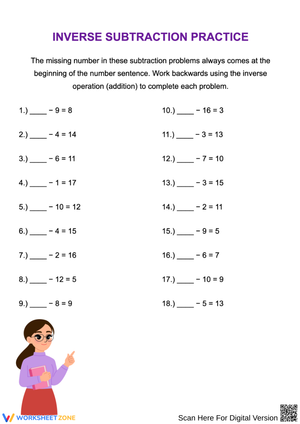
- Missing minuend and subtrahend: Problems like □ − 145 = 322 require students to use addition as the inverse operation rather than running the subtraction algorithm. These worksheets surface conceptual gaps that equation-only practice can hide for a surprisingly long time.
- Regrouping across zeros: Dedicated practice on problems like 400 − 236 and 700 − 481, keeping the borrowing-across-zero skill isolated until students are solid before it appears embedded in mixed practice.
- Word problems: Single- and two-step contexts that require students to identify the minuend and subtrahend from a real-world scenario. The text load is controlled — enough context to require interpretation without turning every item into a reading task.
Fitting These Worksheets Into Your Instructional Week
The format that gets the most consistent classroom mileage is using one worksheet as a daily warm-up during the first five to eight minutes of the math block — before the lesson, not after. Students arrive, see a familiar structure, and the low-stakes entry task settles the room while activating prior knowledge. For regrouping across zeros specifically, returning to the skill every few days through warm-up practice is more effective than covering it intensively for two days and moving on. Spacing those returns out, even briefly, improves retention in a way that massed practice does not.
For small group instruction, the missing-minuend worksheets work well as a quick diagnostic before pulling a group. Students who solve □ − 145 = 322 by adding 145 and 322 already understand the inverse relationship; students who stare blankly at it reveal the gap immediately, and you know what the group needs before the session starts. The subtraction printable worksheets for 3rd grade in this set also laminate cleanly for dry-erase center use, which cuts down on paper and lets students who finish early run through the same worksheet a second time under a different constraint — timing themselves or checking every answer by adding up.
Standard Alignment
These resources align to CCSS 3.NBT.A.2, which expects students to fluently add and subtract within 1,000 using strategies grounded in place value, properties of operations, and the relationship between addition and subtraction. "Fluently" in CCSS language means accurate, efficient, and flexible — not merely able to execute the standard algorithm on a good day. The subtraction printable worksheets for 3rd grade in this collection address that three-part expectation directly: vertical and horizontal formats push efficiency, missing-number tasks push flexibility, and the regrouping-across-zeros focus addresses the accuracy breakdowns that assessors most commonly flag. 3.NBT.A.2 sits within the supporting cluster for Grade 3, but it feeds directly into the major work — students who are shaky on multi-digit subtraction struggle with two-step word problems (3.OA.D.8), which appear heavily on state assessments throughout the year.
Adjusting the Work for a Range of Learners
Students who are not yet ready for three-digit computation benefit from starting with two-digit equations and regrouping only in the tens column, then moving to three-digit problems where only the ones column requires borrowing. Using the vertical-format worksheets with a place-value chart drawn alongside the problem gives those students a reference point without changing the task itself — the chart becomes a self-check tool rather than a crutch they are dependent on.
For students who have cleared the procedural bar and need a harder ask, the missing-minuend problems are a natural push. Ask them to write a word problem that matches each equation they solve — that combination of algebraic reasoning and language production is appropriately demanding for 3rd graders working above grade level. Students who finish quickly can also be required to verify every answer using the inverse operation, which turns the back of any worksheet into a second productive task without any additional preparation.
Frequently Asked Questions
What subtraction skills should students have by the end of 3rd grade?
Third graders are expected to fluently subtract within 1,000 using strategies based on place value, properties of operations, and the inverse relationship between addition and subtraction. That includes multi-digit equations with and without regrouping, problems involving zeros in the top number, and two-step word problems that require identifying the correct operation before computing.
How should I introduce regrouping across zeros to students who are stuck?
Start with physical base-ten blocks before the pencil comes out. Have students build 500 using five hundred-flats, then ask them to remove 247. They cannot pull 7 ones because there are none, so they trade one hundred-flat for 10 ten-rods, then trade one ten-rod for 10 unit cubes. Running that physical trade two or three times before introducing the written algorithm gives students a concrete mental model to fall back on when they get confused mid-problem. The subtraction printable worksheets for 3rd grade that focus on regrouping across zeros are most effective after this hands-on stage, not as a replacement for it.
What is the difference between worksheets with and without regrouping?
In a worksheet without regrouping, every digit in the top number is greater than or equal to the digit directly below it in the same place value column — no borrowing is needed. In a regrouping worksheet, at least one column has a top digit that is less than the bottom digit, requiring the student to borrow from the next place value before subtracting. This distinction matters for sequencing: most teachers run students through non-regrouping practice first to build familiarity with the algorithm's structure before borrowing enters the picture.
How many problems should a 3rd grade subtraction timed drill contain?
Twenty to thirty problems is a reasonable range for a timed drill at this grade level, depending on equation complexity and the time limit. The goal is building automaticity, not inducing anxiety. Starting with fewer problems and a relaxed time limit, then increasing the count as students build speed, keeps the drill format productive. Students who feel perpetually behind on timed drills often disengage from computation practice altogether, which is a worse outcome than a slower pace.













 Interactive Worksheet Maker
 Quiz Maker
 Word Search Maker
 Crossword Puzzle Maker
 Word Scramble Generator
 Sentence Scramble Generator
 Handwriting Worksheet Generator
 Name Tracing Generator
 Fill In The Blank Generator