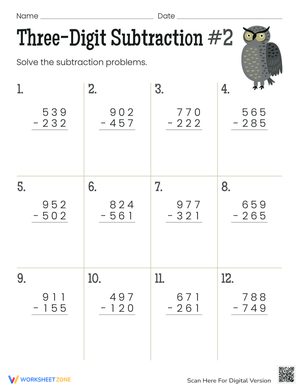
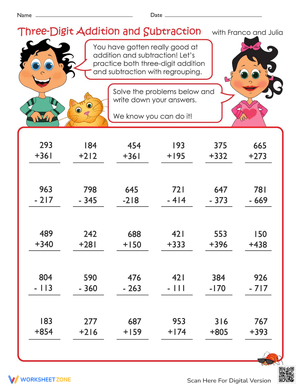
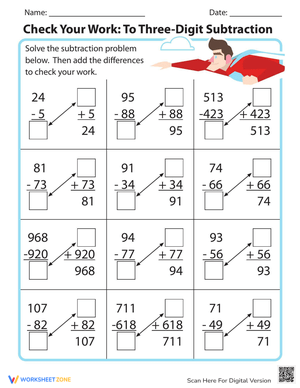
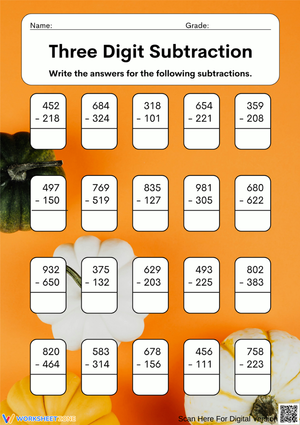
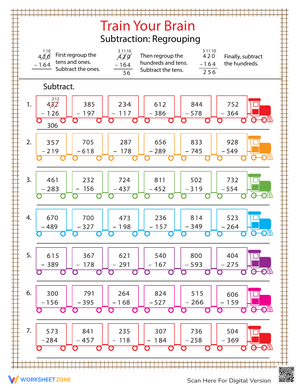
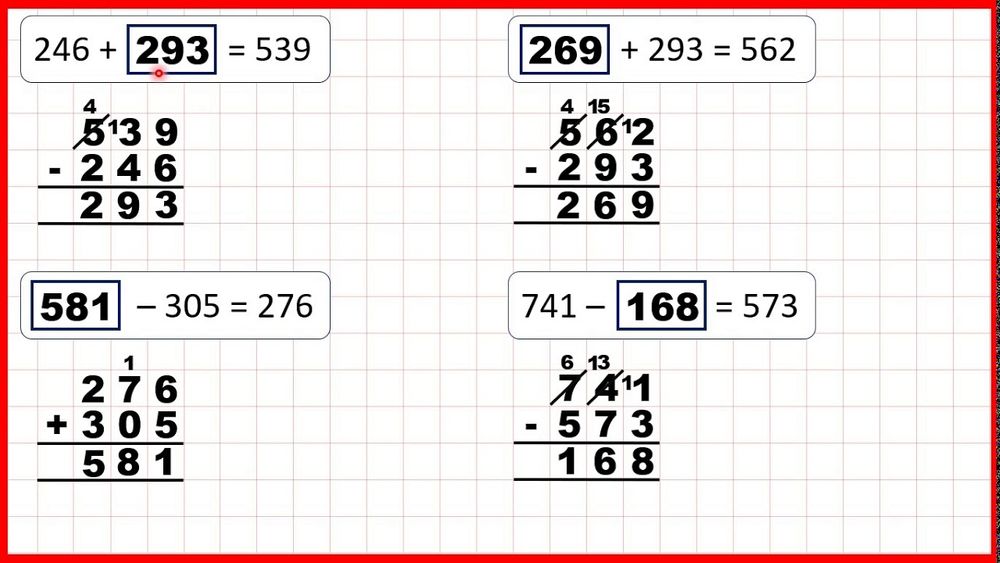
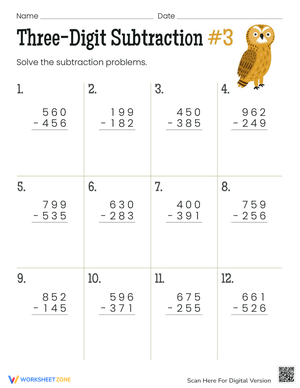
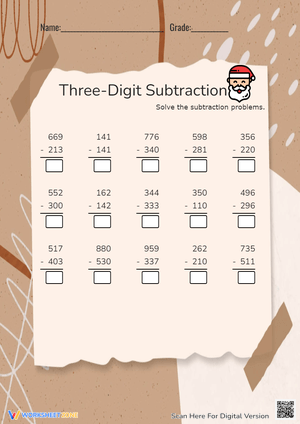
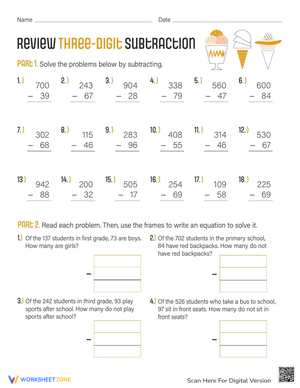
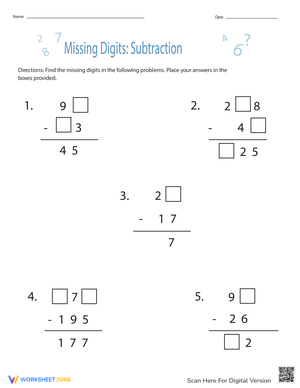
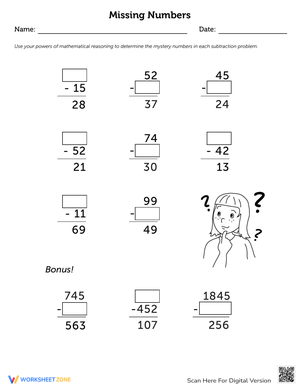
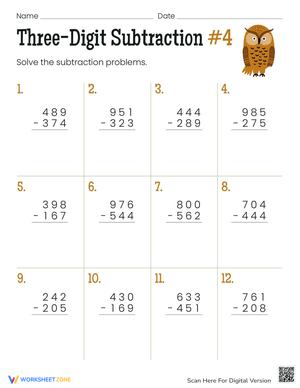
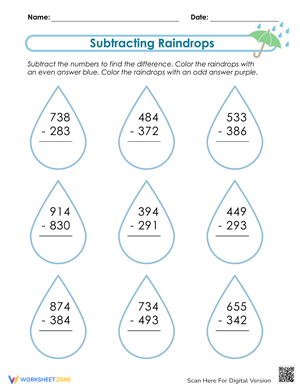
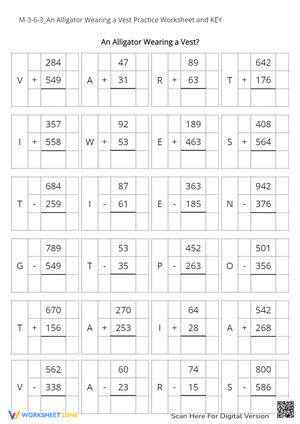
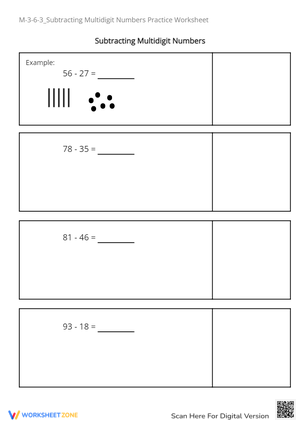
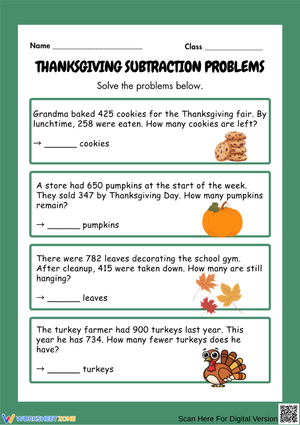
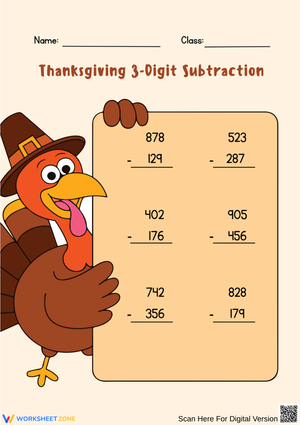
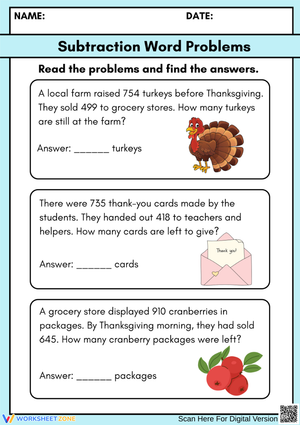
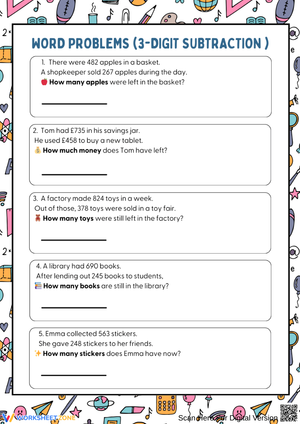
These three digit subtraction printable worksheets for 3rd grade give teachers a sequenced set of practice resources covering the full range of subtraction skills students need before leaving third grade — basic regrouping, double regrouping, and subtracting across zeros. Each worksheet focuses on a specific skill level, so teachers can assign precisely what students are ready for rather than moving through a one-size sequence at the wrong pace. Problems stay within 1000, matching the fluency expectation at this grade level.
What the Set Covers
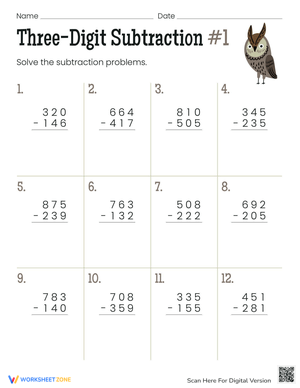
The worksheets are organized by increasing complexity. Early ones address regrouping from the tens place only — problems where the hundreds digit stays stable and students practice the single-trade move before anything harder enters the picture. From there, the set moves to problems requiring regrouping in both the tens and ones places, then to problems where a zero in the tens column forces students to regroup from hundreds all the way down to ones in a two-step chain.
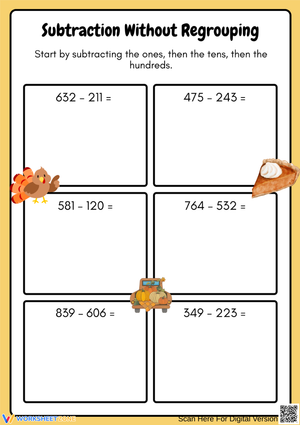
- Three-digit subtraction with regrouping in the ones place only
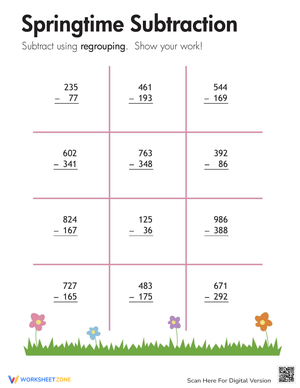
- Problems requiring regrouping across both tens and ones
- Subtraction across zeros — such as 500 minus 247 — where the tens digit is zero and the regroup cannot start there
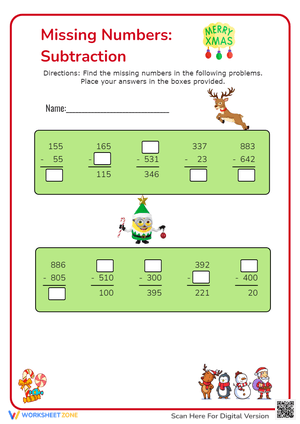
- Missing-number problems where either the minuend or the subtrahend is unknown
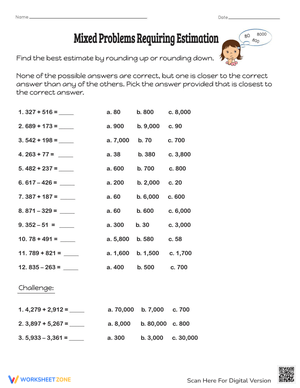
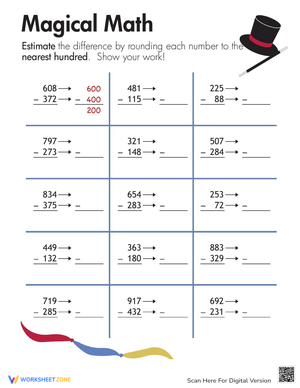
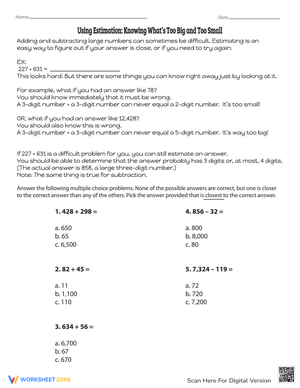
- Estimation warm-ups asking students to round to the nearest hundred before solving
The estimation problems are worth noting separately. A student who rounds 542 to 500 and 278 to 300 knows their answer should land near 200. That reasonableness check catches a surprising number of regrouping errors before students ever raise a hand to say they are finished.
Student Errors Worth Watching For
The most persistent mistake at this grade is subtracting the smaller digit from the larger regardless of position. In a problem like 532 minus 178, a student writes 466 — taking 2 from 8 in the ones column instead of regrouping — and the answer looks plausible enough that they move on. This error shows up most often in the middle of a mixed practice set, when students stop checking each column and start moving fast. More practice problems do not fix it; what fixes it is building a self-check habit: "Is my top digit greater than or equal to my bottom digit? If not, I regroup." The early worksheets in this set build that internal dialogue directly into the problem format.
Subtracting across zeros is a different failure mode entirely. Faced with 400 minus 163, some students try to regroup from the tens place, notice it is zero, and stall. Others skip regrouping entirely and write something like 363. The underlying confusion is that they understand regrouping as one single step — not as a chain. The chain reads: borrow one hundred from the hundreds column, give ten tens to the tens column, then borrow one ten from the tens column and give ten ones to the ones column. Writing that chain in two separate lines, with color-coded place-value notation, makes the sequence visible in a way that verbal explanation alone does not.
Standard Alignment
CCSS.MATH.CONTENT.3.NBT.A.2 requires students to fluently add and subtract within 1000 using strategies grounded in place value, properties of operations, and the relationship between addition and subtraction. In practical classroom terms, this standard lands near the end of the third-grade sequence — most teachers reach it in late winter or early spring, after students are steady with two-digit work and have spent real time with base-ten models. The fluency expectation here is genuine: a student counting up on a number line for every problem is not meeting the standard. The goal is accurate, reasonably efficient execution of the algorithm, and that comes through consistent, well-sequenced practice.
Building These Worksheets Into Your Weekly Rotation
The most effective use pattern is a short daily warm-up — four or five problems — rather than a full worksheet assigned as a single sitting. Five minutes at the start of math, before the lesson moves into something new, keeps regrouping accessible without turning it into an endurance task. The three digit subtraction printable worksheets for 3rd grade in this set are formatted so teachers can use the full worksheet for a longer independent practice block or pull individual rows for a targeted warm-up without reprinting anything.
For small-group intervention, pull two or three problems from the zeros worksheets and work through them at the back table while the rest of the class practices independently. The gaps surface quickly — often within the first problem — and you can redirect before the wrong procedure gets reinforced through repetition. For students who finish early, the missing-number problems work well as extensions: finding the missing minuend in __ minus 356 equals 228 requires reasoning backward through the algorithm, which is genuinely harder than running it forward.
Adjusting the Set for a Range of Learners
Students who are not yet solid on two-digit regrouping are not ready for the standard three-digit algorithm — assigning those worksheets before they are ready produces procedural confusion, not fluency. For those students, pair the worksheet with a place-value mat and base-ten blocks. Let them solve the problem physically first, record the result, and then try the next one using the written algorithm. The concrete-to-abstract move happens faster than most teachers expect once students can see the connection between trading a hundred-flat for ten ten-rods and crossing out the digit in the hundreds column.
On the other end, students who breeze through standard regrouping benefit from the missing-number and estimation sections. These three digit subtraction printable worksheets for 3rd grade include enough problem variety that teachers at both ends of the ability range find something appropriate without pulling separate materials. A student asked to find the missing minuend is doing harder mathematical reasoning than a student executing the same algorithm on a straightforward problem — the format difference is small, but the thinking required is not.
Frequently Asked Questions
How does this set address CCSS.MATH.CONTENT.3.NBT.A.2?
Every worksheet in the set targets fluency within 1000 using the standard algorithm and place-value strategies — the direct expectation of 3.NBT.A.2. The progression from single-step regrouping through subtracting across zeros mirrors the instructional sequence teachers use when building toward end-of-year fluency on this standard. The estimation warm-ups also address the "strategies based on place value" language in the standard, which is often underpracticed relative to the algorithm itself.
What should I do when a student keeps getting problems like 600 minus 254 wrong?
The issue is almost always the two-step regroup chain that runs across two zeros. Have the student write the steps explicitly in sequence: first, rewrite 600 as 500 plus 10 tens; then rewrite that ten as 9 tens plus 10 ones. Seeing the chain broken into two labeled moves — rather than trying to hold both trades in working memory simultaneously — is what breaks the logjam. After two or three problems worked out this way in writing, most students can execute it without the intermediate notation.
Can these worksheets work for test prep?
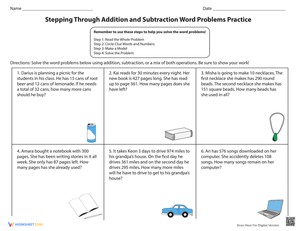
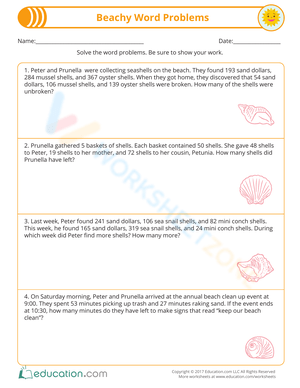
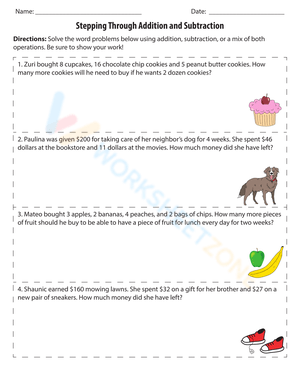
Three-digit subtraction with regrouping appears on most third-grade state assessments as both standalone computation and embedded in word problems. The three digit subtraction printable worksheets for 3rd grade in this set include both computation-only and word-problem formats, so teachers can use them for routine practice and pre-assessment review. The estimation problems also prepare students for the reasonableness questions common on state tests, where students judge whether a given answer makes sense rather than compute from scratch.
How do I correct a student who has practiced the wrong procedure for weeks?
Start with base-ten blocks before going back to paper. A student who has overlearned an incorrect algorithm needs to see the physical trade — one hundred-flat exchanged for ten ten-rods — to disrupt the flawed mental model. Worksheet practice alone will not overwrite a deeply embedded procedural error. The physical model has to come first, even if returning to blocks feels like a significant step backward. It rarely takes as long as teachers fear once the correct understanding clicks.













 Interactive Worksheet Maker
 Quiz Maker
 Word Search Maker
 Crossword Puzzle Maker
 Word Scramble Generator
 Sentence Scramble Generator
 Handwriting Worksheet Generator
 Name Tracing Generator
 Fill In The Blank Generator