3rd Grade Subtraction With Regrouping worksheets
These 3rd grade subtraction with regrouping worksheets resources give teachers print-ready practice that targets the most cognitively demanding stretch of the Grade 3 subtraction sequence — managing place value, tracking borrowed digits, and keeping columns aligned, all within a single problem. Subtracting within 1,000 is where students who handled 2-digit work confidently often start making consistent errors, and structured repetition through a well-ordered set is what addresses those gaps. The worksheets work across multiple classroom routines without requiring teachers to build separate materials for each phase of instruction.
The Specific Skills Each Worksheet Targets
The set moves through subtraction with regrouping in a progression that mirrors how most Grade 3 curricula introduce the skill — narrower problems first, then increasing complexity once the core exchange is solid.
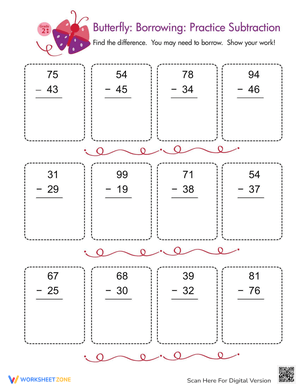
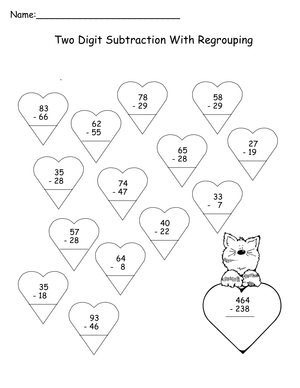
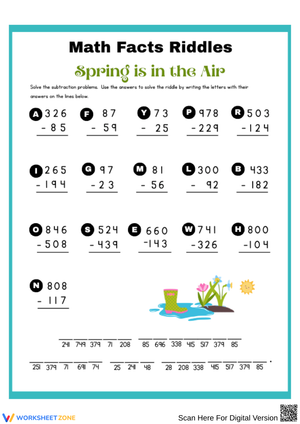
- 2-digit subtraction with regrouping: Students practice trading 1 ten for 10 ones in a format that keeps place value relationships visible before the hundreds column adds another layer.
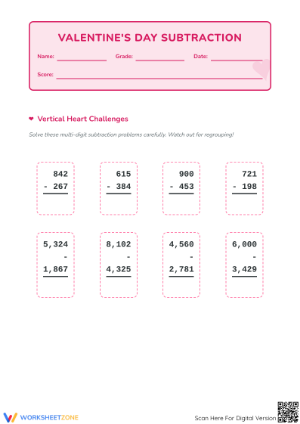
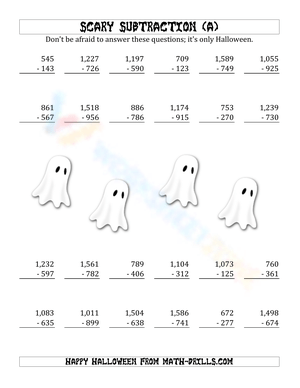
- 3-digit subtraction, single exchange: One regrouping step is required — either tens to ones or hundreds to tens — which extends place value reasoning without overwhelming students who are still tracking the algorithm.
- 3-digit subtraction, double exchange: Both columns require regrouping in the same problem. This is where accuracy often breaks down mid-solve, particularly when students lose track of which digit they have already updated.
- Across-zero subtraction: Problems such as 400 − 253 require borrowing to cascade across two place values. These warrant a separate worksheet because the error pattern is distinct and the instructional move is specific.
- Mixed review: Regrouping and non-regrouping problems appear together, so students must decide which approach a problem requires rather than executing the same steps on autopilot.
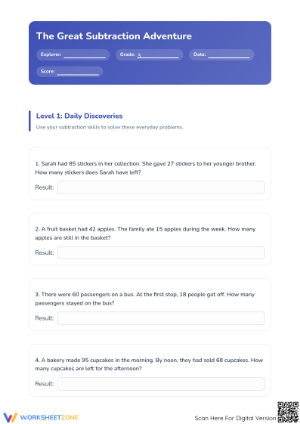
- Contextual word problems: Students read a situation, identify the subtraction relationship, and apply regrouping in a Grade 3 context that connects the written algorithm to real quantities.
Clean column spacing and room for borrowing notation matter more than they might seem. Students working in cramped problem formats tend to misalign digits, and the resulting errors look like conceptual confusion when they are actually organizational. Each worksheet in this set gives students enough white space to mark exchanges clearly.
Student Error Patterns Worth Anticipating Before You Assign These
Regrouping errors in Grade 3 fall into a small number of predictable categories, and identifying which one a student is making changes the reteaching approach entirely. The most common: subtracting the smaller digit from the larger regardless of position. In a problem like 83 − 47, a student writes 44 because they subtracted 3 from 7 rather than regrouping the tens to make 13 ones. They are applying a "find the difference between the two digits" rule that worked on basic subtraction but breaks here. This is not a careless mistake — it is a coherent but wrong strategy, and more repetition without correction will deepen it.
A second pattern surfaces when students regroup correctly in the ones column but forget to reduce the digit they borrowed from. The crossing-out notation is there; the new ones value is correct. But then they subtract the tens column as if nothing happened. In 3-digit problems with two regrouping steps, this becomes even harder to catch because there are two digits to update and students are managing several things at once. Watching a student solve a problem aloud usually reveals whether they understand that borrowing changes the digit or whether they are marking the symbol without grasping what it means.
The across-zero error is the most disruptive to solve. In 503 − 268, students need to borrow from the hundreds column because the tens column holds a zero. Many attempt to borrow from the tens, encounter the zero, and either freeze or write an invented digit. The two-step cascade — 1 hundred becomes 10 tens, then 1 ten becomes 10 ones — is not intuitive without direct instruction, and a worksheet focused solely on across-zero problems gives teachers a clean way to identify exactly who needs that lesson again.
Building These Worksheets Into Your Lesson Planning
During a mini-lesson, one worksheet covers the guided practice phase well. The teacher models the first two problems at the board, students complete the next two with a partner, and then the remaining problems serve as independent work. That structure uses a single worksheet across three instructional phases without requiring separate materials — a practical advantage when planning time is limited.
For small-group reteaching, pulling back to the 2-digit regrouping worksheets is a deliberate diagnostic move, not a remedial one. A student who regrouped correctly at 2-digit but struggles at 3-digit usually has a column-tracking issue rather than a conceptual gap. That distinction matters because the fix is different: it calls for a structured note-taking routine or a borrowing checklist, not a return to manipulative-based modeling of the exchange concept.
For exit tickets, two or three problems pulled from a worksheet tell a teacher nearly everything needed for the next day's planning. One 2-digit problem, one 3-digit with a single exchange, and one across-zero problem covers the main skill levels in the sequence. Answer keys included in the set make this fast enough to actually use at the end of a 45-minute block rather than saving it for after school.
One sorting system that works well in practice: keep the worksheets in three labeled folders — one for initial instruction work (right after modeling, with plenty of visual space), one for independent practice (less support structure, more problems per worksheet), and one for review and screening (shorter sets used as exit tickets or intervention checks). Sorting once at the start of a unit removes the daily question of which worksheet to grab.
Standard Alignment
These worksheets address CCSS 3.NBT.A.2, which requires students to fluently add and subtract within 1,000 using strategies based on place value, properties of operations, and the relationship between addition and subtraction. "Fluently" in this standard means accuracy and reasonable efficiency — not just occasional success when a student works slowly through each step. In classroom terms, this standard typically arrives after students have built three-digit place value understanding and practiced addition with regrouping, placing it in the middle stretch of Grade 3 math. The 3rd grade subtraction with regrouping worksheets set fits directly into that instructional window, and the progression from 2-digit to 3-digit to across-zero problems mirrors the depth that 3.NBT.A.2 expects by year's end.
Adapting the Set for a Range of Student Readiness Levels
For students still building conceptual understanding, pairing the written worksheet with base-ten block work clarifies why the algorithm does what it does. A student builds the minuend with blocks, physically trades 1 ten for 10 ones, and then records what happened on the worksheet. Once a student can explain the trade without the blocks, the written notation starts to carry meaning rather than functioning as a series of memorized marks.
Students who move through 3-digit regrouping quickly benefit from across-zero problems and word problems that require deciding whether subtraction is the right operation — not just more of the same problem type with larger numbers. The 3rd grade subtraction with regrouping worksheets set supports this because the problem types genuinely increase in cognitive demand rather than just scaling up the digits involved.
For students working above grade level, adding an inverse-operation verification step raises the ceiling meaningfully. After solving, they add the difference to the subtrahend and confirm they get the original minuend. This deepens understanding of addition and subtraction as related operations and slows down students who rush — which regularly exposes regrouping errors they had been glossing over.
Frequently Asked Questions
When in Grade 3 should these worksheets enter the rotation?
Most Grade 3 curricula introduce regrouping in subtraction after students have worked with three-digit place value and addition with regrouping. Beginning with the 2-digit worksheets makes sense even if students practiced 2-digit regrouping in Grade 2 — a short review confirms whether the foundational understanding is solid before the hundreds column adds complexity. Teachers working with students who have no prior exposure to regrouping should model with manipulatives before assigning written practice independently.
How many problems per sitting is actually productive for 8- and 9-year-olds?
Six to ten problems is enough to reveal accuracy patterns without wearing students out. A student who finishes 20 regrouping problems carelessly has practiced errors. Shorter sets with a built-in check step — circling each regrouping mark immediately after making it, for example — produce more useful work than longer sets completed at speed. Quality of execution matters more than volume at this stage of skill development.
How should these worksheets be used when students finish at very different speeds?
Build a natural extension into the session rather than treating it as a separate assignment. Early finishers can write a word problem that produces the same subtraction equation they just solved, or verify their answers by adding the difference back to the subtrahend. Both tasks use the same numbers they already have in front of them and deepen the work rather than just adding more of the same problems.
Do these worksheets work for students below grade level in math?
The 2-digit regrouping worksheets in the set work well for below-grade-level students, especially with side-by-side manipulative support. For students who are significantly behind, some additional place-value review may be needed first. The 3rd grade subtraction with regrouping worksheets set produces the most consistent results when students already understand what regrouping means conceptually, even if their written execution is not yet automatic — the worksheets build fluency, but they do not replace the initial conceptual lesson.
Clear All