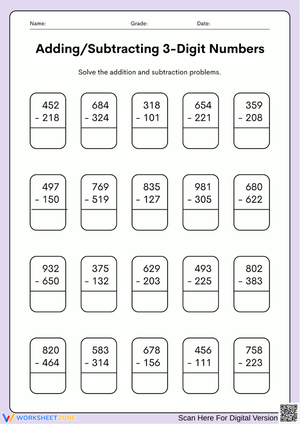
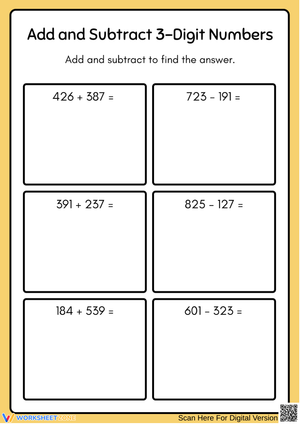
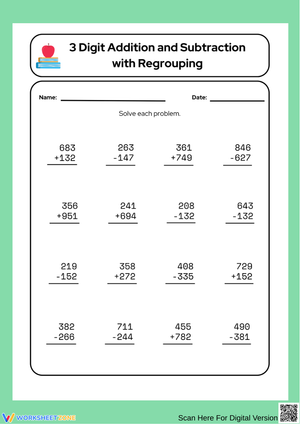
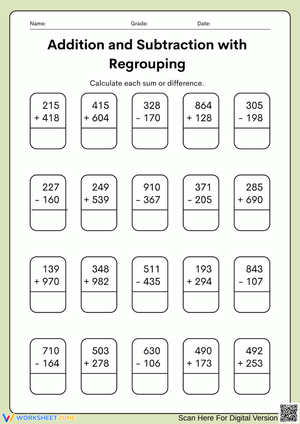
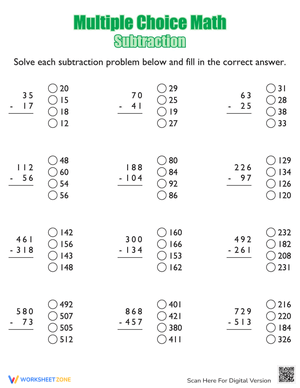
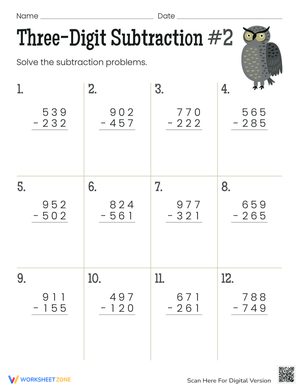
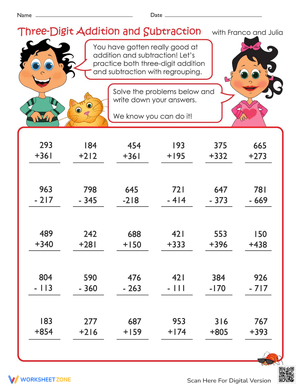
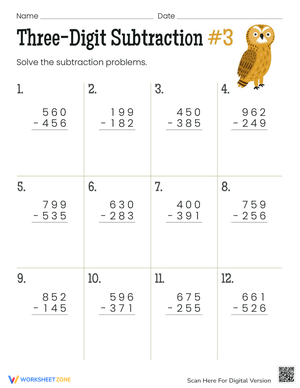
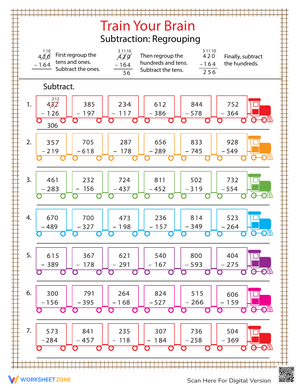
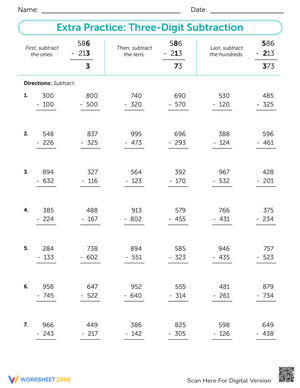
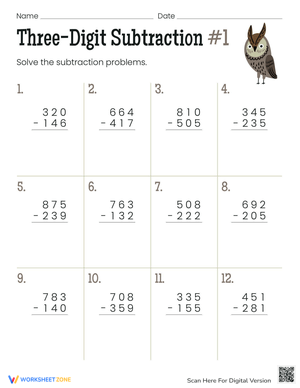
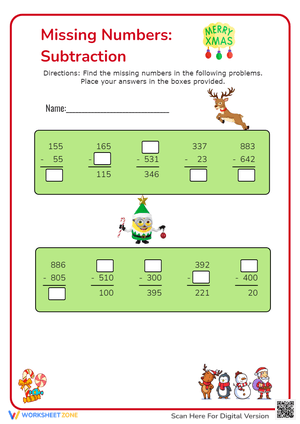
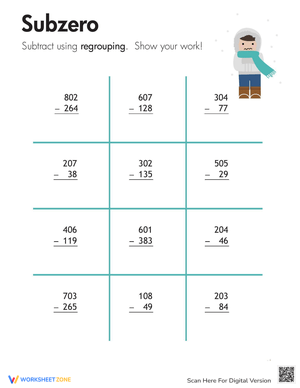
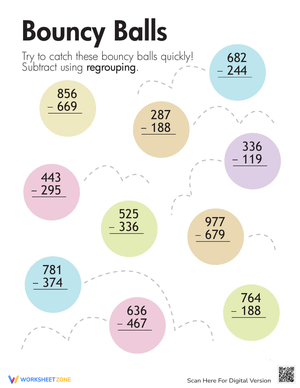
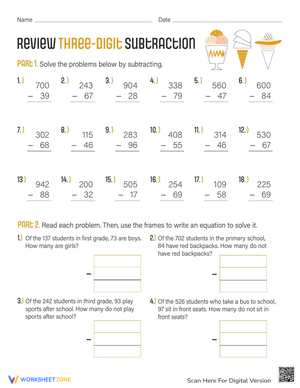
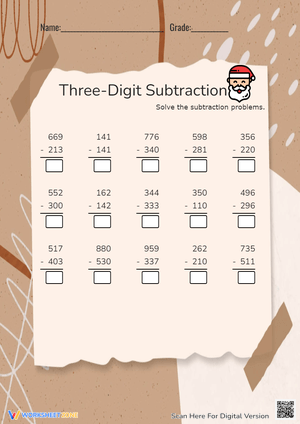
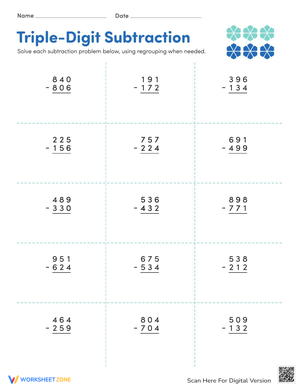
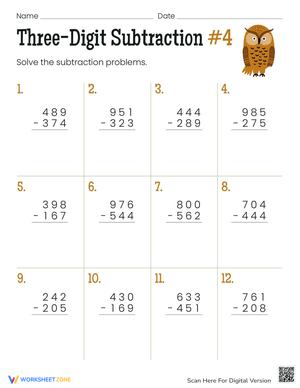
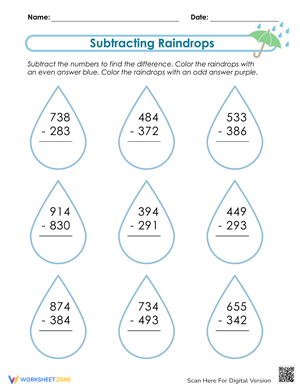
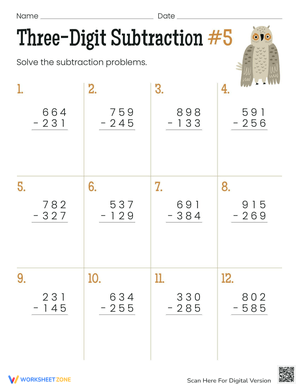
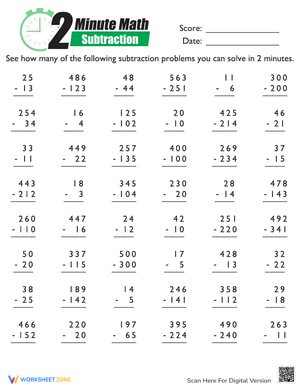
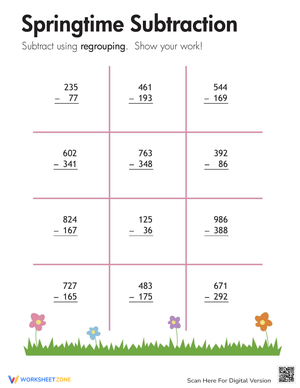
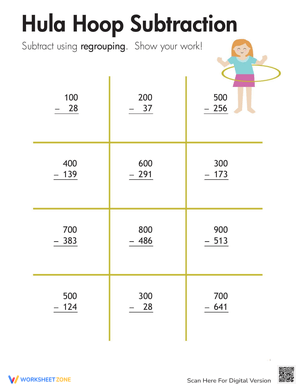
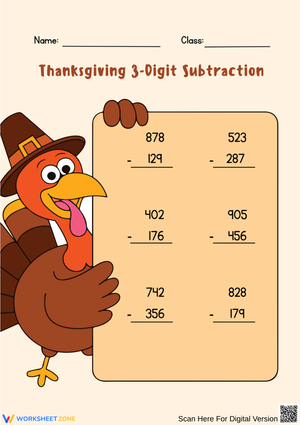
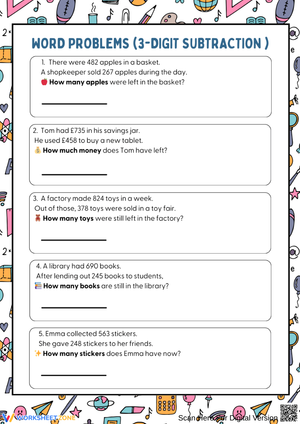
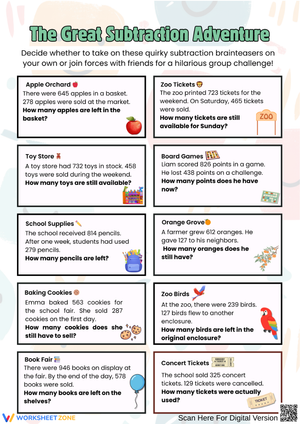
These 3rd grade three digit subtraction and regrouping worksheets give teachers a focused set of practice resources for one of the trickier computation milestones in the elementary math sequence. Each worksheet targets a specific piece of the process — place value decomposition, the standard algorithm, regrouping across zeros, or applying subtraction to word problems — so teachers can assign what students actually need rather than hoping a mixed-review assignment covers every gap.
What Each Worksheet Targets
The set spans the full range of three-digit subtraction skills students are expected to control by the end of third grade. The worksheets separate problem types rather than mixing them, so teachers can pinpoint exactly where each student's understanding holds and where it breaks down.
- Standard algorithm practice with regrouping from the ones column only — a natural entry point before adding complexity
- Problems requiring regrouping from both the tens and hundreds columns within a single equation
- Subtracting across zeros, widely considered the hardest variation at this level
- Error analysis exercises where students examine completed work containing deliberate mistakes and identify what went wrong
- Word problems requiring students to read for relevant information, set up a vertical equation, and execute the algorithm accurately
- Base-ten block diagrams alongside traditional equations, bridging the visual model and the written procedure
Several worksheets include an inverse-operation check column where students verify answers by adding the difference back to the subtrahend. It takes thirty seconds per problem and builds a self-monitoring habit that transfers naturally into later units.
Student Errors Worth Watching For and Correcting
The most persistent error in this unit is the "smaller-minus-larger flip." A student looks at the ones column in a problem like 742 − 368, sees 2 and 8, and writes 6. No regrouping — just a reversal of which digit sits on top. This is not carelessness; it is a stable, wrong mental model. The student has internalized subtract the smaller digit from the larger one as a rule that overrides column position entirely. It operates invisibly on routine drills and then derails students on assessments, producing answers that look almost reasonable at a glance.
The error analysis worksheets in the set address this directly. Instead of offering more practice problems, they show completed work — including that exact flip error — and ask students to locate the mistake, explain it in writing, and correct it. Naming the error forces students to confront the faulty rule rather than unconsciously repeat it.
The second predictable breakdown is subtracting across zeros. A problem like 500 − 247 requires two separate regrouping steps before a student can even begin the ones column, and students who have only practiced single-step regrouping tend to freeze or misapply the procedure. Dedicated worksheets for this variation slow the sequence down and give students the targeted repetition the skill requires before zeros appear inside a mixed problem set.
Standard Alignment
The set aligns to CCSS.MATH.CONTENT.3.NBT.A.2, which requires third graders to fluently add and subtract within 1000 using strategies and algorithms based on place value, properties of operations, and the inverse relationship between the two operations. "Fluently" is the operative term — the standard is not satisfied by students who execute the algorithm accurately only on familiar, single-step problems. The worksheets build toward its full expectation: straightforward regrouping, multi-column regrouping, zero-in-the-minuend problems, and word problems that require students to determine which operation applies before they compute.
3.NBT.A.2 typically enters instruction midway through third grade, after students have consolidated two-digit subtraction and developed enough place value understanding to reason about hundreds. These 3rd grade three digit subtraction and regrouping worksheets land best at that instructional moment — not as a first exposure to the concept, but as the structured practice layer that moves students from initial understanding to genuine fluency.
How to Fold These Worksheets Into Your Week
The 3rd grade three digit subtraction and regrouping worksheets fit several different classroom structures, but the strongest use pattern is running an error analysis worksheet as a Monday warm-up after the weekend gap. Students who genuinely understood the algorithm on Friday can still locate and fix a planted mistake; students who were mimicking steps without understanding the place value logic typically cannot — and that gap surfaces in the first five minutes of class, before the week's lesson builds on unstable ground.
The sage-and-scribe method pays off with the algorithm-focused worksheets. One student holds the pencil and writes only what their partner dictates; the partner narrates every step aloud: "I see 3 minus 8 in the ones column, I can't subtract, so I'm regrouping one ten into ten ones, I cross out the 4 in the tens and write 3, I write 13 above the ones." This slows the work considerably and pulls the procedure back into explicit language — exactly where third graders need it when the algorithm is still fragile. Teachers circulating during this activity hear the math in ways a completed worksheet never reveals.
The base-ten block worksheets work well in shorter windows, like the last 8 minutes before a transition. The visual support keeps students working independently and reduces the raised hands that come when a student hits a regrouping step and goes blank.
Adjusting the Set for Different Levels of Learners
For students still building place value confidence, start with the base-ten block worksheets and require them to draw the trade before recording any numbers. Drawing a ten-rod exchanged for ten unit cubes — then crossing out what was traded — gives students a physical record of the regrouping logic that the abstract algorithm makes invisible.
Students who have mastered standard regrouping and need a stronger challenge move directly to the across-zeros problems and error analysis worksheets. The error analysis in particular requires written justification — explaining why a fictional student's answer is wrong — which demands the kind of mathematical reasoning that algorithm-only practice sidesteps entirely.
For students who are nearly fluent but making inconsistent errors, the inverse-operation check worksheets function as a self-correction tool. These 3rd grade three digit subtraction and regrouping worksheets give teachers enough distinct problem types that different groups can work on different worksheets in the same class period without any group feeling singled out.
Frequently Asked Questions
How do I introduce three-digit regrouping to students who are still shaky on two-digit subtraction?
Return to two-digit problems using base-ten blocks until the physical trade is automatic, then reintroduce written notation alongside the blocks. Once students can narrate the step out loud — "I'm trading one ten for ten ones" — move to three-digit equations with block representations still on the worksheet. Remove that visual support only after students have completed several sets accurately with it in place.
What helps students who consistently forget to update the regrouped digit in the tens or hundreds column?
Require a second color — literally a different pencil — exclusively for every regrouped digit they write. The physical switch forces a deliberate action rather than a habitual one, and the color contrast makes those rewritten values impossible to overlook when reviewing work. Most students need about a week of this before the habit holds on its own.
At what point in the year should three-digit subtraction with regrouping be introduced?
Most third-grade pacing guides place this unit in the second quarter, after two-digit regrouping is secure and students have had direct instruction in hundreds as a place value unit. Introducing three-digit regrouping before that conceptual foundation is solid tends to produce students who follow the steps mechanically but cannot explain what the steps mean — which makes the across-zeros problems nearly impossible to address effectively later.
Do the worksheets include problems where no regrouping is needed?
Yes, and intentionally so. Students who have just learned the algorithm tend to apply it everywhere, even where no regrouping is required. Encountering a problem like 876 − 432 and recognizing that each column resolves without a trade is a meaningful skill — it tells the teacher whether a student understands the condition for regrouping or is executing steps on autopilot.













 Interactive Worksheet Maker
 Quiz Maker
 Word Search Maker
 Crossword Puzzle Maker
 Word Scramble Generator
 Sentence Scramble Generator
 Handwriting Worksheet Generator
 Name Tracing Generator
 Fill In The Blank Generator