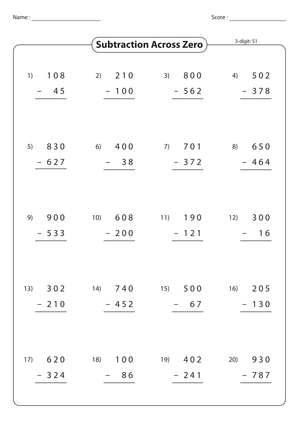
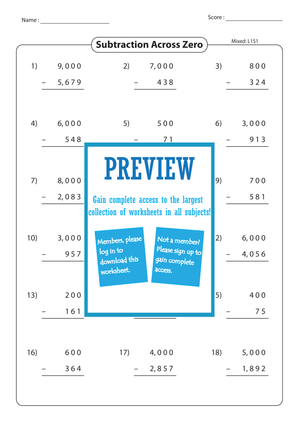
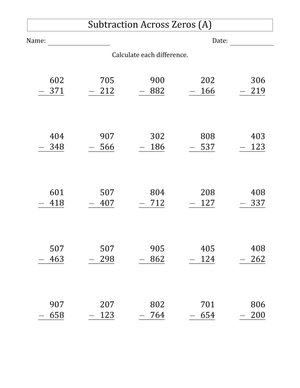
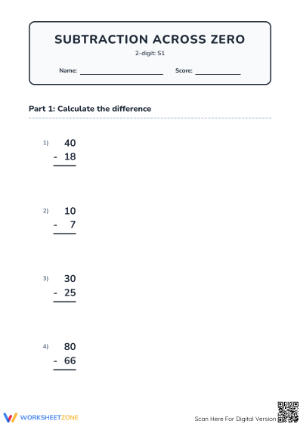
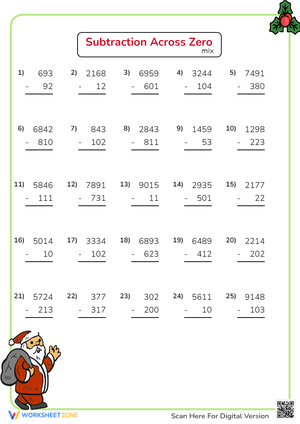
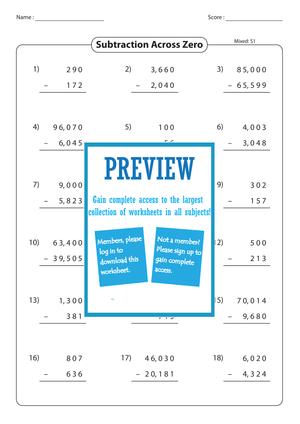
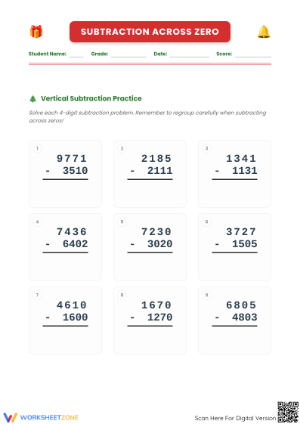
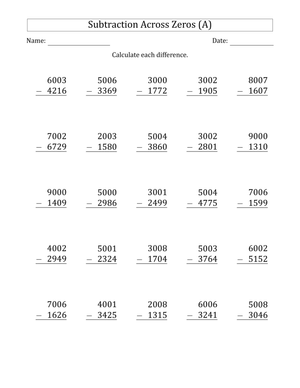
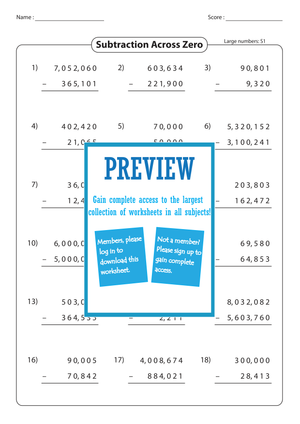
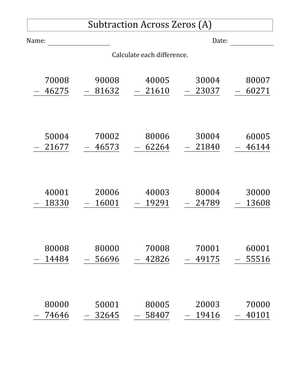
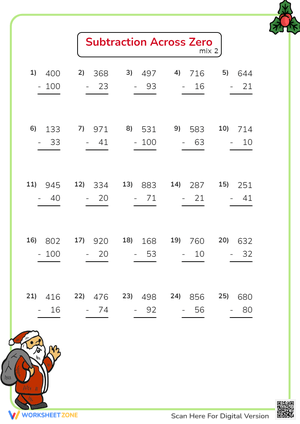
3rd grade subtraction across zeros printable worksheets address one of the most reliably difficult inflection points in third-grade math: the moment a student stares at 400 − 163 and discovers that borrowing from the tens column is impossible because the tens column holds a zero. Each worksheet in this set works through the chain-regrouping process — trading one hundred for ten tens, then one of those tens for ten ones — until those steps become automatic rather than a source of stalling.
What Students Work Through in Each Worksheet
The set moves from two-digit problems with a zero in the ones place up through three-digit problems where both the ones and tens columns begin at zero. Students underline the column they need to borrow from, mark the regrouping adjustments above the problem, rewrite the adjusted values, and complete the subtraction. That procedural sequence stays consistent across every worksheet so students internalize the steps rather than reinvent them each session.
Several worksheets also include error-analysis tasks. Students examine a problem that has already been worked through incorrectly — typically one where the regrouping marks are present but the tens digit was left at 10 rather than adjusted down to 9 — and identify exactly where the logic broke down. That format asks students to inspect someone else's thinking rather than just execute their own, which surfaces misconceptions that standard drill tends to miss entirely.
Building These Worksheets Into Your Lesson Week
The highest-yield use is a five-minute warm-up at the start of your math block — two or three problems at a time — for the week immediately following your initial lesson on chain regrouping. Spaced retrieval matters here: students who work through ten problems in a single sitting perform measurably worse on end-of-week checks than students who encounter three problems Monday, three Tuesday, and four Wednesday. Short daily exposure keeps the multi-step logic fresh without demanding a full lesson period every day.
For students still shaky on the concept, these work well as a small-group pull during independent work time. Sitting with four students and talking aloud through 500 − 278 — "we can't borrow from the tens because it's zero, so what do we do next?" — reveals thinking that a completed worksheet never shows. Ask each student to verbalize every step and stop them the moment they skip the adjustment to the tens digit, because that is where the breakdown almost always lives. The 3rd grade subtraction across zeros printable worksheets also serve as a clean homework option once students have demonstrated basic accuracy in class, since the format is predictable enough that parents can follow along without needing a teacher guide.
Error Patterns That Show Up When Students Work Across Zeros
The single most frequent error — visible in roughly three-quarters of first attempts — is the "bigger minus smaller" shortcut. A student working 400 − 163 will subtract 0 from 3 and write 3 in the ones place, subtract 0 from 6 and write 6 in the tens place, then subtract 1 from 4 and write 3 in the hundreds place. The answer comes out 363 instead of 237, and the student often has no idea anything went wrong because the arithmetic felt correct — they subtracted, they got a number. Every problem in the set is built so the standard algorithm only produces the right answer if students regroup in the correct direction, which makes this error impossible to hide.
The second error shows up after students begin regrouping correctly. In a problem like 500 − 246, a student borrows 1 hundred and writes 4 in the hundreds place and 10 in the tens, then borrows 1 ten for the ones — but leaves the tens digit at 10 rather than dropping it to 9. The subtraction in the tens column then becomes 10 − 4 instead of 9 − 4, and the final answer is off by exactly 10. Students rarely catch this independently because the result looks plausible. The error-analysis tasks on several worksheets surface this pattern faster than additional drill ever does.
Standard Alignment
These worksheets address 3.NBT.A.2, which calls for third graders to fluently add and subtract within 1,000 using strategies and algorithms grounded in place value and the relationship between the two operations. Subtraction across zeros sits at the harder end of that standard's range because it specifically tests whether students understand how the base-ten system decomposes — not just whether they can execute a memorized procedure. Most classrooms reach this material in the second or third unit of the year, after students have worked with three-digit numbers and basic regrouping. Attempting chain regrouping before students have stable place value understanding tends to produce procedural shortcuts that become very difficult to undo.
Adjusting These Worksheets for a Range of Learners
Students who are not yet solid on place value benefit from keeping a labeled column chart — hundreds, tens, ones — beside the worksheet as they work. It gives them something concrete to point to when the chain-regrouping logic stalls. Remove the chart once a student demonstrates three consecutive correct regroupings without consulting it; that's a reliable signal that the internal model is holding.
Students moving quickly through the standard problems can extend their thinking with the same-difference strategy. If a student is solving 500 − 167, subtracting 1 from both numbers gives 499 − 166 — no zeros in the top number, straightforward regrouping, same result. Asking those students to solve both versions and confirm the answers match gives them a genuine self-checking method rather than just more of the same practice. This extension works especially well with the 3rd grade subtraction across zeros printable worksheets that use three-digit minuends ending in two or three zeros, where the same-difference adjustment is most visually striking and the payoff is easiest to explain.
Frequently Asked Questions
Why does regrouping across zeros cause so much more trouble than standard regrouping?
Standard regrouping asks students to look one column to the left. Regrouping across zeros forces them to look two or three columns left before finding a digit to borrow from, then work back to the right with newly adjusted values at each stop. That chain is a longer working-memory demand than most third graders have encountered in math before. It is also the first time many students discover that following the standard algorithm in the wrong order produces a wrong answer that still looks like a real number.
When is the right point to introduce the same-difference strategy?
After students can execute chain-regrouping steps correctly at least eight out of ten times. Introduced earlier, the strategy functions as an escape hatch — students use it to sidestep regrouping entirely and never build fluency with the standard algorithm. Once the algorithm is stable, the same-difference method becomes genuinely useful for mental math and for quickly verifying answers on assessments.
Are these a good fit for students with working-memory challenges?
The 3rd grade subtraction across zeros printable worksheets use a consistent layout across the full set — same column structure, same placement for regrouping marks — which reduces the cognitive work of setting up each problem and leaves more mental bandwidth for the computation itself. Students who need additional support still benefit from verbalizing each step aloud and keeping a visible place value chart while they work. The error-analysis tasks are particularly accessible for these students because the problem is already completed; they only need to inspect one step at a time rather than manage the entire sequence at once.













 Interactive Worksheet Maker
 Quiz Maker
 Word Search Maker
 Crossword Puzzle Maker
 Word Scramble Generator
 Sentence Scramble Generator
 Handwriting Worksheet Generator
 Name Tracing Generator
 Fill In The Blank Generator