


























Views
Downloads

Essential Associative Property of Area Worksheet | Grade 3
Paste this activity's link or code into your existing LMS (Google Classroom, Canvas, Teams, Schoology, Moodle, etc.).
Students can open and work on the activity right away, with no student login required.
You'll still be able to track student progress and results from your teacher account.
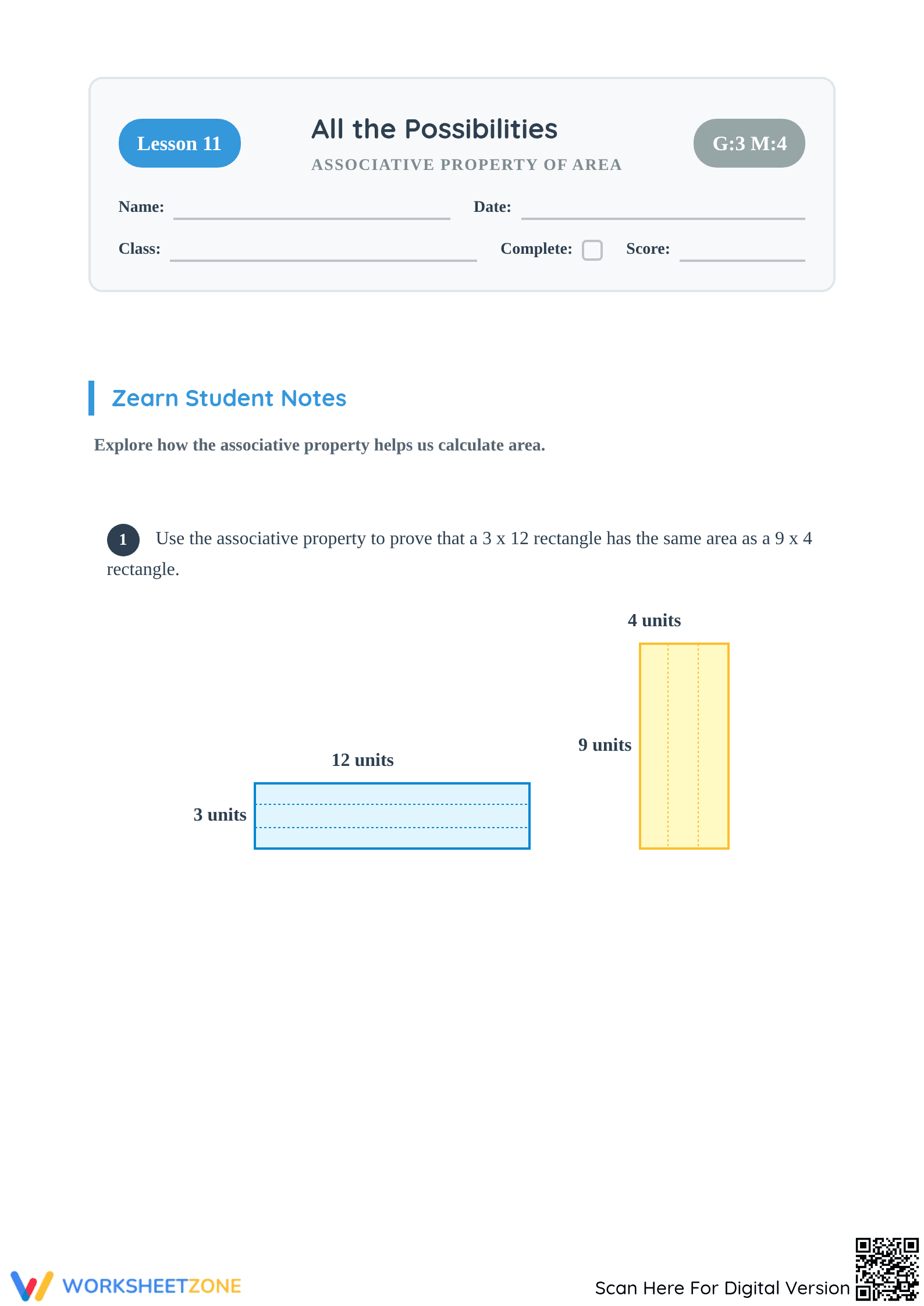
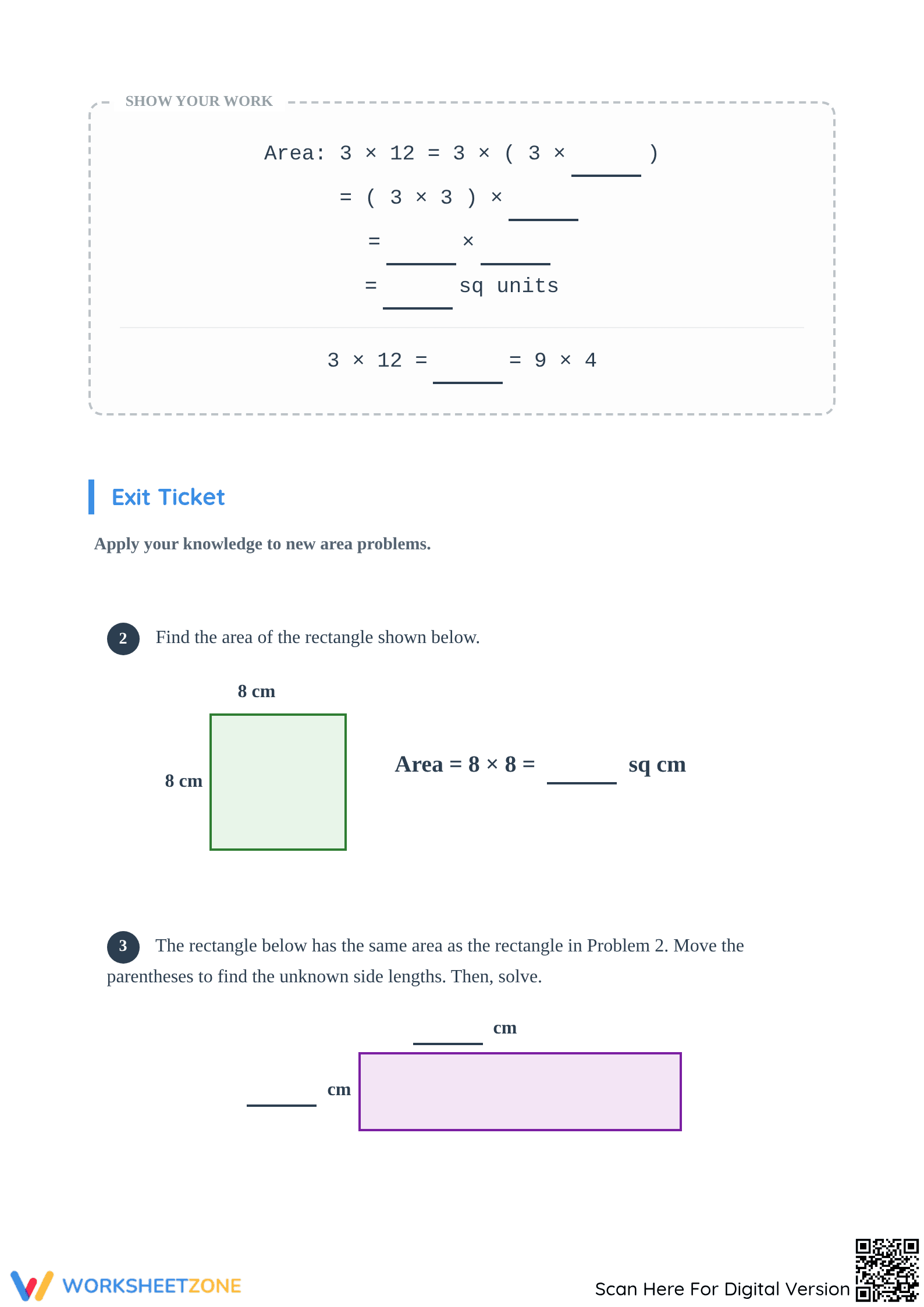
This Grade 3 math worksheet provides a comprehensive guide to understanding the associative property of area. Students learn to decompose rectangles and regroup factors to prove area equivalence, transitioning from visual models to abstract algebraic reasoning. It ensures learners grasp why different groupings of side lengths result in the same total square units.
At a Glance
- Grade: 3 · Subject: Math
- Standard:
CCSS.MATH.CONTENT.3.MD.C.7— Relate area to the operations of multiplication and addition- Skill Focus: Associative Property of Area
- Format: 4 pages · 6 problems · Answer key included · PDF
- Best For: Lesson supplement or formative assessment
- Time: 20–35 minutes
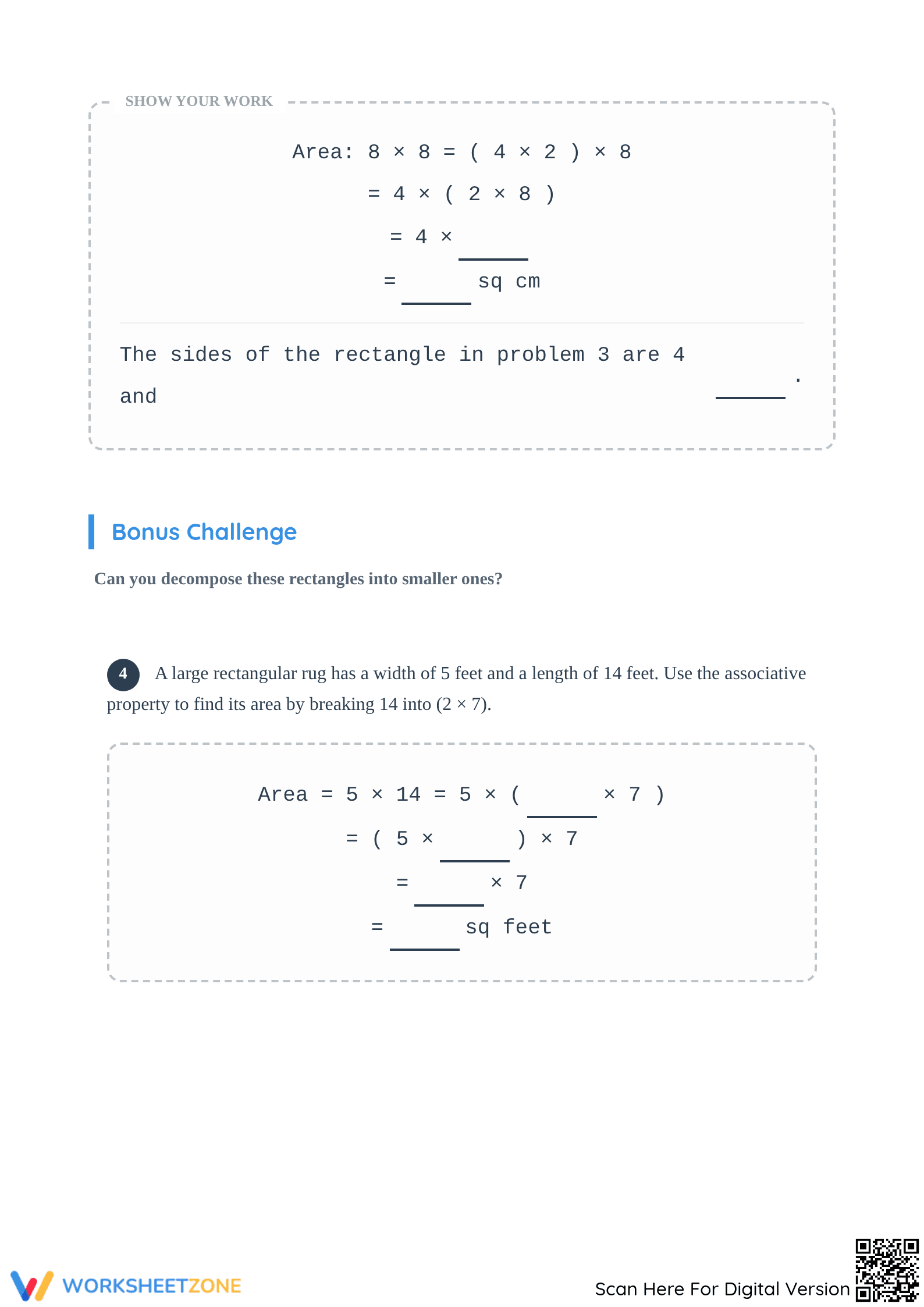
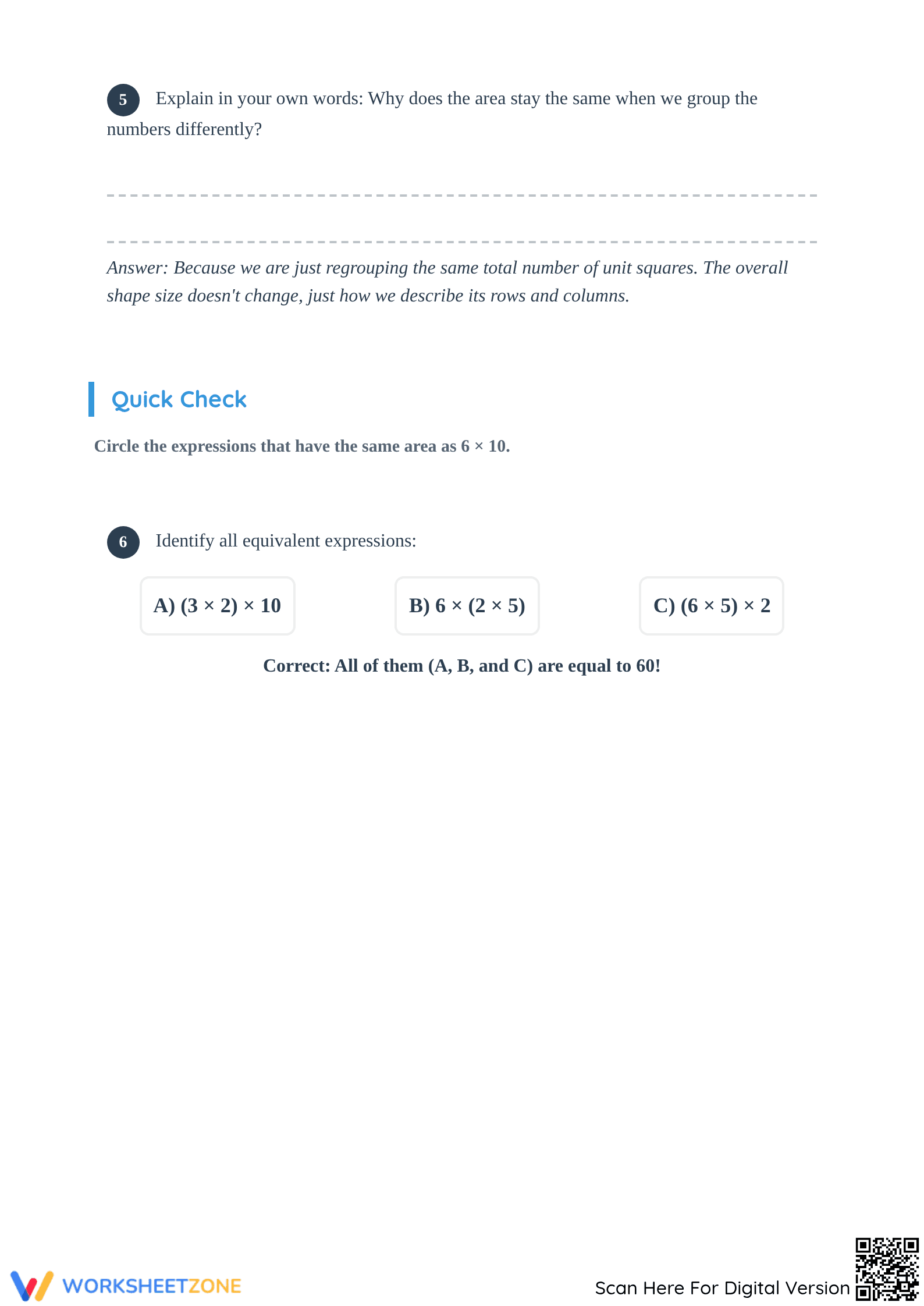
The packet includes four structured pages: Zearn-aligned student notes, an exit ticket for immediate feedback, a bonus challenge for extension, and a quick check for mastery verification. It features clear geometric models, step-by-step calculation frames, and writing prompts to elicit conceptual explanations. The answer key is fully integrated for rapid grading and feedback.
Zero-Prep Workflow
- Print: Select all four pages for a full lesson or specific pages for targeted practice (30 seconds).
- Distribute: Hand out the guided notes to introduce the associative property concept (1 minute).
- Review: Use the built-in Quick Check to verify student understanding before moving to independent work (2 minutes).
Total teacher preparation time for this complete area instructional set is under five minutes.
The primary focus is CCSS.MATH.CONTENT.3.MD.C.7.c, which requires students to use area models to represent properties in mathematical reasoning. Additionally, it supports CCSS.MATH.CONTENT.3.OA.B.5 by applying the associative property of multiplication. Both standard codes can be copied directly into lesson plans, IEP goals, or district curriculum mapping tools.
Use these notes during the "We Do" phase of direct instruction to model the decomposition of large rectangles. Alternatively, assign the "Exit Ticket" as a mid-lesson check to identify students who may need additional scaffolding with parentheses. Monitor how students fill in the algebraic frames to catch errors in regrouping factors during the formative assessment phase.
This resource is designed for third-grade students mastering multiplication properties and area concepts. It is particularly effective for learners who benefit from visual-to-abstract transitions and can be paired naturally with an anchor chart displaying the associative property formula. It provides excellent support for students who struggle with abstract multi-step equations.
According to the RAND AIRS 2024 analysis of elementary mathematics instruction, the use of visual area models significantly enhances a student's ability to internalize abstract properties of operations such as the associative property. This worksheet aligns with CCSS.MATH.CONTENT.3.MD.C.7 by bridging the gap between tiling and numerical multiplication. Research from EdReports 2024 emphasizes that high-quality instructional materials must provide multiple opportunities for students to show their work through structured problem sets and conceptual explanations. By requiring students to explain why area remains constant despite regrouping side lengths, this resource builds the rigorous mathematical reasoning skills identified as critical in the NAEP framework. Teachers using these materials can expect improved student performance in multi-step multiplication tasks and a deeper conceptual foundation for fourth-grade measurement standards. The inclusion of an exit ticket ensures that data-driven instruction remains at the forefront of the classroom workflow.


