


























Views
Downloads

Printable Pot of Gold Multiplication Worksheet | Grade 2
Paste this activity's link or code into your existing LMS (Google Classroom, Canvas, Teams, Schoology, Moodle, etc.).
Students can open and work on the activity right away, with no student login required.
You'll still be able to track student progress and results from your teacher account.
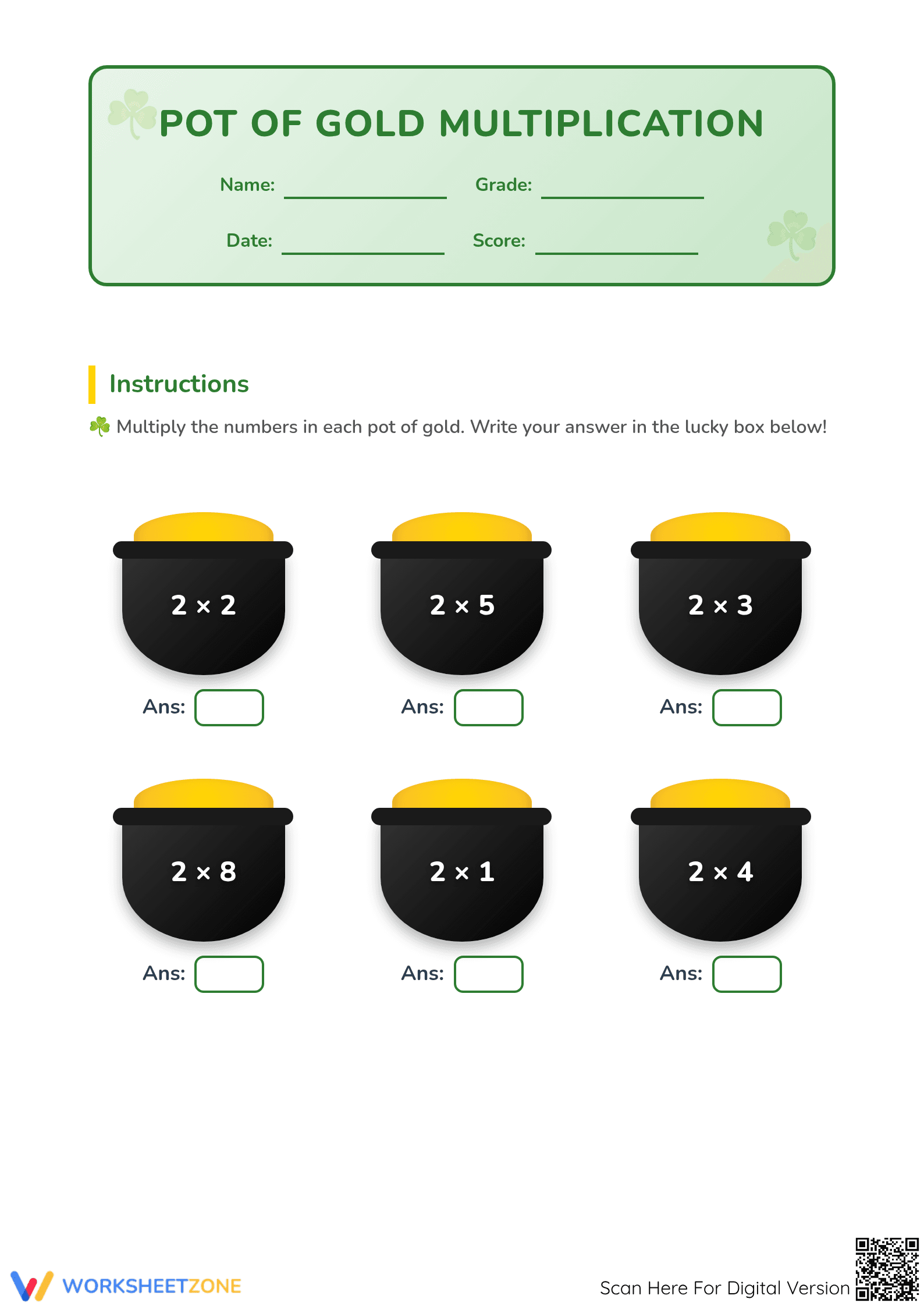
The Pot of Gold Multiplication worksheet provides a festive and focused way for second and third-grade students to master basic multiplication facts. By engaging with seasonal imagery, learners solve 30 distinct problems that build computational fluency and conceptual understanding of products. This resource ensures students gain confidence in multiplication through clear, structured practice and immediate feedback opportunities.
At a Glance
- Grade: 2 · Subject: Math
- Standard:
CCSS.MATH.CONTENT.3.OA.A.1— Interpret products of whole numbers as the total number of objects in groups- Skill Focus: Basic Multiplication Facts (2-5)
- Format: 3 pages · 30 problems · Answer key included · PDF
- Best For: Seasonal Math Centers and Fact Fluency
- Time: 15–20 minutes
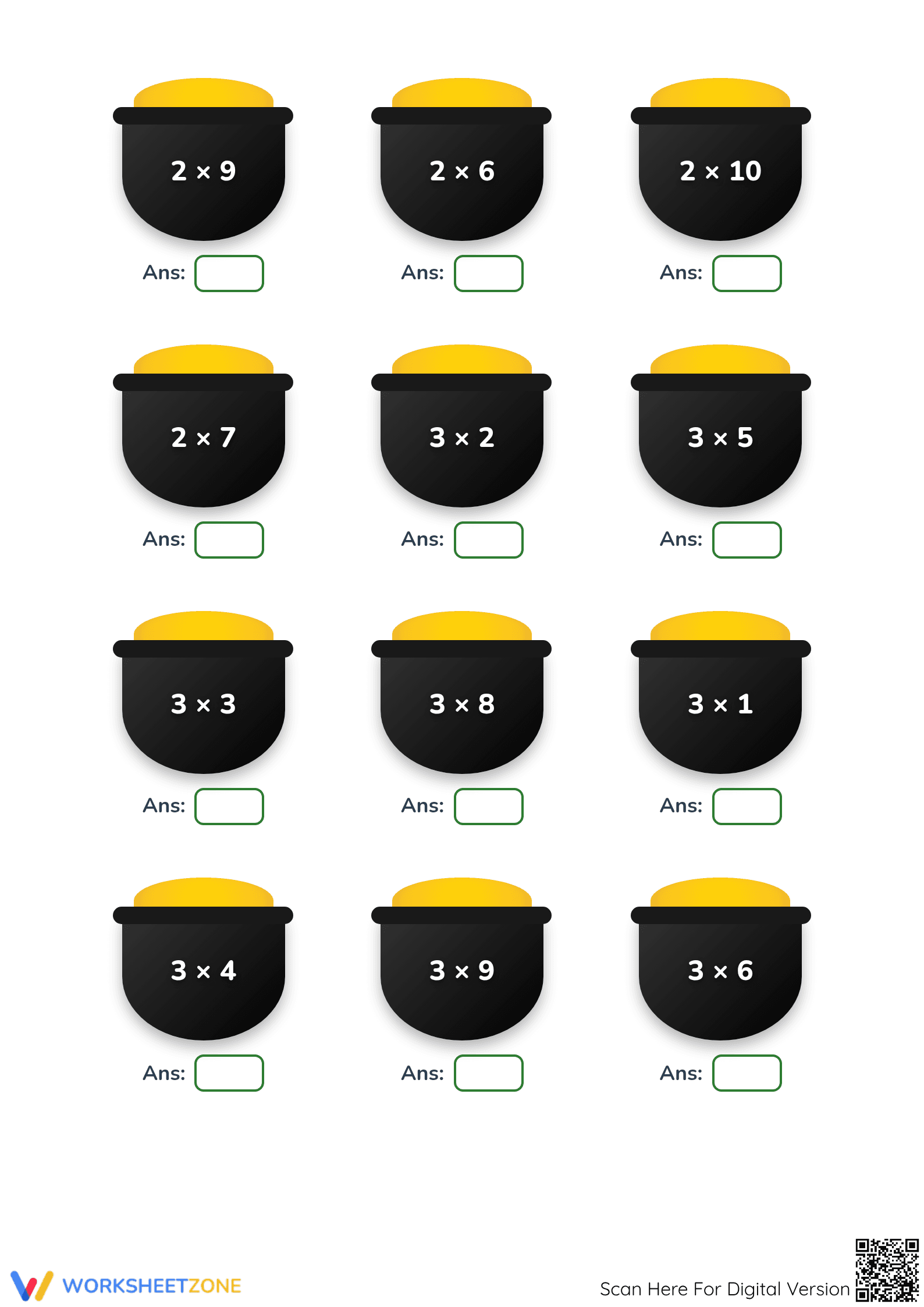
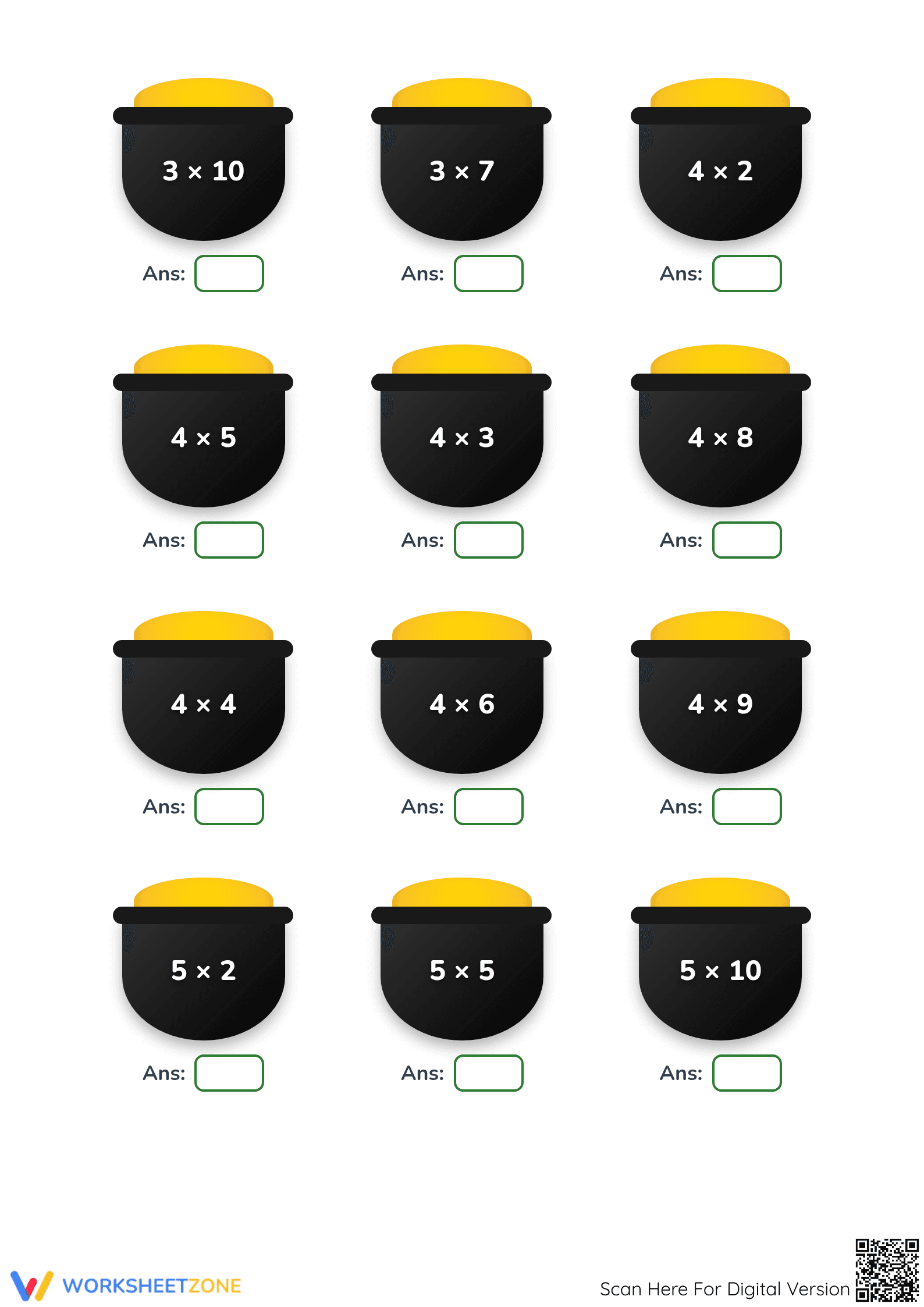
Inside this three-page PDF, you will find a total of 30 multiplication problems presented inside themed "pots of gold." The layout is clean and uncluttered, providing ample space for students to write their answers in the designated "lucky boxes." A comprehensive answer key is included, allowing for quick grading or student self-correction during independent work periods.
Skill Progression
- Guided Practice: The first page introduces factors of 2 with 6 problems, allowing students to apply repeated addition concepts in a simplified multiplication format.
- Supported Practice: Page two expands the challenge with 12 problems covering factors of 2 and 3, increasing the complexity while maintaining visual support.
- Independent Practice: The final page provides 12 rigorous problems focusing on factors of 4 and 5, requiring students to retrieve facts with less scaffolding.
This gradual release model follows the "I Do, We Do, You Do" instructional framework to ensure mastery before moving to higher factors.
Standards Alignment
The primary focus of this worksheet is `CCSS.MATH.CONTENT.3.OA.A.1`, which requires students to interpret products of whole numbers. By solving for the total "gold" in each pot, students visualize the relationship between factors and products. Additionally, it supports `CCSS.MATH.CONTENT.3.OA.C.7` by building fluency for multiplication within 100. Both standard codes can be copied directly into lesson plans, IEP goals, or district curriculum mapping tools.
How to Use It
Incorporate this worksheet during the "You Do" phase of a lesson on multiplication or as a festive morning work activity during the week of St. Patrick's Day. Teachers should observe students as they solve the first few problems on page one to identify any misconceptions regarding the multiplication symbol versus addition. Completion usually takes 15 to 20 minutes depending on prior fact exposure.
Who It's For
This resource is designed for Grade 2 and Grade 3 students beginning their multiplication journey. It is particularly effective for learners who benefit from thematic engagement and clear spatial organization. This worksheet pairs naturally with a St. Patrick's Day themed read-aloud or a hands-on math center using gold coin manipulatives to model the groups before writing the abstract products.
Research by Fisher & Frey (2014) emphasizes that the gradual release of responsibility is essential for students to internalize new mathematical operations like multiplication. By moving from the familiar factor of 2 to factors of 5 across 30 problems, this worksheet provides the necessary repetition for cognitive retrieval. The inclusion of CCSS.MATH.CONTENT.3.OA.A.1 ensures that practice remains aligned with evidence-based instructional goals. For primary educators, providing tasks that use visual themes can reduce math anxiety while increasing time-on-task. This multiplication activity bridges the gap between concrete modeling and abstract fact fluency, a critical milestone in early elementary mathematics. This citation capsule serves as a summary of the worksheet's pedagogical value and its direct alignment with established educational standards and research-backed teaching methods.


