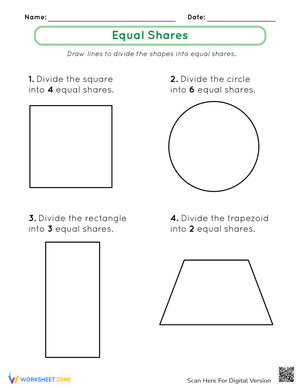
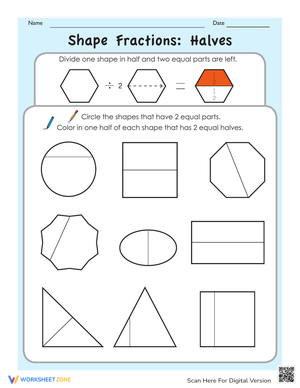
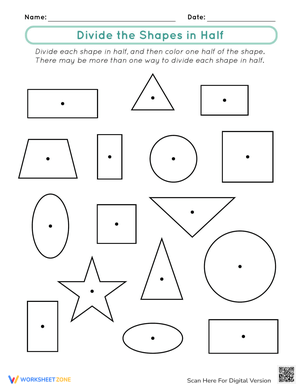
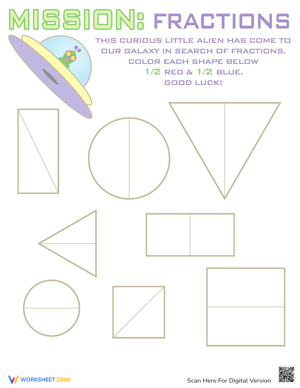
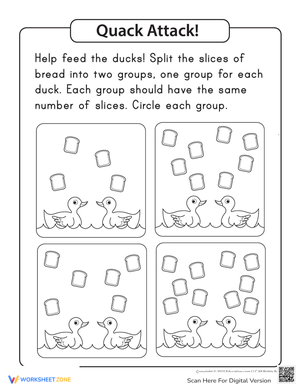
These fractions and fair shares worksheets for 3rd grade give teachers a focused set of resources built around one foundational insight: before students can interpret notation like 1/2 or 1/4, they need direct experience dividing shapes into equal parts and physically verifying what "equal" actually means. Each worksheet targets a specific step in that progression — from drawing partition lines, to labeling unit fractions, to evaluating whether a given model shows a genuine fair share.
The Specific Skills Targeted in Each Worksheet
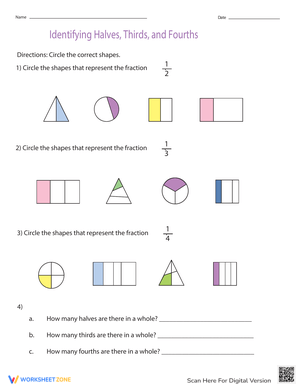
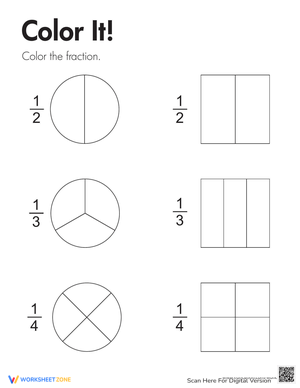
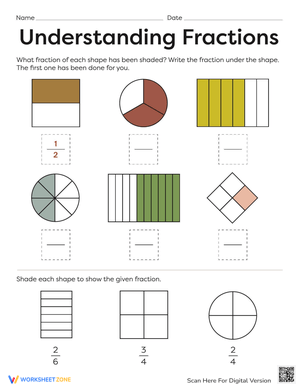
Students partition circles and rectangles into halves, thirds, fourths, sixths, and eighths, then label each section with the correct unit fraction. Some worksheets present shapes that are already partitioned and ask students to shade a specified fraction; others require students to draw the partition lines themselves, which is harder and more revealing. A third category asks students to evaluate pre-drawn models — some equal, some not — and decide whether each shows a fair share. Including non-examples is worth the few minutes it takes, because students who only see correct models tend to assume that any set of lines through a shape produces valid fractions. The set also includes set-model tasks where students divide groups of counters equally, connecting the partitioning work to the equal-groups reasoning students built during multiplication. Using these fractions and fair shares worksheets for 3rd grade alongside hands-on manipulatives — physical fraction tiles or folded paper squares — reinforces the same skills through a different sensory channel.
Frequent Student Errors Worth Watching For
The most persistent misconception is denominator-size confusion: students conclude that 1/4 is greater than 1/2 because 4 is greater than 2. Worksheets that place both fractions side by side on identically sized rectangles make the inverse relationship visible without requiring extended re-teaching. What students see — one part out of four narrow columns versus one part out of two wide columns — often resolves the confusion faster than verbal explanation alone.
A second error pattern shows up in student-drawn partitions. A student will draw two lines across a circle to show "thirds" but cluster both lines toward one side, producing two slivers and one large section. The number of parts is correct; the sizing is not. Tasks that ask students to cut out their sections and stack them expose this problem in a way that circling the right answer cannot. A third error surfaces in set models: when 12 counters are divided into 3 groups, some students write 3 as the fraction rather than 1/3, losing track of what constitutes the whole. A short label on the worksheet — "the whole set = 12" — prevents most of that confusion without requiring teacher intervention each time.
Working These Worksheets Into Your Lesson Planning
The most productive placement for these worksheets is immediately after a hands-on activity, not instead of one. A routine worth building is "Partition, Predict, Prove": project a shape on the board, ask students to predict how many equal parts are possible, then let them draw the partition on the worksheet and verify by cutting or folding. That cycle takes roughly 8–10 minutes and gives the worksheet a genuine function — it becomes the record of what students proved, not just a task to finish before moving on.
During small-group rotations, these worksheets double as quick diagnostics. Scanning completed worksheets at the end of a station block reveals who is still drawing unequal slices and who is partitioning accurately. That information directly shapes the next day's guided group. The fractions and fair shares worksheets for 3rd grade also fit well into Monday warm-ups after a weekend gap, since returning to concrete partitioning models helps students re-anchor the concept before moving to more abstract work later in the week.
Standard Alignment
These worksheets address CCSS.MATH.CONTENT.3.NF.A.1, which requires students to understand that a fraction 1/b represents the quantity formed by one part when a whole is partitioned into b equal parts. In Grade 3 scope and sequence, this standard typically appears in the first fraction unit — late fall or early spring — after students have built multiplication and division fluency. Several worksheets in the set also connect to 3.NF.A.3, particularly the tasks that ask students to compare two fractions drawn on identical shapes. When a student places 1/2 and 1/4 side by side on matching rectangles and explains which part takes up more area, they are working directly within that standard's expectations. Students who develop a solid mental image of what 1/3 or 1/6 looks like inside a shape carry that reference into later work — placing fractions on a number line becomes significantly more intuitive once equal partitioning is internalized.
Adjusting the Set for a Range of Learners
Students who are not yet secure with equal partitioning benefit from starting with halves and fourths on rectangles. Rectangles are easier to divide accurately than circles because straight lines are more manageable, and allowing a ruler removes a drawing barrier that can mask genuine conceptual confusion. Beginning with simpler denominators on simpler shapes keeps the cognitive demand on the concept rather than on the mechanics of the task.
For students ready for deeper work, the most effective extension asks them to show the same fraction multiple ways — three different arrangements for sixths in a rectangle, for instance. This does not introduce new content; it deepens the existing concept by demonstrating that equal parts do not need to be arranged identically to represent the same fraction. A student who can produce multiple valid partitions for 1/6 has internalized what the fraction means, not just memorized a procedure.
Frequently Asked Questions
How do you introduce fair shares to a student who has never seen fraction notation?
Start with something concrete and personal: "If you and a friend split one granola bar, each piece should be the same size — that is a fair share." Then connect that to a rectangle on paper, split into two equal parts. Once students understand halves through that lens, thirds and fourths follow the same logic. Keeping early examples tied to familiar sharing situations reduces the abstraction load before any notation appears.
What is the difference between equal and unequal shares in a fraction model?
Equal shares means every section of the whole is identical in area. Unequal shares occur when dividing lines produce sections of different sizes. Only equal shares support fraction notation — and that distinction is exactly where many Grade 3 students first go wrong. Worksheets that show both types of models side by side train students to check size, not just count pieces.
Do the comparison tasks address the denominator-size misconception directly?
Several worksheets include side-by-side comparison tasks — 1/2 and 1/4, or 1/3 and 1/6, drawn on identically sized shapes so students can see which part takes up more area. These tasks appear across the set rather than clustering in one unit, because spaced practice over multiple sessions builds more durable understanding than a single concentrated lesson does.
Are these resources useful for fraction review, or only for initial instruction?
The fractions and fair shares worksheets for 3rd grade work equally well at the start of a unit and as review in the weeks before standardized assessments. The partitioning tasks that felt demanding in the fall often serve as confidence builders in the spring — students recognize the models, work through them more quickly, and reach the comparison tasks with stronger accuracy. That shift in pace is itself a useful piece of formative data.













 Interactive Worksheet Maker
 Quiz Maker
 Word Search Maker
 Crossword Puzzle Maker
 Word Scramble Generator
 Sentence Scramble Generator
 Handwriting Worksheet Generator
 Name Tracing Generator
 Fill In The Blank Generator