3rd Grade Fraction Strips PDF Worksheets for Math Mastery
These 3rd grade fraction strips worksheets give students a linear model for fractions at exactly the moment they need one most — when the shift from counting whole objects to reasoning about parts of a whole starts to crack the foundation of their number sense. Each worksheet in the set targets a specific skill: identifying unit fractions, comparing fractions with the same whole, or building toward equivalence through visual alignment. Teachers get ready-to-use practice that moves students from "fractions are two numbers with a line between them" toward a genuine understanding of fractional quantity.
What's Inside the Set
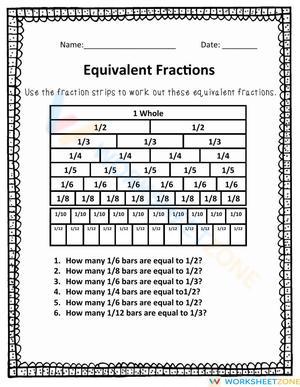
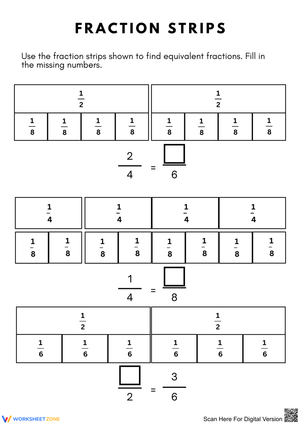
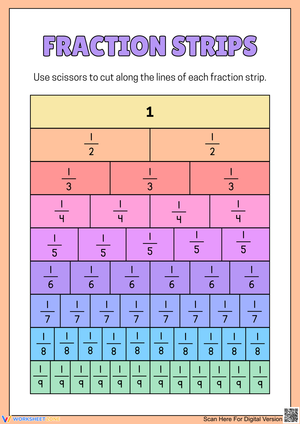
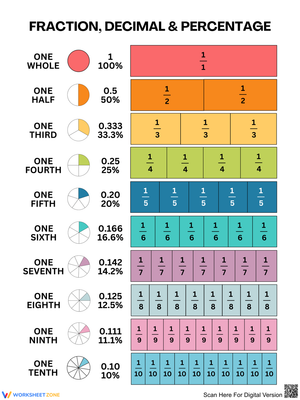
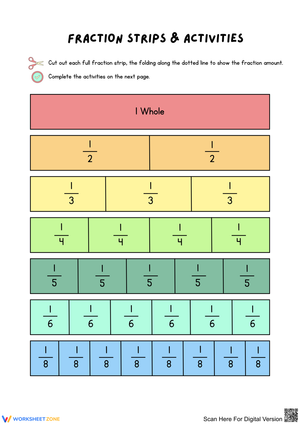
The worksheets address the denominators emphasized in the Grade 3 curriculum: halves, thirds, fourths, sixths, and eighths. These aren't arbitrary — they're chosen because their relationships are visible without computation. Students can see that four eighths align exactly with two fourths and one half, which is a more convincing proof of equivalence than any rule a teacher could write on the board.
Across the set, students work with these skills:
- Shading and labeling unit fractions on pre-drawn strips, connecting the denominator to the number of equal parts in the whole
- Comparing two fractions with different denominators by examining strip length rather than the size of the numerals
- Using stacked strips to identify equivalent fractions by drawing vertical lines where parts from different rows end at the same point
- Placing fractional values in order from least to greatest using strip length as the measure
- Connecting the endpoints of fraction strip sections to marked positions on a number line directly below the strip
That last task — transferring the strip directly onto a number line — is where these worksheets earn their place in the sequence. Students who can make that translation own the concept in a way that doesn't evaporate between units.
Standard Alignment
CCSS.MATH.CONTENT.3.NF.A.1 defines a unit fraction as one part of a whole partitioned into equal parts — exactly the concept these worksheets build from the first exercise. CCSS.MATH.CONTENT.3.NF.A.3b requires students to recognize and generate simple equivalent fractions and explain why they are equal using a visual model; the stacked-strip equivalence worksheets are a direct match for that standard's intent, not just its surface language. CCSS.MATH.CONTENT.3.NF.A.3d covers comparing fractions with the same numerator or same denominator — the comparison worksheets address this with strips that make the size relationship visible before students write any symbol.
Mistakes Students Make That These Worksheets Help You Catch
The most durable misconception at this level is that a larger denominator signals a larger fraction. Students who have spent two years learning that larger numbers mean larger quantities apply that logic here and conclude that 1/8 is bigger than 1/4. The error makes complete sense given their prior experience — the problem is that fraction magnitude inverts the relationship between the denominator and the part size. When a student places a 1/8 strip next to a 1/4 strip and physically sees that the eighth is shorter, the correction tends to stick in a way that a verbal explanation won't.
A second error pattern shows up specifically during equivalence work: students will correctly identify that 2/4 and 1/2 cover the same length on their strips, then turn around and write that 2/4 is greater than 1/2 because "2 is bigger than 1." They've read the visual correctly but reverted to whole-number logic when writing the symbolic answer. Watching for this split — right with the model, wrong on the written response — tells you the student needs more time bridging the visual and symbolic representations before moving forward.
Recommended Lesson-Planning Strategies for These Worksheets
These worksheets fit cleanly into the guided practice segment of a lesson, after direct instruction and before independent work. That placement matters: students who skip straight to independent practice with fraction strips often use them as answer-checkers rather than reasoning tools. Doing a few problems together first — narrating what you're looking for as you align the strips — models the thinking process, not just the procedure.
For math centers, one station can ask students to find every equivalent fraction for 1/2 using the strips available, while a second station presents fraction comparison cards where students must use a strip to justify their answer in writing. The justification step is worth requiring explicitly; "I could see it was longer" is a complete mathematical argument at this stage, and students who can articulate that reasoning are building the language they'll need for 4th grade fraction work.
The transition-to-number-line worksheet works well as the capstone lesson for the unit rather than an introduction. Place it in the final week of the fraction unit, after students have handled strips fluently for a few days. Rushing to the number line before students are comfortable with the strips reproduces the exact confusion the strips were meant to prevent.
Adjusting the Worksheets for a Range of Learners
Students who are still working to stabilize the concept of equal parts benefit from starting with halves and fourths only, using the physical cut-and-fold version of the strip before touching the worksheet. Folding a paper strip in half, then in half again, and labeling each section with 1/4 gives students a kinesthetic anchor for what equal partitioning actually means — the crease lands in the same place every time.
For students who have the foundational understanding and need more challenge, the equivalence worksheets can be extended by asking them to predict where a 1/10 strip would fall relative to 1/8 and 1/12 before any model is shown. This requires them to generalize the relationship between denominator size and part size rather than read it directly from the strips — a meaningful shift in cognitive demand within the same basic format.
Frequently Asked Questions
What denominators are covered, and why these specifically?
The worksheets use halves, thirds, fourths, sixths, and eighths. These denominators were selected because their relationships are accessible through doubling and tripling — students can see the halves-fourths-eighths family and the thirds-sixths family as connected groups rather than isolated facts. Introducing more complex denominators at this stage adds symbolic complexity without adding conceptual depth, so they're appropriately deferred.
Can these worksheets replace physical fraction strip manipulatives?
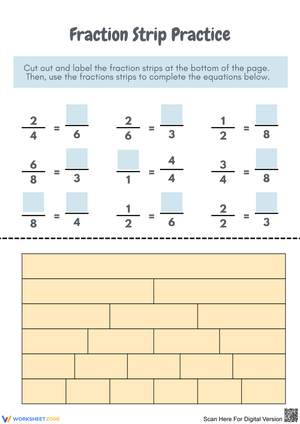
For most students, the worksheets and the physical manipulatives work better together than either does alone. Students who have handled cut-paper strips before working on the printed worksheets tend to use the drawn models more purposefully — they already know what aligning strips reveals. If manipulatives aren't available, the cut-and-use worksheets where students cut apart printed strips and arrange them to solve problems serve as a reasonable substitute.
How do these fraction strips worksheets connect to number line instruction?
Fraction strips are a linear model, which means the endpoint of each fractional section corresponds directly to a point on a number line. Once students can identify where 3/4 falls on a strip, placing it on a number line is a short, concrete step rather than an abstract leap. Several worksheets in the set include a number line directly below a strip for this reason — students draw tick marks at the end of each section and label the corresponding fractions, making the connection explicit rather than assumed.
Are these appropriate for students who are ahead of grade level?
Students who have already grasped unit fractions and basic equivalence can use the more open-ended comparison tasks and the number line transition worksheets as extension work. Asking them to construct their own fraction strip arguments — writing a written explanation of why 3/8 is less than 1/2 using only the strip as evidence — pushes into the kind of mathematical reasoning that previews 4th grade fraction standards without introducing out-of-grade content.
Clear All