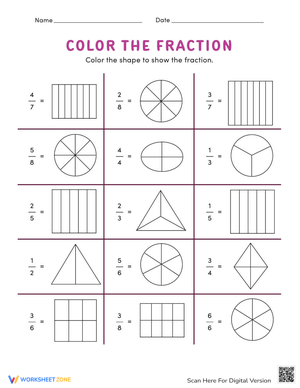
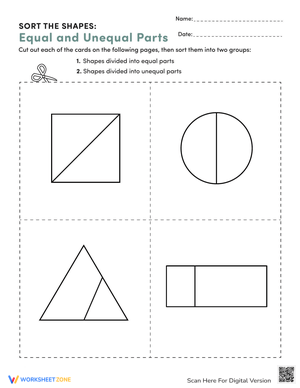
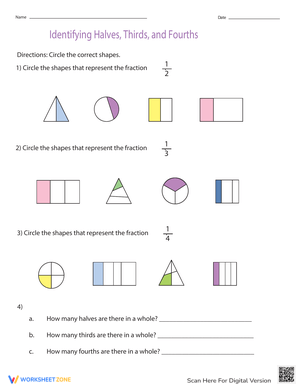
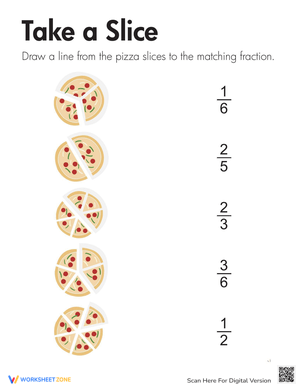
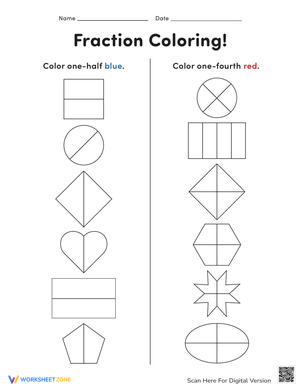
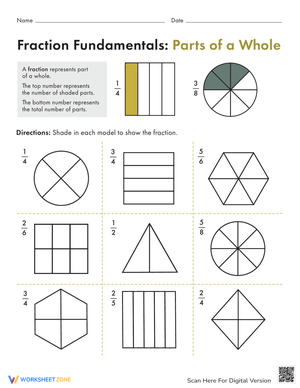
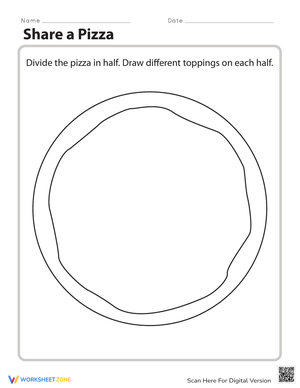
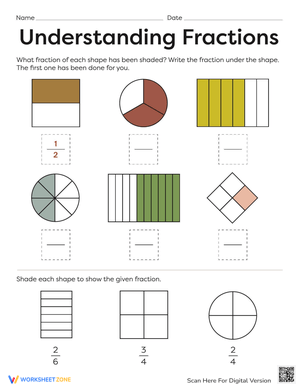
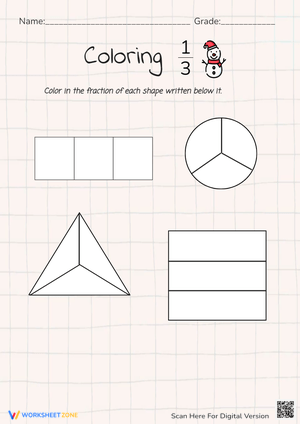
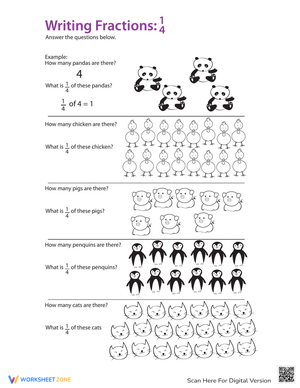
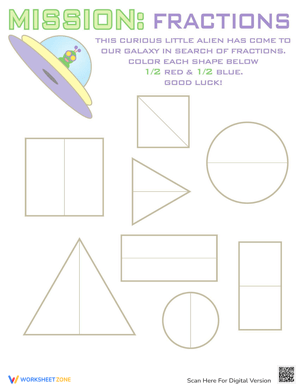
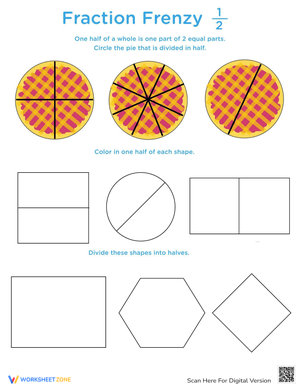
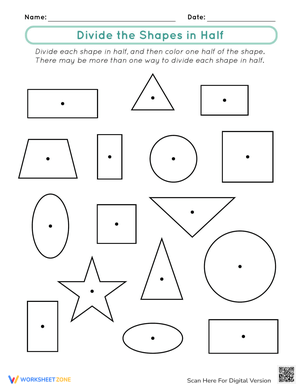
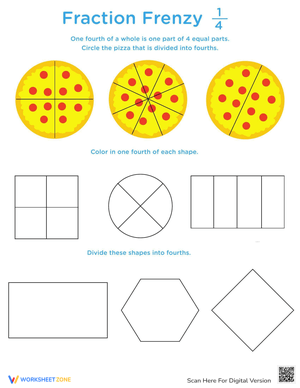
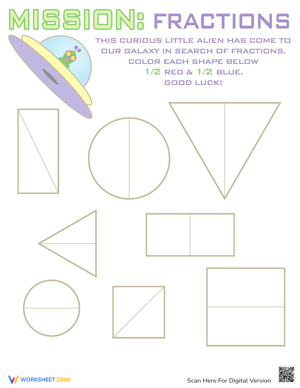
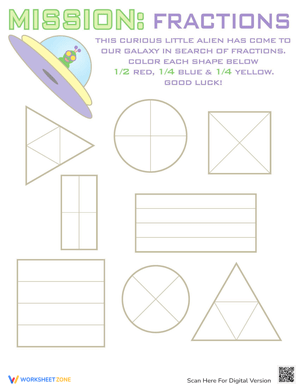
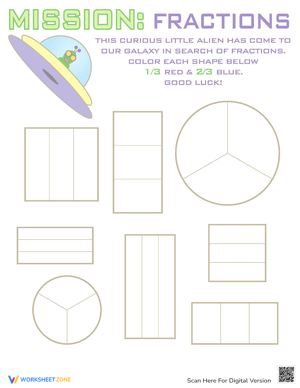
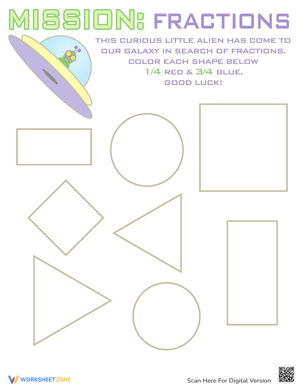
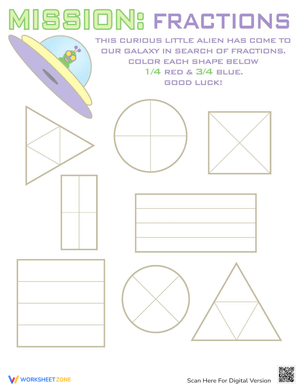
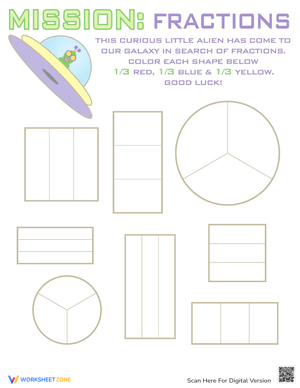
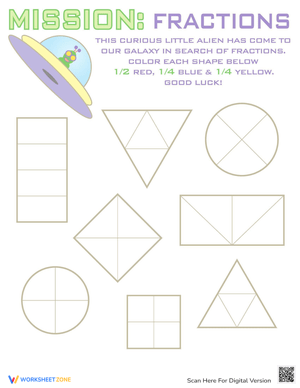
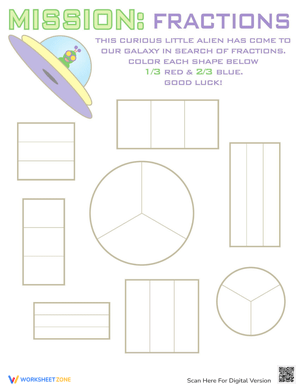
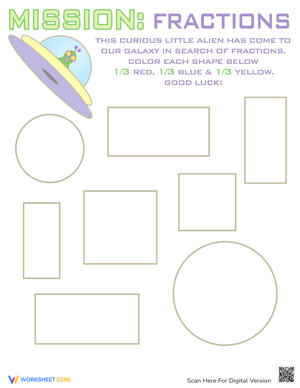
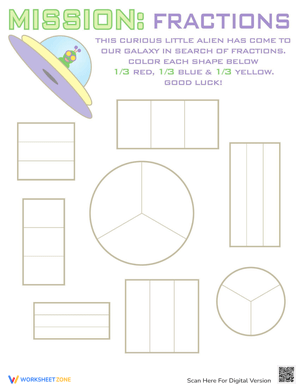
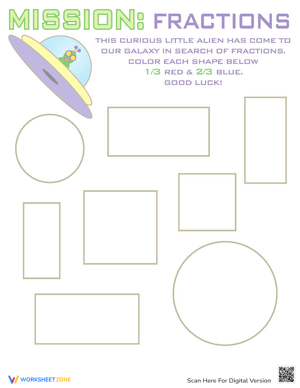
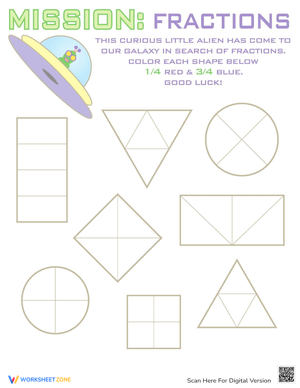
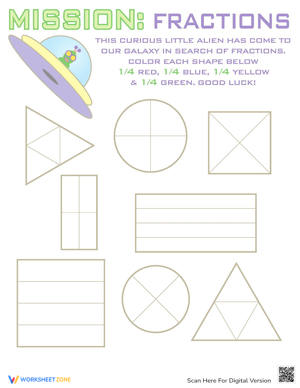
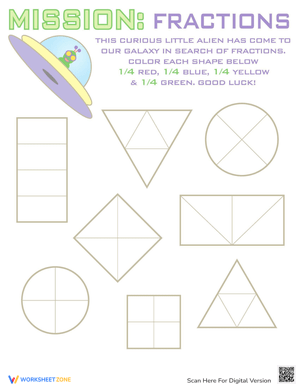
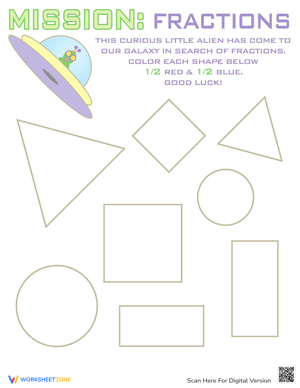
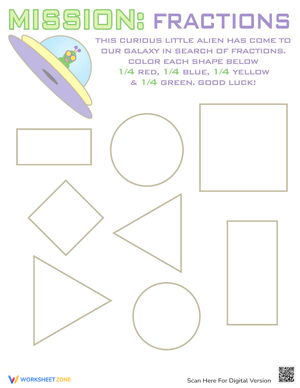
These 2d shapes and fractions pdf worksheets for 3rd grade give teachers a direct line into the hardest part of early fraction instruction: convincing eight-year-olds that equal parts are not optional. Each worksheet in the set targets partition work with circles, rectangles, and polygons — students shade named fractions, identify unit fractions, create equal divisions on blank shapes, and flag models where the partitions fail the equal-shares test. That range of task types supports a full instructional sequence from first introduction through mixed review without requiring teachers to piece together materials from separate sources.
Skills These Worksheets Build
The set covers the foundational skills that Grade 3 fraction instruction requires before students move to number lines or symbolic comparison. Every skill appears across worksheets in slightly varied contexts so students cannot simply repeat a memorized step — they have to read the situation. Locating 2d shapes and fractions pdf worksheets for 3rd grade that test the same skill across multiple shape types matters because students who shade a pre-divided circle correctly will sometimes fail when the shape changes to a hexagon or a blank rectangle with no partition drawn yet.
- Equal vs. unequal partitions: Students decide whether a shape has been divided fairly before naming any fraction.
- Unit fractions — halves through eighths: Students identify one equal part out of the total and write the matching symbol.
- Shading from a named fraction: A fraction is given; students shade the correct portion of a pre-divided shape.
- Writing fractions from shaded models: Students record both the fraction word and the symbol from a marked shape.
- Drawing partitions: Blank shapes require students to create equal divisions themselves — revealing far more about their understanding than reading a finished model ever does.
Errors Teachers Should Anticipate When Using These Worksheets
The most consistent mistake at this grade is what might be called the piece-count fallacy: a student sees four sections in a shape, writes 1/4 without checking whether those sections are equal, and has no idea anything is wrong. These worksheets surface this directly by including shapes where the section count matches a familiar fraction but the pieces are visibly unequal. Students who have only worked with well-formed models are often genuinely surprised — and that surprise creates the opening for real instruction.
A second reliable problem: students who shade correctly will still reverse the numerator and denominator when writing the symbol. They write 3/1 for one-third because they counted three parts aloud and recorded that number first. Restating the rule rarely fixes this. What tends to help is a verbal anchor students say before picking up the pencil: "The bottom number tells me how many equal parts make the whole." That small habit, repeated across several sessions, reduces the reversal error more reliably than re-explaining the concept from scratch.
Drawing tasks reveal a third gap that reading tasks hide entirely. A student who correctly labels a pre-divided rectangle as 1/4 may draw a rectangle "divided into fourths" where one section is clearly wider than the other three. This is partly a spatial reasoning issue, and it responds to physical work — folding paper, using a ruler to estimate thirds — before returning to freehand drawing. These worksheets make that gap visible early, which is the necessary first step to closing it.
How to Build These Worksheets Into Your Lesson Plans
The strongest placement for 2d shapes and fractions pdf worksheets for 3rd grade is immediately after whole-group instruction — while the modeled example from the board is still fresh and students are primed to try independently. That ten-to-fifteen-minute window right after modeling is where independent practice has the most impact. Saving worksheets for Friday review is a reasonable backup, but using them during the day's main practice window gives the concept the retrieval practice it needs before it fades overnight.
- Mini-lesson follow-up: Move directly from the board model to a shading or labeling worksheet. The visual directions let most students start without repeated prompting.
- Math center: Pair any shading worksheet with a crayon and a partner-check step — one student shades, the other confirms the fraction before both record. That two-step routine catches the equal-parts error without constant teacher involvement at every table.
- Exit check: Pull two or three problems from a draw-and-shade worksheet. Students finish before the transition bell; teachers sort responses by accuracy during the five minutes after dismissal.
- Intervention group: Return to the equal-vs.-unequal worksheets before re-teaching notation. Students who are confused about fraction symbols are almost always confused about equal parts first.
- Homework: Send a shading worksheet home only after the format is familiar from class. First exposure to a new task type at home — without a teacher to redirect — tends to generate confusion rather than understanding.
One routine worth adding before any session: ask students to point to the whole shape in the first problem. That two-second step anchors the task in the idea that a fraction describes parts of one complete figure, not just shaded pieces floating on a page.
Standard Alignment
The primary standard is CCSS 3.NF.A.1, which asks Grade 3 students to understand a fraction 1/b as one part of a whole partitioned into b equal parts, and to interpret fractions as numbers. The equal-parts identification work in these worksheets — deciding whether a partition is valid before naming the fraction — directly addresses the conceptual foundation that standard requires. Students who skip this step and jump to symbolic notation often cannot explain what a denominator actually means, a gap that reappears and causes real difficulty in 4th-grade work with equivalent fractions and comparison.
CCSS 3.G.A.2 applies to the drawing tasks: students partition shapes into equal areas and express each part as a unit fraction. That geometry-fraction overlap is worth naming explicitly in class. When students draw equal thirds in a rectangle, they are doing geometry work and fraction work at the same time, and making that connection visible helps students see the two domains as related rather than as separate sets of rules with nothing to do with each other.
Differentiating These Worksheets Across Ability Levels
Students who need additional support move forward more steadily when they start with the equal-vs.-unequal identification worksheets before any fraction naming begins. Pairing those worksheets with a concrete object — folded paper strips, pre-cut rectangles, or fraction tiles — lets students verify their reasoning physically before committing an answer to the worksheet. The goal is not to slow the sequence indefinitely but to ensure the student is genuinely reasoning about equal parts rather than guessing from a shape's general appearance.
For students ready to push further, the draw-and-shade prompts offer a natural extension: partition the same blank shape two different ways, then explain why both representations show the same fraction. That task requires generalizing rather than replicating, and it shifts thinking toward the understanding that a fraction describes a relationship between parts and the whole — not a fixed visual arrangement. These students are also positioned to connect the area models on these worksheets to a fraction's location on a number line, a bridge toward 3.NF.A.2 work that benefits from early exposure.
Frequently Asked Questions
Can these worksheets be used before students learn fraction notation?
Yes, and that sequence often produces stronger results. The equal-vs.-unequal tasks and shading exercises work well before students know the formal numerator/denominator structure. A student can shade one out of three equal parts and describe it in words — "one out of three" — before writing 1/3. Using the worksheets in that order, with language and shading before symbols, builds understanding that holds up better than introducing notation first.
How many worksheets should I assign before moving to number lines?
The signal to watch for is not a number of worksheets but a demonstrated skill: when a student can draw equal partitions across circles, rectangles, and at least one other shape, and can write the unit fraction correctly as both a word and a symbol, they are ready for the number line. If they can only do this reliably with one shape type, more area-model work is still needed. These 2d shapes and fractions pdf worksheets for 3rd grade cover the area-model phase — they are not meant to replace number line instruction, but to lay the groundwork so that instruction actually lands.
What should I do when a student can shade correctly but draws unequal partitions?
Treat drawing and reading as separate skills for a while. Have the student continue shading pre-divided shapes to build confidence with fraction notation, and do separate hands-on work — folding paper, using a ruler to approximate thirds — to build the spatial side. Most students close that gap within a week or two once you stop expecting both skills to develop at the same pace and address each directly.













 Interactive Worksheet Maker
 Quiz Maker
 Word Search Maker
 Crossword Puzzle Maker
 Word Scramble Generator
 Sentence Scramble Generator
 Handwriting Worksheet Generator
 Name Tracing Generator
 Fill In The Blank Generator