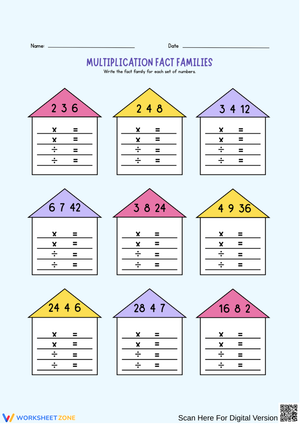
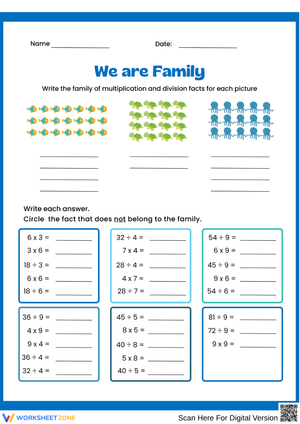
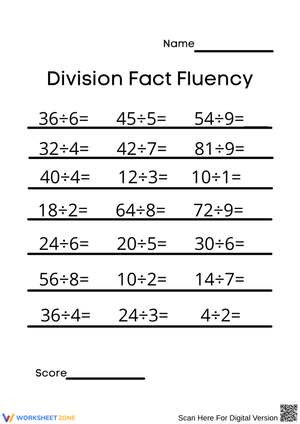
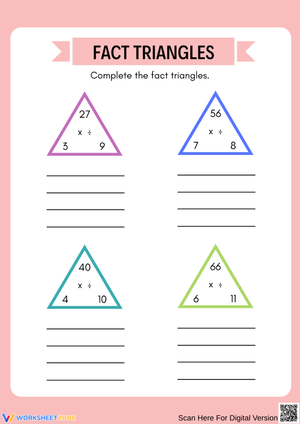
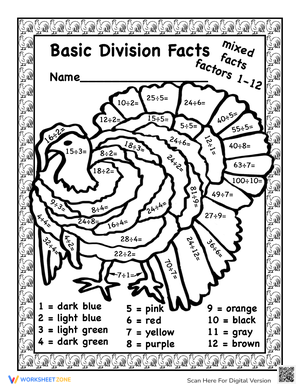
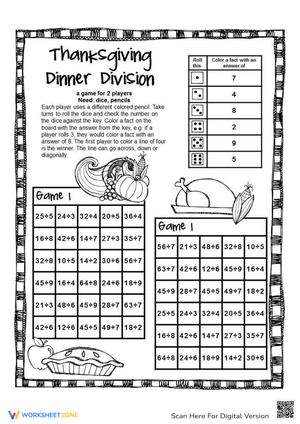
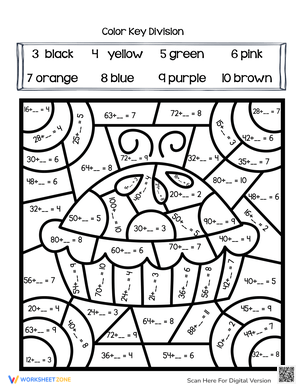
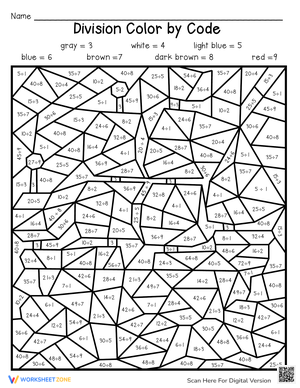
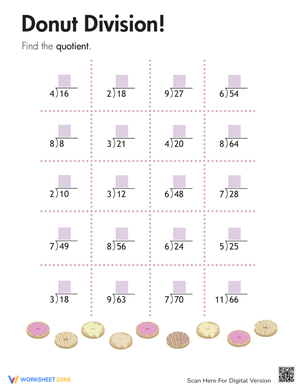
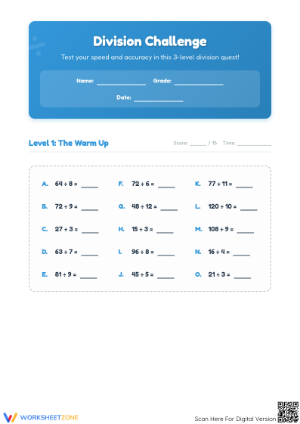
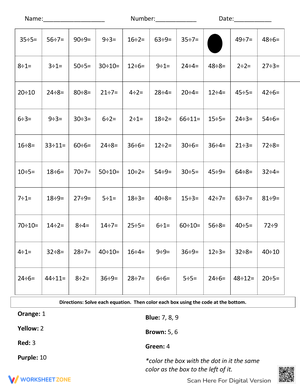
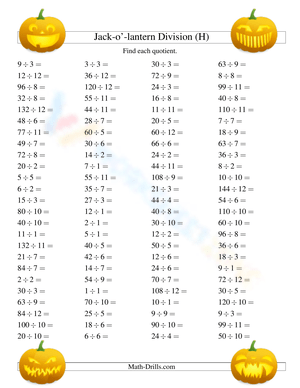
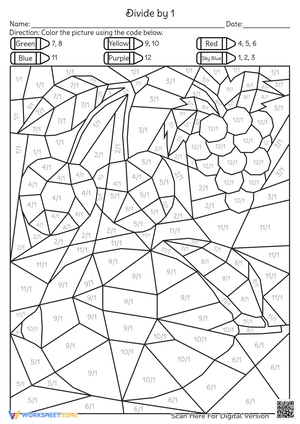
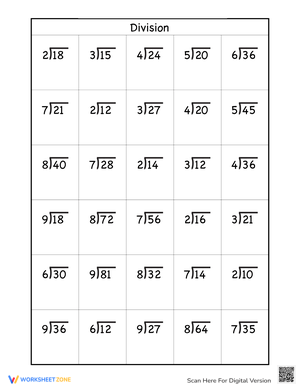
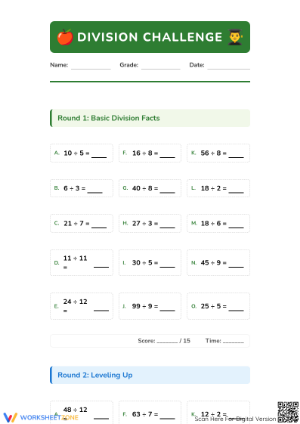
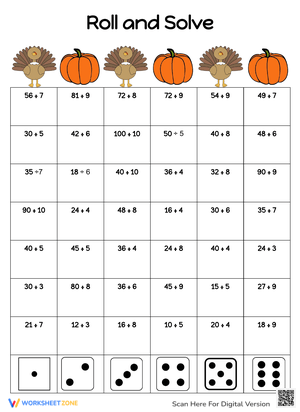
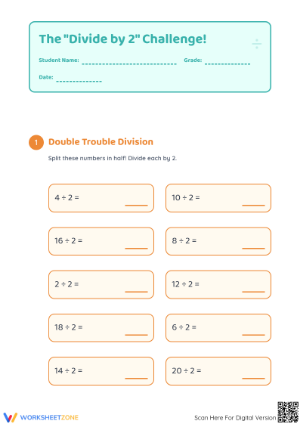
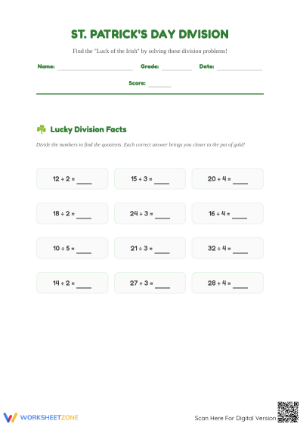
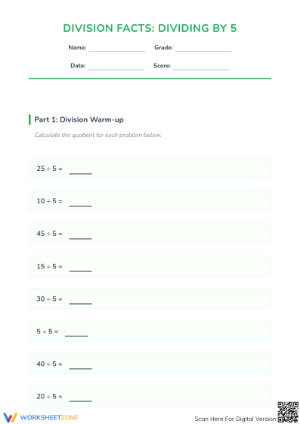
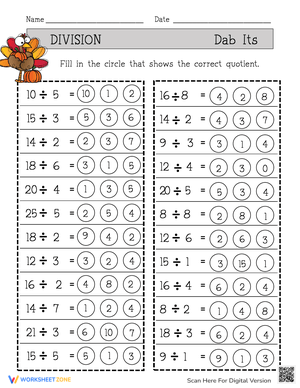
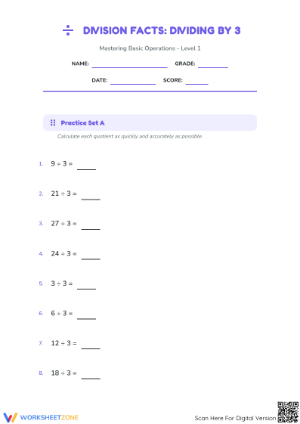
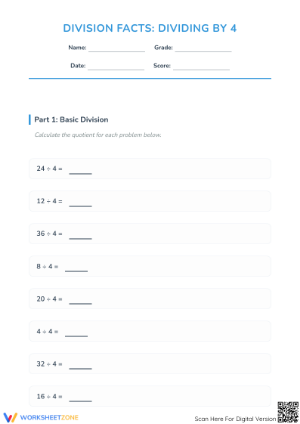
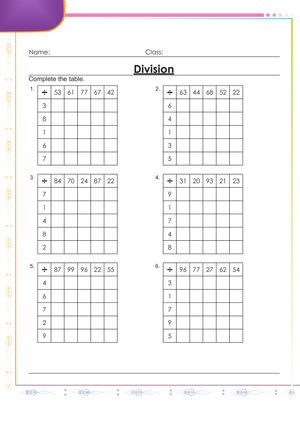
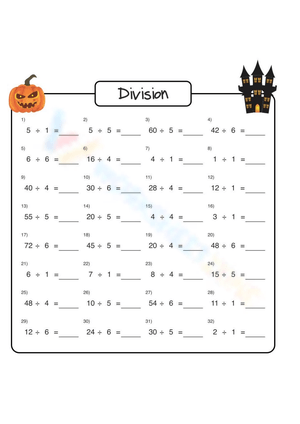
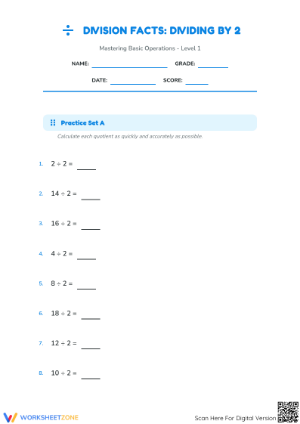
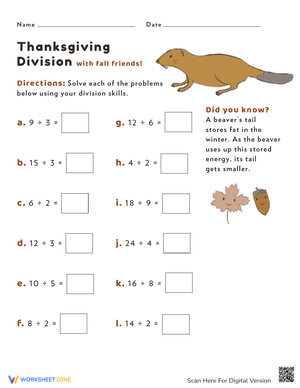
These division fact fluency worksheets for 3rd grade address the specific transition students face in the second half of third grade: moving from skip-counting and array diagrams to just knowing that 32 ÷ 4 = 8 without reconstructing the problem from scratch. The set covers all divisors from 1 through 10, mixing standard equation formats with missing-factor problems and fact-family frames to build genuine recall rather than procedural guess-and-check.
What the Set Covers
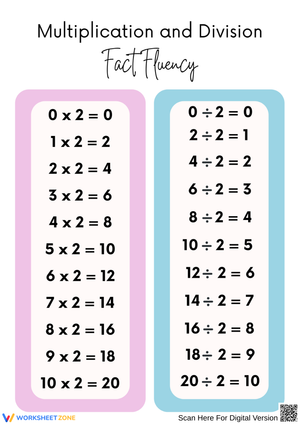
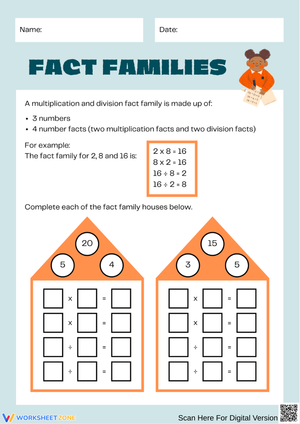
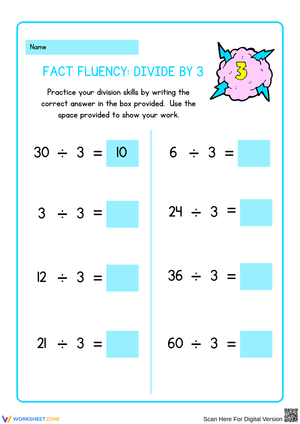
Each worksheet targets a narrow slice of the division facts rather than placing all 90 combinations on one sheet. Some worksheets isolate a single divisor — all ÷ 7 problems, for instance — letting students notice the pattern before mixing in other divisors. Others present fact-family triangles where students fill in all four related equations for a given trio of numbers. Still others use missing-factor format: __ × 6 = 42, which prompts students to use known multiplication facts to arrive at the division answer.
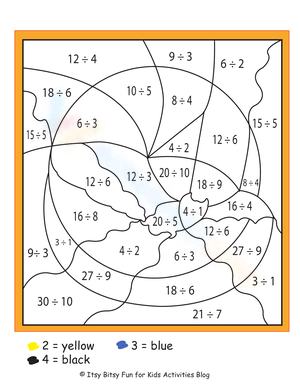
A handful of worksheets in the set use a two-step format: students first sort a bank of equations by quotient, then write one related multiplication equation for each. That sorting step forces students to actually evaluate each problem rather than move past ones they're unsure of.
The Inverse Relationship Students Have to Internalize
Third grade is the first year the Common Core explicitly requires students to treat division as a formal operation rather than a sharing activity. Before this point, students may have distributed counters into equal groups during second-grade work, but they weren't expected to connect that action to a symbolic equation. By third grade, the abstract form 24 ÷ 6 = 4 has to become as automatic as 4 × 6 = 24. The most direct path there is making the inverse relationship visible and repeatable. Students who understand that knowing any one equation in a fact-family gives them the other three carry a far lighter memorization load than students who treat multiplication and division as two separate lists.
Error Patterns That Surface in Division Fact Practice
The most consistent error in division fluency practice is asymmetric recall: a student who has no trouble with 18 ÷ 3 = 6 will still pause on 18 ÷ 6 = 3, because they internalized 3 as the "starting" factor in the multiplication sentence and haven't extended that knowledge to the partner equation. Watching for this asymmetry in student work is the fastest diagnostic you have. If a student answers all the ÷ 3 problems correctly but misses the matching ÷ 6 problems, the gap is conceptual, not a fluency issue. These division fact fluency worksheets for 3rd grade include enough mirror-image pairing that the error surfaces clearly on the page rather than staying hidden under correct answers.
A second error worth noting: students who grew up hearing about remainders sometimes abandon any problem where the answer doesn't feel "clean." Because every worksheet in the set stays within 100 and uses only whole-number quotients, this anxiety won't interfere here — but it explains some of the hesitation you'll see from students who otherwise know the facts.
Standard Alignment
These worksheets address 3.OA.C.7, which requires students to fluently multiply and divide within 100 using strategies including the relationship between multiplication and division. In practical classroom terms, this standard is introduced after students have built multiplication fluency for at least the 2s, 5s, and 10s — typically sometime between December and February of third grade — and it carries directly into fourth-grade work with multi-digit multiplication and long division. Teachers who want students to arrive at fourth grade without relying on repeated subtraction to solve division problems should begin structured fluency work no later than January. Starting with the ÷ 2, ÷ 5, and ÷ 10 worksheets is a natural entry point because students already have those multiplication facts solid.
Making Room for These Worksheets in the Math Block
The most effective placement for these worksheets is the first five to eight minutes of the math block — before direct instruction, while students are still settling. A single worksheet at that moment functions as a retrieval warm-up: low stakes, familiar format, done before anyone has had to think hard about anything new. Research on spaced retrieval consistently shows that brief daily practice outperforms longer weekly sessions for building automaticity, and these worksheets are sized to fit that window. Division fact fluency worksheets for 3rd grade that are organized by divisor also make targeted small-group intervention efficient. If a student is stuck on ÷ 8 specifically, you can sit with them, work through two or three fact-family triangles together, then let them finish the worksheet independently — a focused 10-minute pull-aside that doesn't require building a new lesson around one divisor.
For progress monitoring without the pressure of graded timed tests, consider having students track their own scores on a simple chart kept in their math folders — not to compare students against each other, but so individual growth is visible week over week. Students who see their own score move from 14 correct to 19 correct in two weeks understand what the practice is doing for them in a way that a grade never communicates.
Adjusting the Set Across Ability Levels
For students who are still shaky on multiplication, start with the fact-family triangles rather than straight equation drills. Having the multiplication equations visible while working the division equations gives them a concrete bridge. Over two or three sessions, most students stop looking at the multiplication side and begin recalling directly — a natural, observable progression you can watch for.
Students who have already hit fluency benchmarks benefit most from the mixed-divisor worksheets and sorting tasks. These formats slow down automatic recall just enough to reinforce flexible thinking — students have to scan the full problem before reaching for an answer, which builds the adaptability that holds up during multi-step problem-solving. For these students, adding a student-tracked stopwatch to the activity gives them a genuine challenge without introducing competitive pressure against classmates.
For English learners, the equation-only formats in this set carry an inherent advantage: there is no language barrier in 42 ÷ 7 = __, and the fact-family triangle's visual layout communicates the relationship between numbers without relying on written directions. That practical benefit matters when the goal is fact fluency rather than reading comprehension.
Frequently Asked Questions
At what point in third grade should I introduce these worksheets?
Once students have reasonable fluency on multiplication facts for 2s, 5s, and 10s — usually mid-fall to early winter — the corresponding division worksheets for those same divisors are a natural next step. Starting the division side early, even with a limited set of divisors, establishes the inverse relationship before students have a chance to treat division as an entirely separate topic.
Can these be sent home for independent practice?
Yes. The single-divisor equation formats are clear enough that students can complete them without adult guidance after the divisor has been introduced in class. The fact-family triangles are also intuitive for most third graders once they've seen the structure once. For students who struggle to work independently, these worksheets work best as homework after classroom practice on that same divisor, not before.
Our school uses a timed multiplication and division test program. How do these fit in?
These worksheets function as the daily practice layer, while the school's timed assessments serve as checkpoint measurements. Running untimed worksheet practice on most days and reserving the timed test for periodic evaluation reduces the anxiety that builds when every fluency activity carries a clock. Students who have worked through these division fact fluency worksheets for 3rd grade consistently arrive at timed assessments with stronger recall and less avoidance than students whose only fluency practice has been the timed test itself.













 Interactive Worksheet Maker
 Quiz Maker
 Word Search Maker
 Crossword Puzzle Maker
 Word Scramble Generator
 Sentence Scramble Generator
 Handwriting Worksheet Generator
 Name Tracing Generator
 Fill In The Blank Generator