




























Views
Downloads



Grade 3 Dividing by 4 — Complete Printable Division Facts

Paste this activity's link or code into your existing LMS (Google Classroom, Canvas, Teams, Schoology, Moodle, etc.).
Students can open and work on the activity right away, with no student login required.
You'll still be able to track student progress and results from your teacher account.
Mastering division facts for 4 is a critical milestone for third graders building arithmetic fluency. This comprehensive five-page worksheet provides a structured approach, moving from basic computation to mental math and word problems. Students will develop the confidence needed to solve division equations accurately while reinforcing the relationship between multiplication and division.
At a Glance
- Grade: 3 · Subject: Math
- Standard:
CCSS.MATH.CONTENT.3.OA.C.7— Fluently divide within 100 using strategies like the relationship between multiplication and division- Skill Focus: Division facts for 4
- Format: 5 pages · 35 problems · Answer key included · PDF
- Best For: Daily morning work or homework practice
- Time: 20–30 minutes
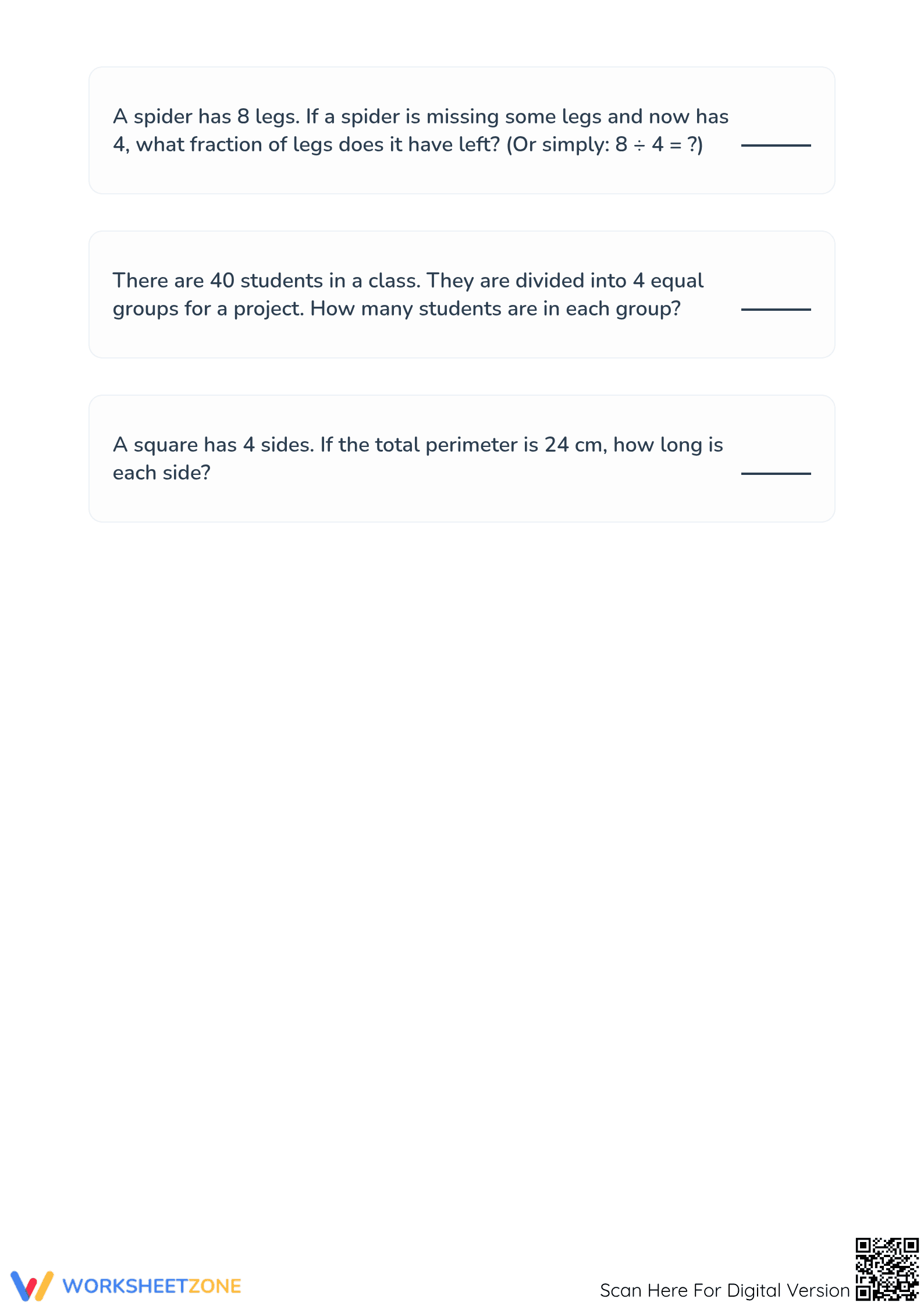
This "Division Facts 4" collection is organized to support gradual mastery. Across five printable pages, students encounter 35 unique tasks: quotient calculation, timed mental math, missing dividends, and word problems. The layout is clean and spacious, featuring high-contrast text to reduce cognitive load. A complete answer key is provided for quick grading or student self-correction.
The zero-prep workflow is designed for busy educators. First, print the five-page PDF (10 seconds). Next, distribute packets for independent work (1 minute). Finally, use the answer key to review results or facilitate a class-wide check (2 minutes). With total prep time under two minutes, this resource is a reliable choice for emergency sub plans.
This resource is directly aligned to `CCSS.MATH.CONTENT.3.OA.C.7`, which requires students to fluently multiply and divide within 100. By focusing specifically on divisor 4, the worksheet helps students internalize these specific facts through repetition and varied application. The inclusion of missing dividend problems also supports the development of algebraic thinking as students work backwards to find unknown numbers. This standard code can be copied directly into lesson plans, IEP goals, or district curriculum mapping tools.
Use this worksheet as a formative assessment after introducing the multiples of four. Assign Part 1 and 2 during a math station rotation to observe how quickly students recall facts without physical manipulatives. For a deeper challenge, Part 4's word problems are excellent for small-group instruction, allowing you to monitor how students translate verbal scenarios into mathematical expressions. Expect a total completion time of 25 minutes for the full packet.
This practice set is ideal for Grade 3 students but also serves as an effective intervention for fourth-graders who haven't yet achieved automaticity with their division tables. It pairs naturally with a short division passage or a classroom anchor chart. The variety of tasks ensures that both visual and logical learners remain engaged throughout the five-page progression.
According to the RAND AIRS 2024 report, consistent practice with arithmetic facts is essential for reducing cognitive burden during complex multi-step problem solving. This worksheet addresses that specific need by providing a high-volume, low-stakes environment for mastering division by 4. By integrating mental math challenges with structured word problems, the resource ensures students do not just memorize facts but understand their application in diverse real-world contexts. Research from Fisher & Frey (2014) emphasizes the importance of the gradual release of responsibility model, which is mirrored here as students transition from simple calculations to independent problem solving. Educators can utilize the 35 included tasks to generate data-driven insights for IEP progress reports or parent-teacher conferences. The inclusion of a clear answer key further supports instructional efficiency, ensuring that feedback is both immediate and accurate for all learners in a modern classroom setting.


