




























Views
Downloads
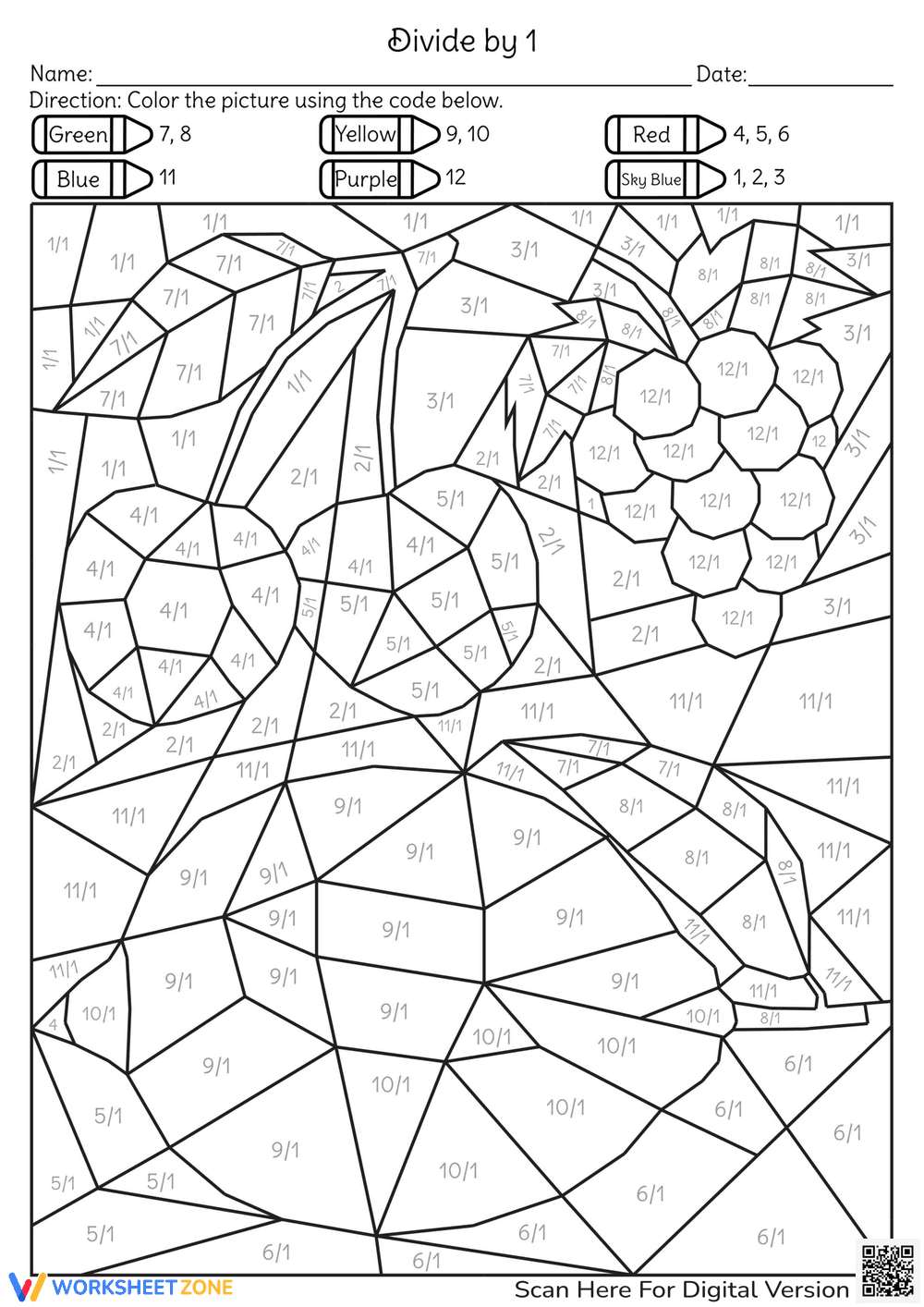

Thanksgiving Division Facts — Printable Coloring Worksheet

Paste this activity's link or code into your existing LMS (Google Classroom, Canvas, Teams, Schoology, Moodle, etc.).
Students can open and work on the activity right away, with no student login required.
You'll still be able to track student progress and results from your teacher account.
This Grade 3-5 division worksheet helps students master the foundational skill of dividing by one through an engaging color-by-number activity. By solving over 60 individual division problems, learners reinforce the identity property of division while creating a vibrant fruit-themed illustration. This resource ensures students achieve computational fluency in a low-stress, high-engagement format.
At a Glance
- Grade: 3-5 · Subject: Mathematics
- Standard:
CCSS.MATH.CONTENT.3.OA.C.7— Fluently divide within 100 using strategies such as the relationship between multiplication and division- Skill Focus: Division by 1 (Identity Property)
- Format: 1 page · 60+ problems · Answer key included · PDF
- Best For: Morning work and early finisher activities
- Time: 15–25 minutes
Inside this resource, you will find one high-density coloring page featuring cherries, grapes, and an apple. The worksheet contains over 60 individual division problems, all focused on dividing by the number one. A clear color-by-code key is provided at the top, mapping quotients to six specific colors: Green, Yellow, Red, Blue, Purple, and Sky Blue.
The zero-prep workflow for this resource is designed for maximum teacher efficiency. First, print the single-page PDF (30 seconds). Second, distribute the sheets to students along with a standard set of crayons or colored pencils (1 minute). Third, review the completed work using the included answer key or by visually checking the color patterns against the fruit illustration (30 seconds). This streamlined process makes the worksheet an ideal choice for emergency sub plans or transition periods where instructional minutes are limited.
This resource is aligned to CCSS.MATH.CONTENT.3.OA.C.7, which focuses on fluently multiplying and dividing within 100. Specifically, it targets the identity property of division, ensuring students recognize that any number divided by one remains that number. Both standard codes can be copied directly into lesson plans, IEP goals, or district curriculum mapping tools.
Use this worksheet as a formative assessment during a unit on division properties. Observe students as they work; those who hesitate on "divide by 1" problems may need additional support with basic number sense. It also serves as an excellent quiet activity for early finishers, typically taking 15 to 25 minutes to complete depending on coloring detail.
This activity is designed for Grade 3, 4, and 5 students who are building or maintaining division fluency. It is particularly effective for English Language Learners (ELLs) and students with IEPs due to the visual nature of the task. Pair this worksheet with a division anchor chart or a short video on the identity property of division for a complete instructional cycle.
According to research by Fisher & Frey (2014) on the gradual release of responsibility, engaging students in repetitive but varied practice is essential for moving mathematical facts from short-term memory to long-term fluency. This worksheet utilizes the CCSS.MATH.CONTENT.3.OA.C.7 standard, which requires students to fluently divide within 100. By focusing specifically on the identity property of division—dividing by one—the resource provides the high-success opportunities necessary to build confidence in struggling learners. The integration of artistic coloring with 60+ mathematical tasks serves as a cognitive break that reduces math anxiety, a common barrier to mastery in the upper elementary grades. Educators can use this tool to bridge the gap between conceptual understanding and automaticity. The clear alignment with national standards ensures that this activity is not merely 'busy work' but a targeted instructional intervention designed to support the rigorous demands of third through fifth-grade mathematics curricula.


