Grade 3 Multiple Syllable Words: A Classroom Guide to Teaching Syllable Division
By third grade, students meet longer words on nearly every page: independent, information, celebration. If a reader can only sound out one-syllable words automatically, every longer word becomes a stopping point that drains attention away from meaning. Grade 3 multiple syllable words instruction gives students a repeatable process for breaking those words apart, blending the pieces, and moving on without losing the thread of what they are reading. This is not a nice extra for strong readers only. It is core grade 3 work, and it belongs in your regular phonics block alongside vowel teams and suffix study.
CCSS.ELA-Literacy.RF.3.3.c names this directly: third graders are expected to decode multisyllable words as part of Reading Foundational Skills. That standard is not asking students to memorize long word lists. It is asking them to apply a decoding process flexibly to words they have never seen before, which is exactly what a strong syllable division routine builds.
The Four Syllable Division Patterns Grade 3 Students Need
Most grade 3 multisyllable instruction centers on four reliable patterns. Teaching these explicitly, in this order, gives students a decision tree instead of a guessing game.
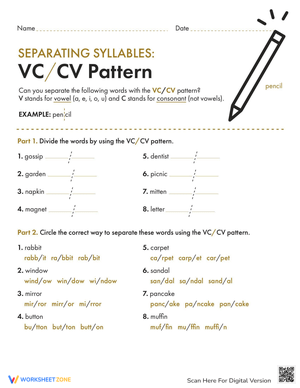
- VC/CV: two consonants sit between two vowels, and the word splits between them, as in napkin or basket.
- V/CV: one consonant sits between two vowels and the first vowel is long, as in tiger or robot.
- VC/V: one consonant sits between two vowels but the first vowel is short, as in cabin or lemon.
- Consonant-le (C+le): a word ends in a consonant plus le, and that final syllable is marked off first, as in candle or turtle.
Students do not need to label these patterns with technical names to use them well. What matters is that they can look at the vowel-consonant sequence in an unfamiliar word and make a reasonable first guess about where to split it, then adjust if the resulting syllables do not sound like a real word.
A Four-Step Classroom Routine for Decoding Longer Words
A consistent routine turns syllable division from an abstract rule into a habit students can run on their own. Many grade 3 classrooms use a version of this four-step process.
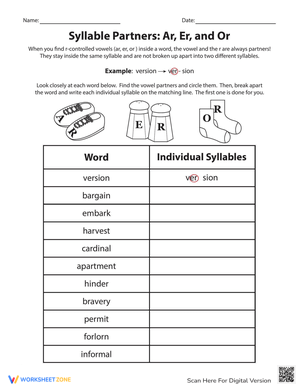
- Underline every vowel or vowel team in the word, since vowels anchor where syllables begin and end.
- Mark the syllable break with a slash, applying the VC/CV, V/CV, VC/V, or C+le pattern that fits the letter sequence.
- Blend each syllable separately, saying it slowly before trying to say the whole word.
- Check the word against the sentence it appears in, confirming that the blended word makes sense in context.
That last step matters more than teachers sometimes assume. A student might decode a word technically correctly but stress the wrong syllable, or land close enough that context confirms or corrects the attempt. Building in that context check turns decoding into reading rather than an isolated word-attack drill.
Connecting Syllable Division to CCSS RF.3.3.c
CCSS.ELA-Literacy.RF.3.3.c is specific about multisyllable word decoding as a grade 3 foundational skill, which means worksheets targeting this skill are not a supplement to your standards-based instruction. They are a direct rehearsal space for it. When you build a worksheet set around the four division patterns above, you are giving students repeated, guided practice with the exact skill the standard describes, in a format that lets you see their thinking on paper rather than only hearing it during oral reading.
This also makes multisyllable word worksheets useful evidence for standards-based grading or intervention documentation. A completed worksheet showing a student consistently marking VC/CV splits correctly, but struggling with C+le words, gives you a concrete data point to bring to a grade-level team meeting or a parent conference.
Common Grade 3 Error Patterns and How Worksheets Correct Them
Three error patterns show up often enough in grade 3 that they are worth planning for directly.
The first is guessing from the first syllable alone. A student sees information, reads the first syllable correctly, and then guesses at the rest based on shape or length rather than decoding it. Worksheets that require students to mark all syllable breaks before blending interrupt this habit, because the student has to slow down and process the whole word structurally before attempting to say it.
The second is ignoring vowel teams when they cross a syllable break, which leads to splitting a word like remain in the wrong place. Practice sets that isolate vowel-team words alongside single-vowel words help students notice the difference.
The third is applying one pattern, usually VC/CV, to every word regardless of fit. This is common right after that pattern is first introduced. Mixed practice sets that rotate through all four patterns in the same worksheet, rather than drilling one pattern per page, push students to actually evaluate each word instead of applying a single rule automatically.
Frequently Asked Questions
1. How many syllable types should grade 3 students know before tackling multisyllable words?
Most classrooms focus on four core division patterns for grade 3: VC/CV, V/CV, VC/V, and consonant-le. Introducing these one at a time, with review between each, gives students a manageable decision process rather than a long list to memorize at once.
2. What is the best way to introduce syllable division rules to a whole class versus a small group?
Whole-class instruction works well for the initial teaching of each pattern, using shared modeling and guided practice on the board. Small-group settings are better suited to repeated, personalized practice and progress monitoring, since you can watch each student's marking and blending closely and adjust pacing per pattern.
3. How do multisyllable word skills connect to CCSS RF.3.3.c?
CCSS.ELA-Literacy.RF.3.3.c specifically requires third graders to decode multisyllable words as part of Reading Foundational Skills, so structured syllable division practice is a direct way to build and document progress toward that standard.
4. How can teachers tell if a student needs more support decoding longer words?
Watch for students who guess at words based on the first syllable, skip vowel teams when marking breaks, or apply only one division pattern regardless of the word structure. A worksheet that tracks accuracy by pattern makes these gaps visible quickly.
5. What prerequisite phonics skills should be in place before teaching syllable division?
Students should have solid single-syllable blending, consistent vowel sound knowledge, and reliable consonant sound-symbol correspondence before syllable division instruction begins, since the strategy builds on those skills rather than replacing them.
Clear All