Why 3rd grade syllables worksheets matter
3rd grade syllables worksheets help teachers strengthen decoding once texts include longer words more often. By grade 3, many readers can handle familiar one-syllable words, but they still slow down with two- and three-syllable words. Focused practice helps students count syllables, divide words into parts, and read those parts smoothly enough to support meaning.
On Worksheetzone, this collection is useful for teachers who need ready-to-use phonics practice that fits a busy week. You can use the pages for whole-class review, center work, intervention, or short homework. Because the focus stays on syllables, the practice remains targeted.
What third graders should be able to do with syllables
In grade 3, syllable instruction moves beyond simple clapping activities. Students should hear the beats in a spoken word, connect those beats to written chunks, and use that information while reading unfamiliar words. The goal is better decoding, more accurate spelling, and smoother oral reading.
The grade-level expectation named in the Common Core State Standards for ELA, Reading Foundational Skills Grade 3 points teachers toward decoding multisyllable words. That matters because many words in science, social studies, and literary texts are no longer short or highly predictable. When students can break a word into manageable parts, they are more likely to read it accurately and keep attention on meaning.
Effective grade 3 practice often includes these moves:
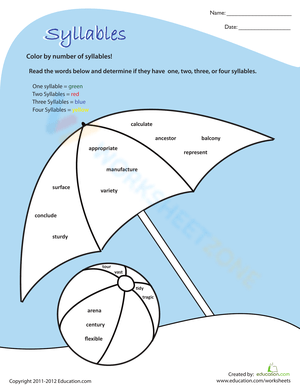
- Count the syllables in spoken and printed words.
- Split words into two or three pronounceable parts.
- Read syllable chunks in sequence without guessing.
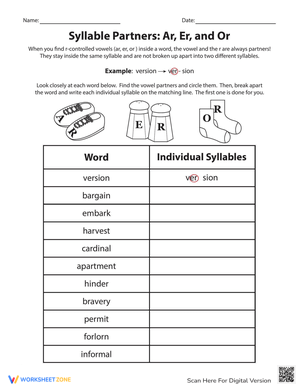
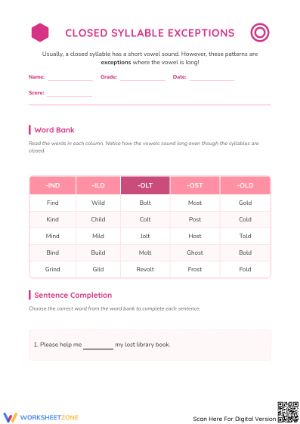
- Notice patterns connected to vowel teams, silent e, prefixes, and suffixes.
- Apply syllable knowledge while reading connected words, not isolated drills only.
Which worksheet tasks give the best decoding practice
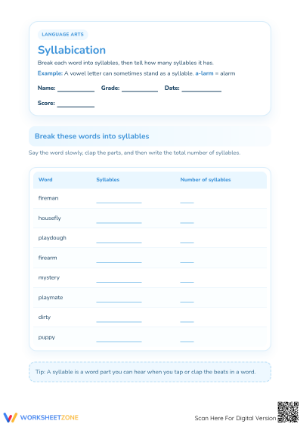
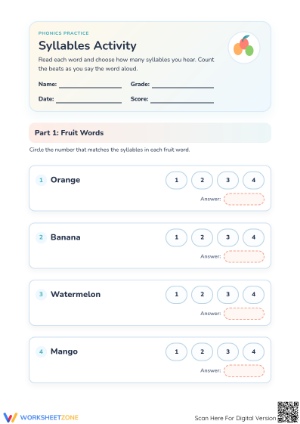
Not every syllable page does the same job. The best 3rd grade syllables worksheets mix several task types so students practice the skill from more than one angle. Counting syllables is a useful entry point because it trains students to hear the structure of a word. Dividing printed words comes next because it pushes them to connect speech to print. Reading words after they are divided matters most because that step sits closest to real decoding.
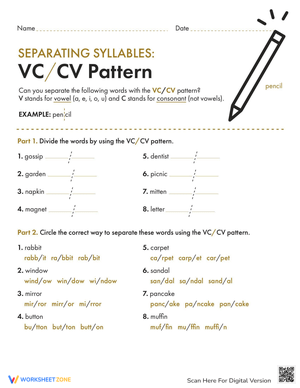
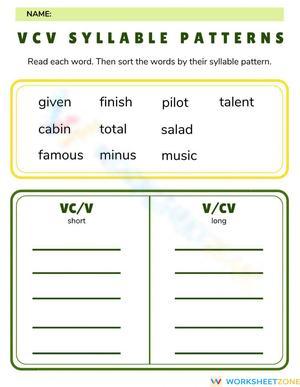
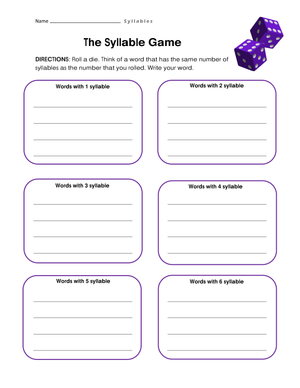
Teachers often get the strongest results from worksheets that ask students to sort words by number of syllables, mark breaks in two- and three-syllable words, and then read or write those words in a second task. That sequence avoids passive completion.
A useful grade 3 pattern is to pair syllable division with morphology as soon as students are ready for it. When a child spots a familiar prefix or suffix, syllable work becomes faster and more accurate. That is one reason teachers often connect syllable lessons to silent e, vowel teams, prefixes, and suffixes instead of teaching each area in isolation.
Reading Rockets: Syllable Games highlights that syllable practice can improve word analysis when students actively manipulate spoken and printed parts of words. For grade 3 instruction, that matters because students are often shifting from 1-syllable control to 2- and 3-syllable decoding, a clear increase in text complexity across the year.
How these worksheets fit whole-class and small-group instruction
A syllables worksheet can start as a short whole-group warm-up and then become a targeted small-group tool later in the week. In whole-class instruction, the page works well after a mini-lesson on vowel sounds, word parts, or likely syllable breaks. Students complete a few items with teacher guidance before finishing the rest independently.
In small groups, the same worksheet becomes more diagnostic. You can listen for students who count syllables correctly but still cannot read the full word, or students who divide a word reasonably yet misread a vowel pattern. That kind of observation helps you decide whether the next step should be more work on syllable types, more practice with affixes, or repeated reading for fluency.
For intervention groups, shorter pages are often better than long packets. A 10-minute routine can be enough: model two words, complete four together, assign four independently, and end with oral reading.
Classroom Implementation
Teachers can use 3rd grade syllables worksheets in several reliable ways without adding prep-heavy routines to the day. The key is matching the worksheet format to the lesson purpose.
- Morning work: choose a short page with 6 to 10 words so students reactivate decoding habits at the start of the day.
- Literacy centers: place one worksheet with word cards or a partner read-aloud follow-up so the task does not end at word splitting.
- Small-group review: assign fewer items, then discuss why a word was divided that way.
- Homework: send a practice page home after the pattern has already been taught in class.
- Quick assessment: use one worksheet as an exit task to see who can transfer the skill independently.
For the strongest classroom use, keep the directions consistent from page to page. Students should spend energy analyzing words, not figuring out a new format each time. It also helps to mix success-level items with a few stretch words.
If you are planning across a week, Monday can focus on counting and hearing syllables, Tuesday on dividing printed words, Wednesday on reading divided words, and Thursday or Friday on mixed review. That progression gives students repetition without making every lesson feel identical.
How syllable practice supports spelling and reading fluency
Syllables instruction supports more than decoding. It also helps students hold longer words in memory while spelling and smooths out oral reading. When students understand where a word naturally breaks, they are less likely to omit a middle sound, reverse a chunk, or guess from the first letter only.
Education.com's 3rd Grade Syllables Worksheets collection reflects the broad classroom use of this skill area, with practice tied to reading and word study rather than isolated oral games alone. That mirrors what teachers often need most: materials that can reinforce decoding while also supporting spelling attention and more fluent reading of longer academic words.
Fluency gains often appear when students revisit the same word set after completing a worksheet. One practical routine is simple: students divide the words, read them aloud, and then reread the list or a short teacher-made phrase line. That repeated contact helps syllable knowledge transfer into smoother reading.
What to look for in a strong printable syllables set
Not all printable resources are equally useful in instruction. The best 3rd grade syllables worksheets tend to share a few traits. First, the words feel appropriate for grade 3 reading development, which usually means common two- and three-syllable words rather than extreme vocabulary. Second, the tasks are clear enough for independent practice. Third, the set offers enough variety that teachers can use it for review over time instead of as a one-day activity.
Worksheetzone is well positioned for this kind of instruction because teachers often need printable review they can pull into different classroom moments quickly. A useful collection should help with immediate practice, but it should also make regrouping easier.
When choosing pages, look for materials that:
- Stay focused on syllables and multisyllable word reading.
- Include both easier review words and more demanding examples.
- Support independent completion in centers or seatwork.
- Work equally well for reteaching and quick checks.
- Connect naturally to other grade 3 phonics patterns already in instruction.
Frequently Asked Questions
1. What should 3rd graders know about syllables?
By grade 3, students should be able to count syllables, divide many two- and three-syllable words, and use those parts to decode unfamiliar words more accurately. They should also begin connecting syllable work to patterns such as vowel teams, silent e, prefixes, and suffixes when those patterns appear in words they read.
2. How do syllable worksheets help with decoding multisyllable words?
They break a large reading task into visible steps. Students learn to notice the parts of a word, pronounce each part, and then blend the full word. That reduces guessing and gives teachers a clearer view of whether the difficulty is with hearing syllables, spotting patterns, or reading the whole word smoothly.
3. Which syllable activities work best for small-group phonics review?
Small groups usually benefit most from short tasks that combine word division and oral reading. Sorting words by number of syllables, marking syllable breaks, and then reading the words aloud gives students immediate practice while giving the teacher useful evidence about who is ready to move on.
4. Can syllable worksheets support spelling and fluency practice?
Yes. When students see how longer words break into parts, they often spell those words more accurately and read them more smoothly. A good routine is to complete the worksheet, read the words aloud, and then revisit the same set in a brief fluency reread so the decoding work transfers into connected reading.












 Interactive Worksheet Maker
 Quiz Maker
 Word Search Maker
 Crossword Puzzle Maker
 Word Scramble Generator
 Sentence Scramble Generator
 Handwriting Worksheet Generator
 Name Tracing Generator
 Fill In The Blank Generator