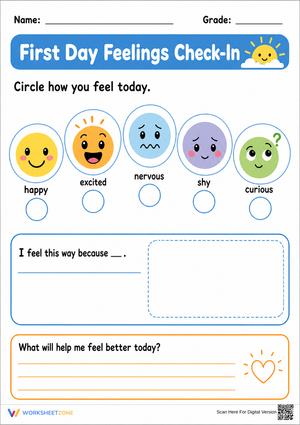
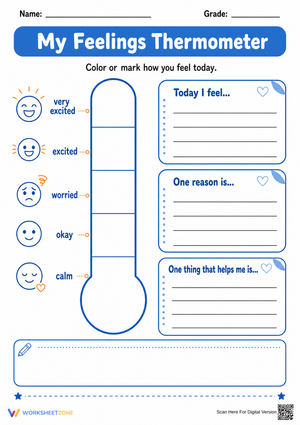
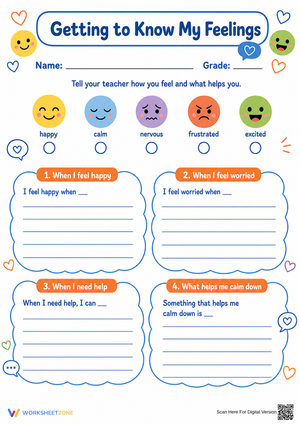
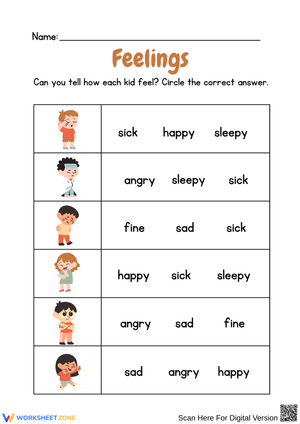
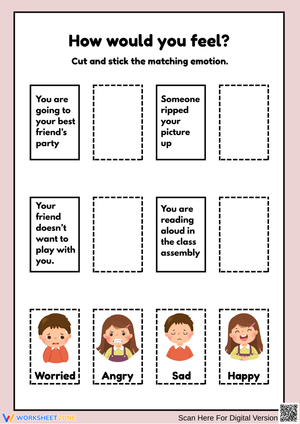
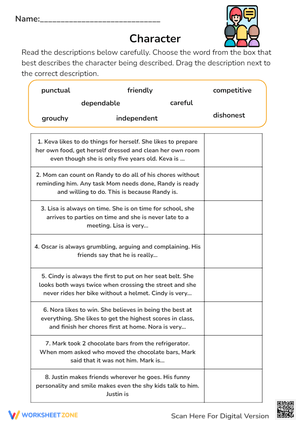
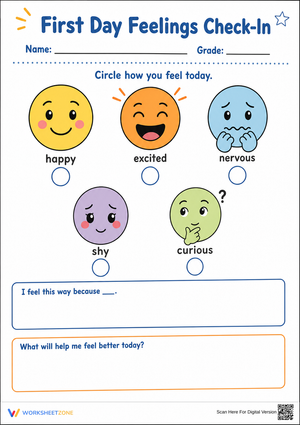
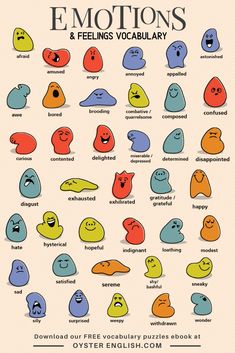
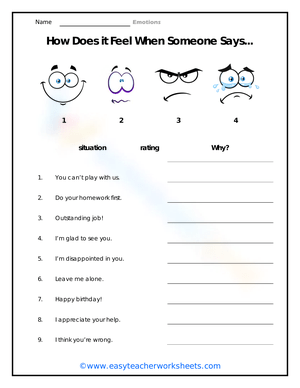
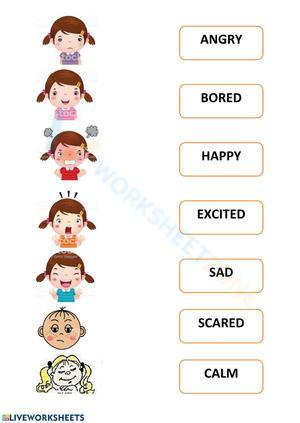
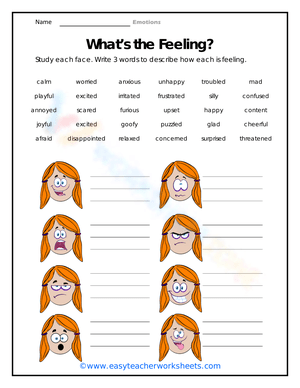
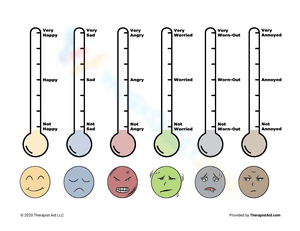
These identifying emotions worksheets for 3rd grade give teachers a printable set of SEL activities built around the four competencies that matter most at this developmental stage: expanding emotional vocabulary, reading physical body signals, sorting feelings by intensity, and perspective-taking through real-world scenarios. Each worksheet functions as a standalone activity — no sequence required, no prep beyond printing. Drop one into a morning check-in, pull one for a small-group counseling session, or use the set as the backbone of a weekly SEL block.
The Specific Skills Targeted
Each worksheet in the set targets a distinct competency rather than restating the same general "name your feelings" prompt in different formats. Taken together, the identifying emotions worksheets for 3rd grade address five interconnected skill areas:
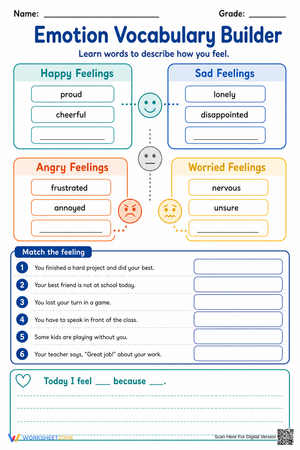
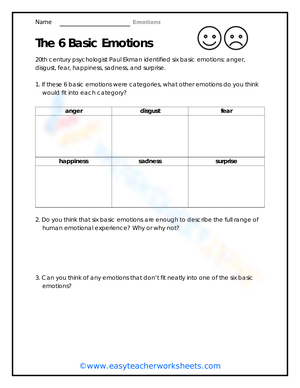
- Emotion synonym sorting: Students group related feeling words — irritated, annoyed, furious — under a shared parent emotion, building the habit of thinking about feelings as categories with gradations rather than isolated labels.
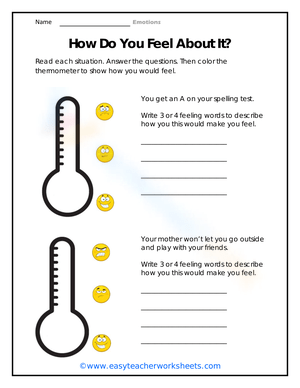
- Intensity scaling: Students place emotion words on a numbered continuum, distinguishing a 2 (mildly bothered) from an 8 (enraged) within the same anger family. This directly addresses the binary "fine or terrible" pattern common at this age.
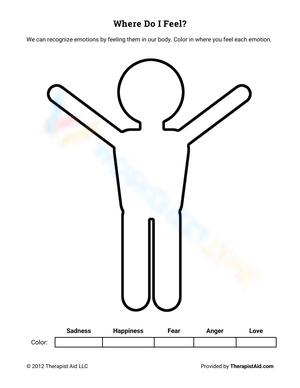
- Body-sensation mapping: Students mark a body outline to show where specific emotions register physically — tight chest for worry, clenched jaw for frustration. This makes abstract emotional concepts tangible and gives students an earlier entry point for self-regulation.
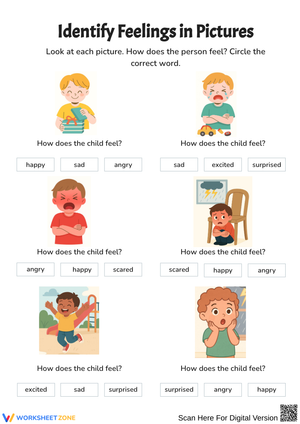
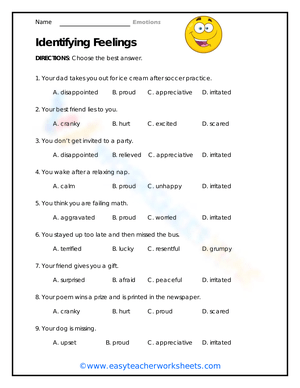
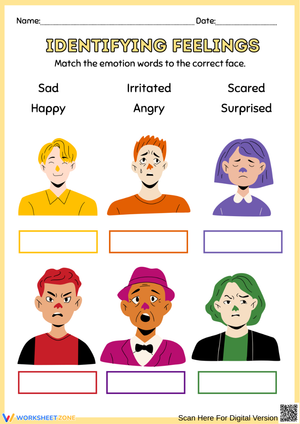
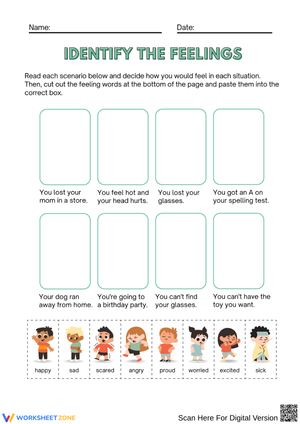
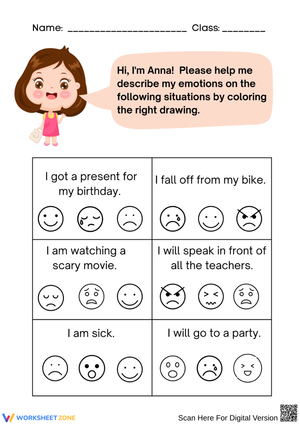
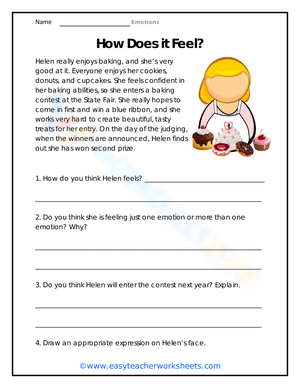
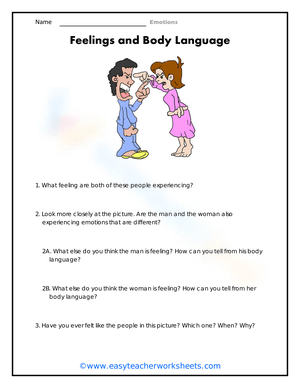
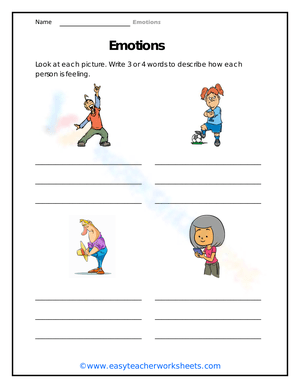
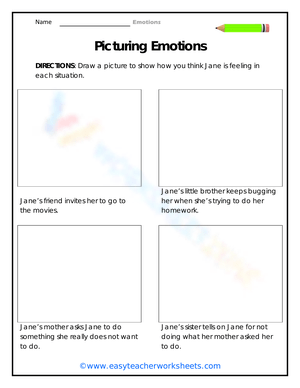
- Scenario-based perspective-taking: Short situational vignettes ask students to identify what a character feels and cite the contextual clues that led to that conclusion — not just guess at a label.
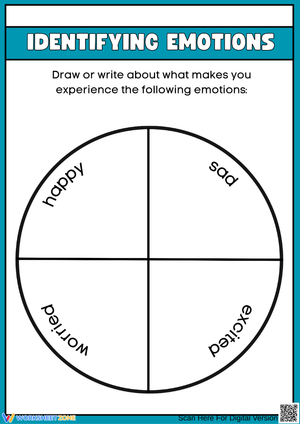
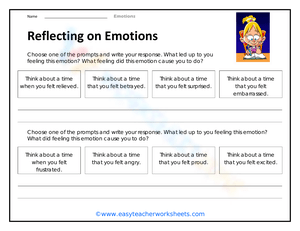
- Personal reflection prompts: Sentence starters connect named emotions to the student's own recent experience, so vocabulary doesn't stay abstract after the worksheet is turned in.
Reading the Body as an Early Warning System
Eight-year-olds frequently don't register an emotion until it has already driven the behavior — the shove, the tears, the shutdown. The body-mapping worksheets address this directly. When students learn to treat physical signals as early indicators — tight shoulders mean rising frustration, a knotted stomach before a test means anxiety — they gain a practical entry point for self-regulation before the emotion crests into action.
What makes this format stick in practice is that the physical experience provides a concrete anchor for the vocabulary. "Anxious" stops being a word on a list when a student connects it to the stomachache they had on the first day of school. That felt memory is what makes the word transfer. Teachers who have used the body-diagram format with third graders consistently report that it sparks unexpectedly candid conversations — students start naming physical experiences they've never had language for, which opens up genuine reflection in ways that a standard fill-in-the-blank vocabulary sheet won't.
Where Students Consistently Get Stuck — and What to Watch For
The most predictable error on scenario-based worksheets is students marking the socially expected emotion rather than thinking it through. When a character is excluded from a game at recess, most students write "sad" because they've learned what the correct-feeling-to-feel is supposed to be. Ask students to write a justification sentence explaining their answer; students who selected the expected response will stall on the reasoning, while genuine analysis comes out in specific detail. That one accountability prompt surfaces the error quickly and gives the teacher useful formative data.
Intensity scaling trips up students in a different way. The concept that "annoyed" and "furious" are both forms of anger — just at different magnitudes — is genuinely new for many third graders. They initially treat emotions as either present or absent, like a light switch. Expect resistance when students are asked to place two "anger words" at different positions on the scale; many will argue that furious is just a fancier word for angry, not a more intense version. A concrete paired scenario cuts through this faster than any explanation: ask whether being accidentally bumped in the hall and having something deliberately stolen feel the same. They don't, and students know it. That distinction is the concept you're building.
There's also a transfer problem that doesn't surface on the worksheets themselves. Students who correctly use "disappointed" on Tuesday are often back to "sad" by Friday. Emotional vocabulary doesn't consolidate the same way spelling words do — it requires repeated use across multiple genuine contexts, not just repeated encounters with a worksheet prompt.
Fitting These Worksheets Into the Week Without Losing Instructional Time
Morning check-ins are the highest-return slot. Five minutes — students complete a brief emotion sentence starter or mark an intensity scale for how they're arriving that day — gives the teacher useful data before instruction begins and gives students a grounded moment before the academic day takes over. This isn't a detour from learning; it's diagnostic information that shapes how the teacher reads the room for the next several hours.
For scenario-based worksheets, the most effective sequence is individual completion first, then partner comparison. Third graders are at exactly the developmental moment when they're beginning to grasp that two people in the same situation can feel entirely different things — but that concept doesn't transfer through direct explanation. It lands when a student discovers their partner wrote "embarrassed" where they wrote "proud." The comparison creates the cognitive friction that teaches the idea. No lecture produces the same effect, and this peer-to-peer moment costs about three minutes of class time.
Identifying emotions worksheets for 3rd grade also fit naturally into a calm-down corner. A student who is activated but not in acute distress — emotionally somewhere in the 5-to-6 range, not a 9 — benefits from a structured, finite task. The body-diagram or intensity-scale format provides exactly that: a clear activity with a visible endpoint. That predictability helps more than open-ended journaling for most students in this age group, because it removes the additional anxiety of not knowing when "done" arrives.
Adjusting the Set for the Range of Learners in the Room
Students who find open-ended prompts frustrating — or who don't yet have a working SEL vocabulary — benefit from a printed word bank attached to any worksheet asking them to name or write emotions. The goal is to assess whether students can identify the right emotion in context, not whether they can retrieve vocabulary under pressure. Separating those two demands makes the formative data more accurate and makes the task accessible without eliminating the actual skill being assessed.
For students who move through activities quickly, the extension isn't more worksheets — it's deeper analysis of the same scenario. Instead of identifying what one character feels, they explain why two characters in the same situation might feel differently, and they cite specific evidence from the scenario. This mirrors the social awareness strand in the CASEL framework and pushes toward the nuanced perspective-taking that shows up in both conflict resolution and literary analysis.
The body-mapping worksheets create a specific access challenge for students who aren't accustomed to noticing physical sensation. Some students genuinely cannot answer "where do you feel nervousness in your body?" without prior modeling. Walk through one example with the whole class before independent work — choose a shared experience like waiting to hear if school is cancelled — and mark a class diagram together. Independent attempts after that shared anchor go noticeably better, because students have a concrete reference point instead of starting from nothing.
Standard Alignment
These worksheets align with the CASEL Social-Emotional Learning framework under the Self-Awareness competency — specifically the benchmarks for identifying and accurately labeling one's emotions, linking emotional states to physical sensations, and recognizing that others may experience different emotions in the same situation. In classroom practice, this translates to a third-grade expectation that students can name an emotion with more precision than "bad" or "good," connect it to a physical cue or a specific cause, and begin interpreting peers' emotional states from context rather than assumption.
States with standalone SEL standards often reference this directly: Illinois Learning Standard 1A, for example, targets accurate identification and description of one's own emotions as a distinct benchmark at this grade level. California's SEL guidelines and Ohio's social-emotional standards carry comparable language for the same grade band. Teachers in states without discrete SEL codes commonly attach this work to ELA speaking and listening standards — particularly those addressing a student's ability to speak about personal experience and respond thoughtfully to the perspectives of others during discussion.
Frequently Asked Questions
My students rush through emotion worksheets and seem to be circling answers at random — how do I get more honest engagement?
Require a justification sentence with every answer: "I think [character] feels ____ because ____." Students who are selecting the socially expected emotion rather than reasoning through it will stall on the because. Occasionally asking a student to share their reasoning aloud also raises the engagement level — students slow down when they know they may need to explain their answer to the class rather than hand it in and move on.
When is the right moment to use these with students who struggle with emotional regulation?
The body-diagram and intensity-scale worksheets are most useful for students who are activated but not at peak distress — the ones who need something concrete to do while they settle. In the immediate aftermath of a conflict, no structured worksheet helps. The window is roughly 10 to 15 minutes after the spike, when a student needs a grounded, finite task rather than open-ended conversation. Morning work and transition moments are more reliable than reactive use during a crisis.
How do I keep the emotional vocabulary from fading between sessions?
The vocabulary consolidates when students use the words in real, unscripted moments — when a teacher says "that sounds like you were disappointed, not just sad" during a routine exchange, or when the morning check-in prompt uses a target word as one of the options. The worksheets introduce and practice the vocabulary; transfer happens in the rest of the day. Treat each worksheet as the introduction and the conversations around it as the actual rehearsal space.
Can these be used in small-group counseling sessions, or are they built specifically for the general education classroom?
Both settings work well. The identifying emotions worksheets for 3rd grade that focus on scenarios are especially productive in a small counseling group because the discussion following completion is where most of the learning happens — the worksheet focuses the group on a shared situation without requiring the counselor to generate all the content from scratch. In a general education classroom, the vocabulary-sorting and intensity-scale formats tend to get the most regular use; in counseling, the scenario and body-diagram formats tend to go deeper.












 Interactive Worksheet Maker
 Quiz Maker
 Word Search Maker
 Crossword Puzzle Maker
 Word Scramble Generator
 Sentence Scramble Generator
 Handwriting Worksheet Generator
 Name Tracing Generator
 Fill In The Blank Generator