


























Views
Downloads
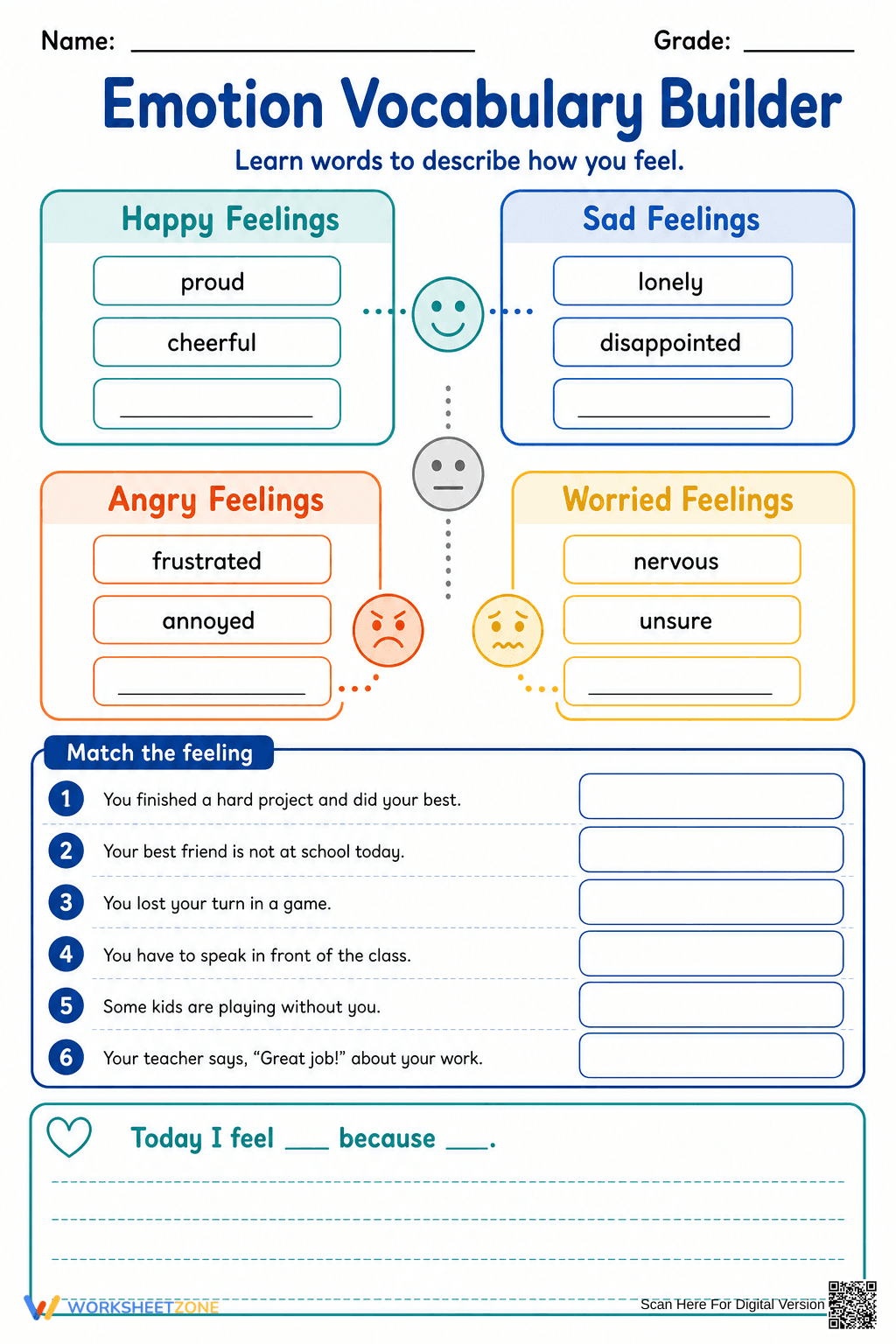

Printable Emotion Vocabulary Builder | Grades 2-5 SEL
Paste this activity's link or code into your existing LMS (Google Classroom, Canvas, Teams, Schoology, Moodle, etc.).
Students can open and work on the activity right away, with no student login required.
You'll still be able to track student progress and results from your teacher account.
This Grade 3-5 Social Emotional Learning worksheet helps students expand their emotional lexicon by categorizing feelings and applying them to real-world scenarios. By moving beyond basic terms like happy or sad, students develop the nuance required for effective self-regulation and interpersonal communication. This resource provides immediate practice in identifying complex internal states and their triggers.
At a Glance
- Grade: 3 · Subject: SEL & ELA
- Standard:
CCSS.ELA-LITERACY.L.3.5.C— Distinguish shades of meaning among related words describing states of mind- Skill Focus: Emotion identification and categorization
- Format: 1 page · 11 problems · Answer key included · PDF
- Best For: Morning meetings and counseling sessions
- Time: 15–20 minutes
The worksheet features a structured feelings map layout divided into four primary quadrants: Happy, Sad, Angry, and Worried. It includes an 8-word bank featuring sophisticated vocabulary like disappointed, frustrated, and unsure. Students are prompted to add their own words to each category, followed by a 6-item matching section where they apply these terms to specific social scenarios. A final reflection box provides space for personal application and sentence construction.
Zero-Prep Workflow:
1. Print: Select the single-page PDF and print enough copies for your group in under 30 seconds.
2. Distribute: Hand out the sheets during a transition or morning meeting; the visual icons make the tasks self-explanatory for most learners.
3. Review: Use the included answer key or facilitate a group discussion about why certain emotions fit specific scenarios. Total teacher preparation time is under 2 minutes, making this an ideal sub plan or emergency SEL resource.
Standards Alignment:
The primary focus is `CCSS.ELA-LITERACY.L.3.5.C`, which requires students to distinguish shades of meaning among related words that describe states of mind or degrees of certainty. By differentiating between annoyed and frustrated, students meet the linguistic demands of the standard while building emotional intelligence. Both standard codes can be copied directly into lesson plans, IEP goals, or district curriculum mapping tools.
How to Use It:
Use this worksheet as a formative assessment during a unit on character traits or as a standalone SEL activity. It is particularly effective after direct instruction on I-statements. Teachers can observe which students struggle to match scenarios to emotions, providing a quick check for social-perceptual needs. Expected completion time ranges from 15 to 20 minutes depending on the depth of the final reflection.
Who It's For:
This resource is designed for general education elementary students, but it is also a valuable tool for school counselors and speech-language pathologists working on social pragmatics. It pairs naturally with a Feelings Wheel anchor chart or a read-aloud focused on empathy and perspective-taking for a complete instructional block.
Research by Fisher & Frey (2014) emphasizes the importance of a gradual release of responsibility when teaching academic and social vocabulary. This worksheet mirrors that framework by providing categorized examples before asking students to apply those terms to independent scenarios. According to the RAND AIRS 2024 report, explicit instruction in emotional labeling is a foundational component of effective Social Emotional Learning programs, directly correlating with improved classroom climate and student self-regulation. By utilizing the `CCSS.ELA-LITERACY.L.3.5.C` standard, this resource bridges the gap between ELA vocabulary acquisition and behavioral health. The inclusion of 11 distinct tasks ensures that students engage with the material through multiple cognitive lenses, from simple categorization to complex situational analysis. This structured approach supports long-term retention of shades of meaning in emotional contexts, providing a measurable way to track student progress in both literacy and social-emotional domains.


